Winter on Mars is not simply a season of plunging temperatures and long polar nights. As the planet moves into winter, its atmosphere begins to change with it. Carbon dioxide, the dominant gas in the Martian atmosphere, can freeze directly onto the ground or fall as snow, building temporary polar caps that hold a substantial amount of the planet’s atmosphere. According to the study published in ResearchGate, titled ‘Mars atmospheric surface interactions and the CO2 cycle’, roughly a quarter of Mars’ atmosphere is cycled through these seasonal caps each year, before the carbon dioxide returns to the air during spring and summer. The process is powerful enough to influence atmospheric circulation across the planet, linking conditions at the frozen poles to changes far beyond them. Scientists studying spacecraft observations have found that the caps are also more varied than they first appeared, with changing surface and thermal properties. Martian winter is therefore a planet-wide atmospheric event, not merely a period of extreme cold.
How do Mars’ seasonal polar caps affect its atmosphere
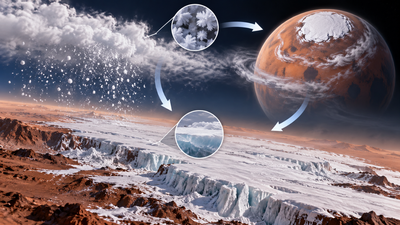
The winter polar caps are therefore closely connected to the Martian atmosphere. In the polar night, carbon dioxide can condense directly onto the surface, while atmospheric precipitation can produce carbon dioxide snow. The two processes work together to build the seasonal caps, which expand through the colder months. The seasonal caps form in both the northern and southern polar regions during their respective autumn and winter seasons.When spring and summer return, the process reverses. Rather than melting in the same way as ordinary water ice on Earth, the seasonal carbon dioxide ice sublimes, changing directly back into gas and returning to the atmosphere. The source describes this seasonal cycle as a major driver of Martian atmospheric circulation. It also notes that observations of carbon dioxide ice in the polar regions help scientists understand how condensation occurs during the polar night.
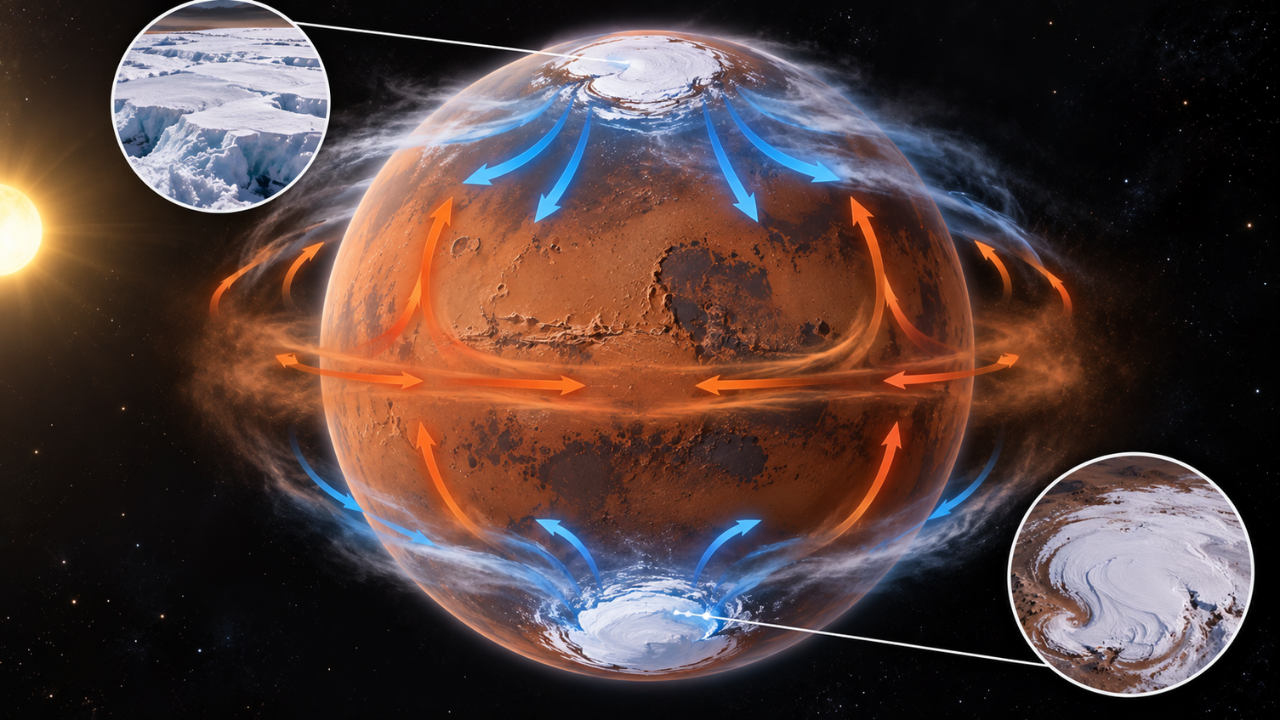
Image AI generated
Why does Mars cycle 25% of its atmosphere each year
One of the most striking features of Martian winter is the scale of this atmospheric transformation. Roughly 25% of Mars’ atmosphere is cycled through the seasonal polar caps every year. Because the atmosphere is predominantly carbon dioxide, this seasonal exchange represents a huge movement of material between the atmosphere and the surface.That movement also affects the planet far beyond its polar regions. The researchers state that the carbon dioxide cycle dominates atmospheric circulation on Mars, meaning that what happens at the poles during winter has consequences for the behaviour of the atmosphere across the planet. As the seasonal caps grow and later retreat, carbon dioxide is repeatedly removed from and restored to the atmosphere, creating a planet-wide rhythm tied to the Martian seasons.
How do Mars’ seasonal polar caps change across the planet
The seasonal caps do not behave as perfectly uniform sheets of ice. Observations from Nasa’s Mars Global Surveyor revealed that their properties vary over time and across different areas. The source notes differences in surface brightness and thermal properties, while measurements from Mars Express also provided information about the distribution of carbon dioxide and water in the seasonal caps and atmosphere.Scientists are still working to understand all the processes involved in Martian winter. The study points to gaps between some atmospheric models and observations, particularly around polar temperatures and the behaviour of the seasonal caps. Continued spacecraft observations and improved modelling are helping researchers investigate how energy, atmospheric circulation and surface processes interact. On Mars, therefore, winter is not simply a period of darkness and cold: it is a season in which the atmosphere itself is transformed, with carbon dioxide moving between the sky and the frozen ground on a planetary scale.