
For generations, inheritance in India has been shaped by family relationships, religious personal laws and the nature of the property being inherited.A daughter may have an equal right with her brother in one situation, but not necessarily in another. A widow may be entitled to a share in her husband’s estate, while a woman may also own property in her own right through inheritance, gifts or other means.The biggest question often arises when a person dies without leaving a will. In such cases, known as intestate succession, the applicable law determines who inherits and in what proportion. The rules differ across religious communities.The Hindu Succession Act, 1956, governs succession among Hindus and also applies to Buddhists, Jains and Sikhs, subject to its provisions. Muslims are generally governed by Muslim personal law on intestate succession, while Christians and Parsis are principally covered by the Indian Succession Act, 1925.So what can a woman legally claim?
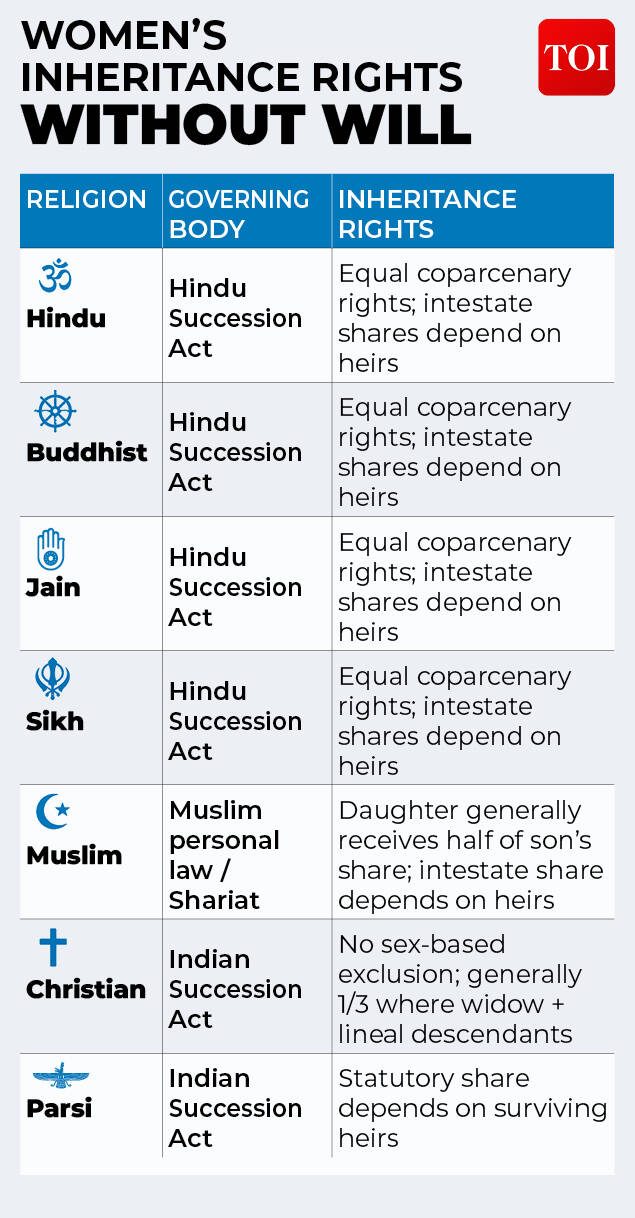
Inheritance rights
Hindu women: Daughter has equal coparcenary rights
One of the biggest changes in women’s inheritance rights came with the Hindu Succession (Amendment) Act, 2005, which made a daughter a coparcener by birth in a Hindu joint family governed by Mitakshara law, with the same rights and liabilities as a son.The Supreme Court’s 2020 judgment in Vineeta Sharma v Rakesh Sharma clarified that this right is by birth and does not depend on the father being alive when the 2005 amendment came into force.Marriage also does not take away a daughter’s coparcenary rights.But an important distinction must be made between coparcenary property and a parent’s self-acquired property.If a Hindu father dies intestate leaving behind his wife, son and daughter and the property is his self-acquired property, all children and the widow are Class I heirs. In a simple example involving Rs 1 crore, the wife, son and daughter would each receive about Rs 33.33 lakh.Advocate Rupali Jain explains why the calculation can be very different for coparcenary property. If the Rs 1 crore is Mitakshara coparcenary property, the father’s notional share is first calculated. His share is then distributed among the relevant Class I heirs.On that calculation, Jain says, “wife receives about Rs 11.11 lakh and each child Rs 44.44 lakh.”The example highlights an important point: a daughter is not automatically entitled to “half” the property simply because she is a daughter. The nature of the property must first be established.Another common misconception is that every property owned by a parent is ancestral property in which children have a birthright. That is not necessarily so.
Muslim women: Share depends on the family structure
Muslim inheritance in India operates under Muslim personal law, which does not follow the same joint-family property model.Islamic inheritance rules identify different categories of heirs and prescribe shares depending on which relatives survive the deceased. The applicable school of Muslim law can also matter.The daughter will generally receive half the son’s share but the actual calculation depends on all the surviving heirs.A widow’s share also depends on whether the deceased leaves descendants. Broadly, under commonly applied Sunni rules, a widow receives one-eighth where there are children or certain descendants and one-fourth where there are none.“The share of a Muslim woman therefore has to be calculated based on the complete family structure,” said advocate Pritish Sunil Teckchandani.Muslim testamentary succession is also different. Generally, a Muslim’s power to make a will is restricted to one-third of the estate without the consent of the heirs, subject to applicable personal-law rules.
Christian women: Sons and daughters inherit equally
For Christians, intestate succession is primarily governed by the Indian Succession Act, 1925.Where a Christian man dies without a will leaving a widow and children, the widow receives one-third of the estate, while the remaining two-thirds goes equally to the children.For example, if a Christian man dies leaving a wife, one son and one daughter and an estate worth Rs 90 lakh, each would ordinarily receive Rs 30 lakh. “The widow and each child would ordinarily receive one-third each,” said Teckchandani.The position changes depending on which relatives survive the deceased, but there is no distinction between sons and daughters in the straightforward situation described above.Unlike Hindu law, Christian succession has no equivalent concept of coparcenary rights by birth. A Christian daughter does not become a co-owner of her father’s property merely because she is his daughter; her inheritance generally arises upon succession.
Parsi women: Daughter does not lose out to son
Parsi intestate succession is governed by special provisions in Part V of the Indian Succession Act. The exact entitlement depends on the relatives who survive the deceased.Thus, where a Parsi man dies intestate leaving a widow, son and daughter, the son and daughter inherit on an equal footing under the applicable rules.The calculation can change where there are more children, a predeceased child, grandchildren or other specified relatives.
What happens when there is no will
When a person dies without a valid will, the property does not automatically go to the eldest son or the closest male relative. The applicable succession law determines who inherits.For Hindus, the Hindu Succession Act lays down a hierarchy of heirs. A widow, son, daughter and mother are among the Class I heirs of a Hindu man who dies intestate.For Muslims, inheritance is calculated under applicable Muslim personal-law rules rather than a Class I heir system.For Christians and Parsis, the relevant provisions of the Indian Succession Act apply.This is why there is no single formula for a woman’s inheritance in India. Her share can depend on her religion, relationship to the deceased, the relatives who survive, the nature of the property and whether there is a valid will.
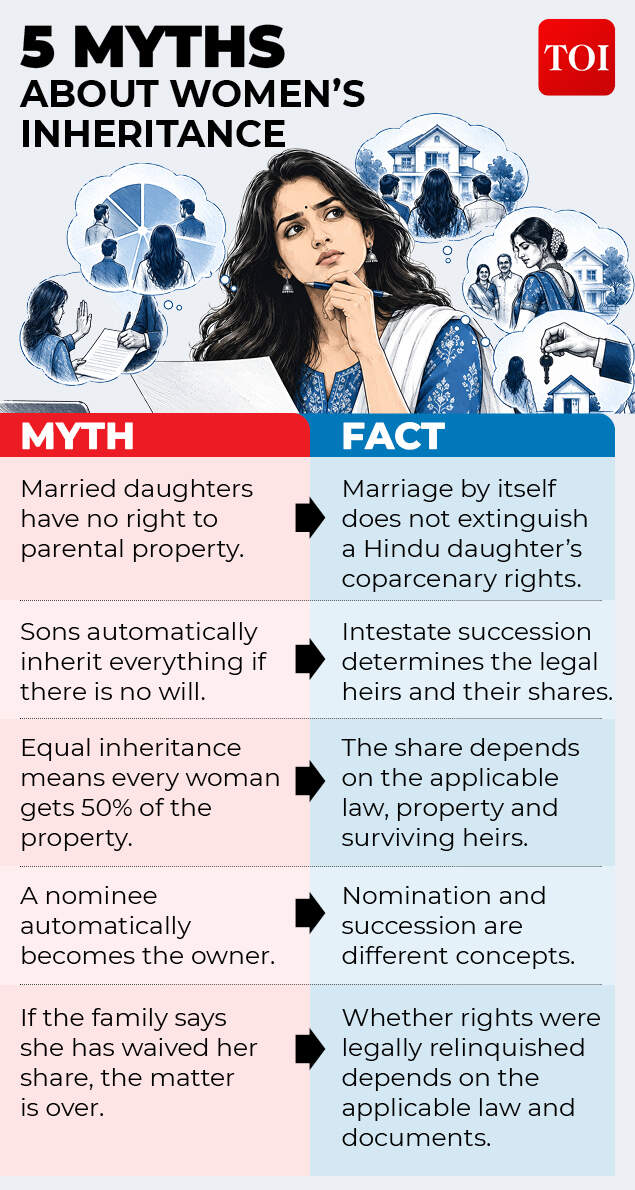
Inheritance rights of women in India.
What if there is a will — but the daughter gets nothing
“For self-acquired property, a Hindu father can generally leave the entire property to his son and exclude his daughter through a valid Will. A daughter has no compulsory share in such property merely by virtue of being his daughter,” said Tekchandani.This is where the nature of the property becomes particularly important.A person can generally make a will determining how property that they legally own and can dispose of should be distributed. Therefore, a Hindu father can ordinarily leave his entire self-acquired property to his son and exclude his daughter.“The daughter has no compulsory share in such property merely by virtue of being his daughter,” said Teckchandani.But a will cannot simply wipe out another person’s existing coparcenary interest. A daughter who already has a coparceny share cannot be deprived of that existing interest merely through her father’s will.“An unfair will is not necessarily an invalid will,” explained Teckchandani. However, a woman can challenge a will if there are grounds to question its validity. These can include forgery, lack of testamentary capacity, coercion, undue influence, improper execution or other suspicious circumstances.Jain said courts may examine factors such as whether the testator was elderly, ill or dependent on the beneficiary, whether the beneficiary isolated the testator from other family members, whether there was a sudden departure from an earlier will, or whether the beneficiary was involved in preparing or executing the document.“The person alleging coercion must produce credible evidence; mere suspicion or the fact that one child received substantially more property is generally insufficient,” said Jain.Medical records, previous wills, messages, bank documents and testimony from doctors, neighbours, lawyers and attesting witnesses may become important evidence.
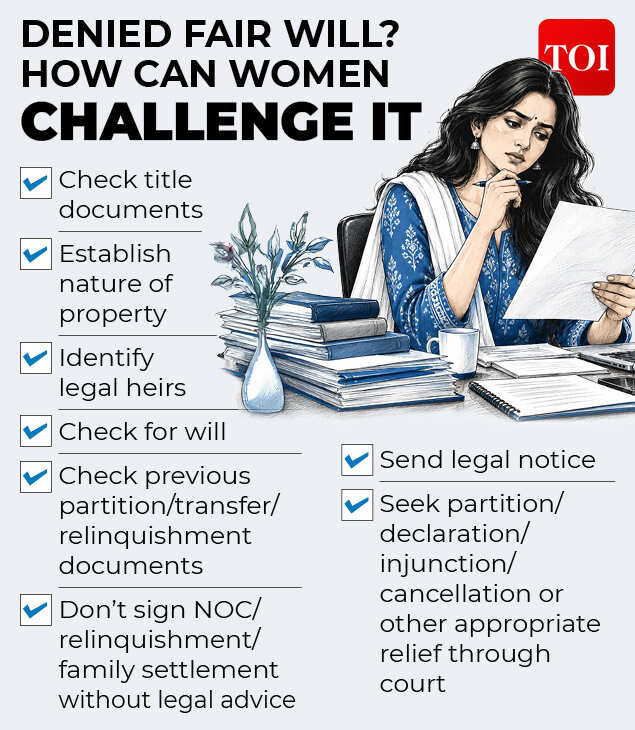
Legal steps to challenge a will
How can one challenge an unfair will
The first step is to establish what the will says and what property it covers.A woman challenging a will should obtain the will, death certificate and relevant property documents. If probate or letters of administration proceedings are pending, she can enter the proceedings and raise objections.“If probate proceedings are filed, enter appearance/file objections or a caveat, after which the proceeding becomes contentious,” explained Jain.If no such proceedings are pending, the appropriate civil remedy will depend on the circumstances.The court can examine whether the will was properly executed and attested, whether the deceased had testamentary capacity and whether there was fraud, coercion, undue influence or another circumstance affecting its validity.
What if a woman is denied her share in property
The first step is to establish the property’s ownership and character. Sale deeds, title documents, mutation records, partition deeds, gift or settlement deeds, wills and other records can help determine what a woman is actually entitled to.Depending on the dispute, a woman may approach a civil court seeking remedies such as partition and separate possession, declaration of rights, cancellation of an invalid document or an injunction.One of the biggest risks comes when family members ask a daughter to sign a release deed, relinquishment deed, family settlement, partition document or NOC without fully understanding its consequences.“The biggest mistake is giving up legal rights informally in the name of maintaining family relations, without understanding the property’s character or documenting the settlement,” said Jain.A woman should determine whether the property is self-acquired, inherited or coparcenary, establish her legal share and obtain independent advice before signing away any interest.
What if the family says she has already given up her share
A daughter may be told that she has no claim because she is married, that her brother “needs the property”, or that her share was already given to her through wedding expenses or stridhan.Whether a woman has actually relinquished a property right depends on the applicable law and whether there is a legally valid document or transaction establishing that relinquishment.“Family pressure can make people sign documents simply to avoid conflict, but such documents can have significant and sometimes irreversible consequences,” said Teckchandani. A verbal family understanding and a legally valid relinquishment or settlement document are not necessarily the same thing.
So, what is a woman’s share in family property
Well, there is no single answer to this question.For a Hindu woman, a daughter can have equal coparcenary rights with a son, while inheritance of self-acquired property after an intestate death follows a different calculation.For a Muslim woman, the share depends on the applicable personal law and the complete family structure. For Christian and Parsi women, succession is principally governed by the Indian Succession Act, with sons and daughters generally treated equally in the relevant intestate situations.A will can also change the outcome, particularly when it concerns property that the testator was free to dispose of. But a will that is unequal is not automatically invalid, nor can it simply extinguish an existing legal interest such as a coparcenary share.
Share your thoughts in the comments
Be respectful · TOI community guidelines
For women facing an inheritance dispute, the key questions are therefore: What personal law applies? Who survived the deceased? What kind of property is involved? Was there a valid will? Was the property already transferred or partitioned? And has the woman actually and legally relinquished her share?Knowing the answers to those questions is often the difference between walking away from property and successfully asserting a legal claim.