
Generation Z is sometimes renowned for asking too many questions and, at other times, accused of taking entitlement a little too far. “We are Gen Z” has, over time, become a slang term that has not only muddied perceptions of their personalities but has also made them synonymous with being demanding, impatient, and unwilling to simply “adjust.“And when it comes to the workplaces, they are always the hot potatoes. Sometimes their lexicon is taken into the dock; other times, their ability to question. While it is agreeable that the entitlement the generation possesses sometimes transcends the boundaries, on the other hand, they deserve a pat on the back for being able to call a spade a spade. When something does not sit right, they are far less likely to swallow their discomfort and move on.The recent controversy centering around a now-deleted social media post purportedly linked to McDonald’s India offers an interesting backdrop to this changing workplace culture. While the allegations made in the post remain unverified and McDonald’s India has categorically denied any association with the content, the episode has once again brought the spotlight back on a generation that is increasingly refusing to remain silent when it believes something is unfair.And perhaps, this is where the present generation deserves a little more credit. Because while “We are Gen Z” may have become shorthand for everything from workplace tantrums to questionable demands, there are moments when this generation’s supposed entitlement begins to look less like arrogance and more like courage.The courage to ask uncomfortable questions.The courage to challenge authority.And, most importantly, the courage to say, “This is not okay,” when previous generations may have simply been expected to put their heads down and carry on.
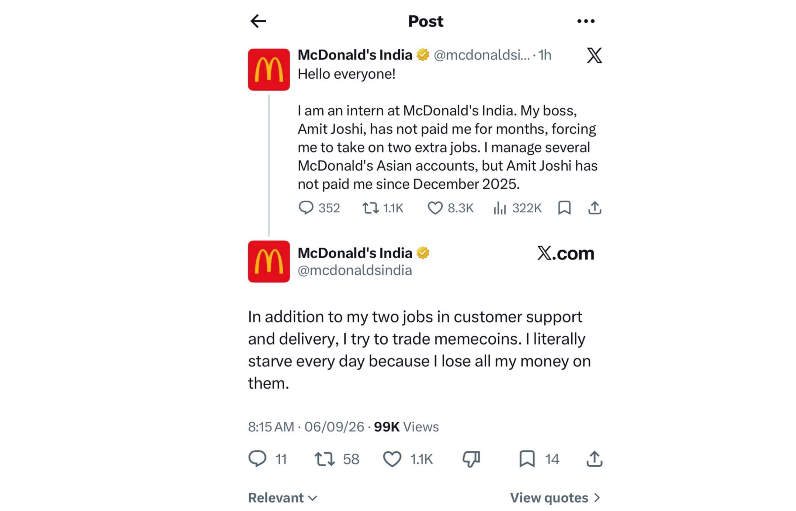
A screenshot, an allegation, and a social media storm
On September 6, a post that briefly appeared online and was purportedly associated with McDonald’s India created a significant stir on social media.The person behind the post claimed to be an intern and alleged that their salary had not been paid for months. The post also named an individual identified as Amit Joshi and claimed that the alleged non-payment had continued since December 2025.According to the allegations, the intern had been forced to take up two additional jobs while managing several McDonald’s Asian accounts.The post was later deleted, but as is often the case with the internet, deletion did not mean disappearance. Screenshots had already begun their journey through social media platforms, group chats, and timelines, travelling faster than any official clarification could.However, there is an important caveat here.The identity of the person who made the claims has not been independently established, and the allegations themselves have not been independently verified. McDonald’s India (West & South) has categorically denied any association with the post, stating that it was fabricated and was never published from the company’s official social media account.The company also said there were visible discrepancies in the image circulating online and urged people not to rely on or spread unverified information.And yet, even with the facts of this particular episode remaining contested, the reaction to it has revealed something larger.
Gen Z has changed the art of complaining
It wasn’t long before workplace suffering was often sobriqueted as “hard work,” and employees were made to think that they should be grateful for having a job.No matter if you have a toxic boss, are unpaid for overtime, or your salary is delayed, you need to “adjust.” For generations, speaking up at work often came with consequences.Employees feared being labelled difficult, ungrateful or, worse, unemployable. Silence became a survival mechanism.Gen Z appears to have read that manual, rolled its eyes and thrown it into the nearest dustbin.This generation has turned workplace conversations into public conversations. They discuss toxic bosses on social media. They openly question unreasonable expectations. They compare salaries. They talk about burnout. They ask why internships should be unpaid or poorly paid. They ask why “passion” is so frequently used as a substitute for proper compensation.And yes, sometimes they can be dramatic.But perhaps a little drama is inevitable when an entire generation is trying to undo decades of workplace conditioning.
The ‘entitled generation’ may simply know its limits
The criticism of Gen Z often rests on a familiar argument: young people today want too much, too quickly.But there is another way of looking at it. Maybe they simply know what they do not want.They do not necessarily want to spend their twenties proving loyalty to employers who may replace them with a job advertisement before the farewell cake has been cut. They do not want to romanticise exhaustion. They are increasingly unwilling to accept delayed payments, unclear roles or the idea that juniors should quietly tolerate poor treatment because they are “learning.” And most importantly, they know how to question “why.”That does not make every workplace complaint correct. Nor does it mean every viral allegation should automatically be believed.But the larger cultural shift remains difficult to ignore.Young workers are less afraid of asking uncomfortable questions. And that is what makes many workplaces uncomfortable.
The real lesson from the McDonald’s controversy
The facts surrounding the viral post attributed to McDonald’s India remain disputed. The company has denied that the post originated from its official account and has called the circulating content fabricated. Until independent evidence establishes otherwise, the allegations should not be treated as fact.But the controversy has still managed to expose a larger truth about the modern workplace.The next generation of employees is watching. And more importantly, it is talking.They may be imperfect. They may occasionally be impulsive. They may turn minor workplace inconveniences into full-blown internet debates.But when it comes to questioning injustice, unfairness, or exploitation, perhaps this generation’s alleged “entitlement” is not always such a bad thing.After all, every workplace loves an employee who knows how to work hard.What many workplaces are still learning to deal with is an employee who also knows when to say:“No. This is not okay.”