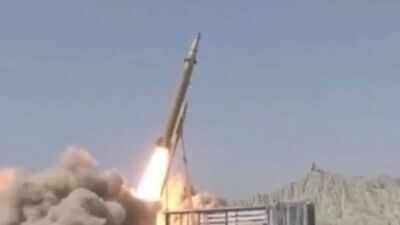
Iran appears to have used an electro-optical-guided missile against US warships for the first time, marking a potentially significant development in Tehran’s efforts to threaten American naval forces operating near the Strait of Hormuz. The reported use of the technology comes as Iran has intensified missile attacks on US vessels in recent days.According to The Telegraph, the missiles used in the latest attack were equipped with electro-optical seekers that use cameras and light sensors to identify and track targets. US central command confirmed that Iran launched attacks against American forces and vessels but said all attempted attacks on US warships failed.The strikes came after the US launched retaliatory attacks that destroyed five Iranian oil tankers near Kharg Island, a key Iranian oil hub, escalating the maritime confrontation between Washington and Tehran.Iran had first revealed the new missile system late last year, naming it the Qassem Bassir, a medium-range ballistic missile equipped with electro-optical sensors designed to improve its ability to identify and hit targets.Mohsen Rezaei, Iran’s newly installed secretary of the Supreme national security council, meanwhile suggested that a new “special anti-destroyer” missile was used in Wednesday’s strike against US ships. However, it remains unclear whether that weapon was the Qassem Basir, meaning the exact missile used in the attack has not been independently confirmed.Iran’s Qassem Bassir missileIran unveiled the Qassem Basir missile in May 2025 as an upgraded version of its Martyr Haj Qassem ballistic missile. According to Iran’s defence ministry, the solid-fuel missile has a range of around 1,200 kilometres and features a manoeuvrable warhead and an upgraded guidance system.Its key feature is an electro-optical guidance system, which Iran says allows the missile to identify targets without relying on GPS and makes it more resistant to electronic jamming.The Qassem Basir is believed to carry a warhead of roughly 500 kilograms, although Iran has not publicly disclosed an official warhead weight. Its 1,200-kilometre range places it in the medium-range ballistic missile category.Strategic implications of electro-optical guidance systemThe electro-optical technology could give Iran a new way to threaten moving US warships by allowing missiles to identify and track targets during the terminal phase while reducing reliance on GPS. Its claimed resistance to electronic jamming could also complicate US efforts to disrupt incoming missiles.The capability could strengthen Iran’s anti-ship and area-denial capabilities around the Strait of Hormuz, potentially increasing the risks for US naval forces operating there. However, its effectiveness would still depend on Iran obtaining accurate targeting data before launch.