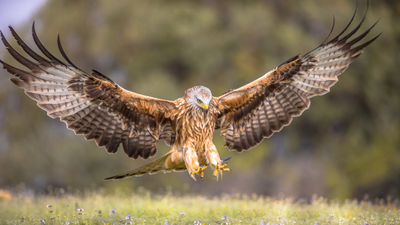
The red kite, once pushed close to extinction in Britain because of human persecution, has made one of the country’s most successful wildlife recoveries. After centuries of hunting and egg collecting reduced the UK population to fewer than 10 breeding pairs in remote Welsh valleys, a reintroduction programme launched in 1989 brought birds from Spain and Sweden to release sites across England and Scotland. Official monitoring data from the Joint Nature Conservation Committee (JNCC) shows that the species has recorded a remarkable 2,613 percent population increase over the long-term trend period. The distinctive bird of prey, known for its reddish-brown feathers, deeply forked tail and five-foot wingspan, has returned to much of its historic range. It has spread from the original release sites to counties across England, Scotland, Wales and Northern Ireland.
From common scavenger to near extinction
During the Middle Ages, red kites were a common sight in cities such as London, where they acted as useful scavengers, feeding on waste and animal remains. Shakespeare mentioned them in Coriolanus and The Winter’s Tale, even warning people to watch their linen when kites were nesting. By the 18th and 19th centuries, attitudes towards the birds changed sharply. Gamekeepers, farmers and egg collectors began targeting them, wrongly blaming the birds for damaging crops and farms. By the late 19th century, red kites had disappeared completely from England and Scotland. Only a small and genetically isolated population survived in the rugged hills of mid-Wales. A few local landowners secretly protected their nesting sites. According to species profiles maintained by the British Trust for Ornithology (BTO) through its BirdFacts database, the surviving Welsh population struggled to grow naturally because of low breeding success, limited genetic diversity and continued local persecution.
The 1989 reintroduction programme
To rebuild the population, the Nature Conservancy Council, now Natural England and NatureScot, worked with the Royal Society for the Protection of Birds (RSPB) to begin an experimental reintroduction programme in 1989. Conservationists brought young red kites from healthy wild populations in Spain and Sweden. They released the birds at controlled sites in the Chiltern Hills of Buckinghamshire and Black Isle in northern Scotland. The birds quickly adapted to the mix of farmland and woodland in southern England. The Chilterns population grew strongly, producing enough young birds to spread naturally into nearby counties and East Anglia. Further reintroduction projects were later established in Northamptonshire, Yorkshire, Dumfries and Galloway, and Gateshead. These efforts helped reconnect suitable habitats across the country.
Official population trends and statistics
The long-term success of the reintroduction is recorded in the official breeding bird population trends report published by the JNCC with the BTO and RSPB. The latest Breeding Bird Survey data shows that red kite numbers increased by 2,613 percent between 1995 and recent survey cycles, making it one of the fastest-growing bird species in the United Kingdom. Data in the BTO BirdFacts portal estimates that the current UK breeding population has grown to more than 4,600 pairs. This makes up a significant share of the global population. Since red kites are largely found in Western Europe, Britain now has about 10 percent of the world’s breeding pairs, giving the country an important role in protecting the species.
Ongoing threats and environmental monitoring
Despite the recovery, conservation groups continue to monitor human-related threats affecting red kites across farmland. As scavengers that mainly feed on dead animals, red kites remain vulnerable to illegal poisoning, pesticides and exposure to rodenticides. Studies of birds of prey have found high levels of anticoagulant rat poison in the bodies of some recovered birds. Collisions with wind turbines, power lines and vehicles on major roads also cause deaths each year. Young birds moving away from their birth areas and searching for new territories are particularly at risk. Despite these threats, red kites have shown that they can live successfully near people. Strong public support and the species’ continued growth have made its recovery a major success story for wildlife conservation in Britain.