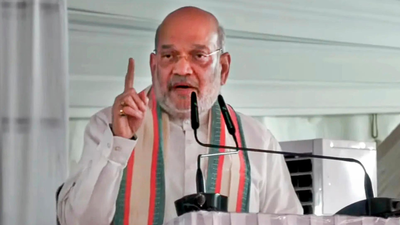
NEW DELHI: Union home minister Amit Shah on Sunday said decolonisation of India’s history and knowledge does not mean erasing the past, but presenting historical truth authentically and from an Indian perspective.Shah made the remarks while inaugurating the ‘Ganesh Gyanarthi’ exhibition at the Asiatic Society of Mumbai. He said India’s knowledge traditions, manuscripts and archives should be preserved and taken to people across the country and the world.“Decolonisation does not mean erasing history. From our perspective, it means presenting historical truth to the world in an authentic manner and from an Indian perspective,” Shah said, as cited by news agency PTI.He said the British had intertwined knowledge and power and argued that the task now was to free knowledge from that framework.“Today, we are moving forward to liberate knowledge from that and towards decolonisation,” Shah said.
‘True knowledge is never held hostage by an ideology’
Shah said knowledge should remain free from ideological constraints and criticised the colonial interpretation of India’s intellectual traditions.“True knowledge is never held hostage by an ideology. Knowledge itself is an ideology. If you bind it in any way, you change the very meaning of knowledge. Knowledge should be free and uninhibited, and its declaration should also be free and uninhibited,” he said, according to ANI.“India’s knowledge was not being written in India’s voice. India’s knowledge was being written in the language of a colonial perspective,” Shah said.He said the focus should now be on using the wealth and collections preserved at the Asiatic Society for the creation of a “Great India”.“Rather than going into why the Asiatic Society was formed, who formed it, and for what purpose, we should move forward in the direction of how the wealth, knowledge, and collections gathered here can be used in the creation of a Great India (Mahaan Bharat),” he said.
Shah highlights manuscripts, proposes wider knowledge network
Shah highlighted the rare manuscripts preserved at the Asiatic Society, including an illustrated copy of the Mahabharata and texts related to Jainism and Buddhism.“A great deal of things are lying here, including an illustrated copy of the Mahabharata. Such texts of Jain Kalpasutra and Buddhism are hardly available anywhere else; such texts are lying here. Much knowledge is present here that should have come out a long time ago,” he said.Shah called on the new committee to expand the institution’s reach by bringing scholars from Maharashtra and across India to study its collections. He also proposed bringing libraries and institutions preserving heritage across the country onto a common platform under the Asiatic Society.He suggested creating a shared pool of knowledge that could be made available to students, researchers and scholars.
Share your thoughts in the comments
Be respectful · TOI community guidelines
Shah further proposed a campaign to collect ancestral documents preserved in villages and households across Maharashtra and link them with the Gyan Bharatam manuscript survey.“Because within these manuscripts lies immense knowledge, and there is a need to conduct research on this knowledge. A great power to take the nation forward lies within them,” he said.Referring to Nalanda, Shah said attempts to destroy physical repositories could not eliminate knowledge preserved through memory and tradition.“One can burn the library of Nalanda… but the knowledge that resides in people’s minds as memory and tradition (Smriti and Shruti)—no one can destroy that knowledge,” he said.Shah said the Asiatic Society should work with the government and institutions across India to preserve and share India’s knowledge traditions. He urged the new team to use Indology for the welfare of the country and the wider world.