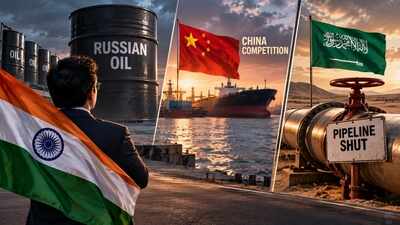
India has managed to evade a major oil shock from the US-Iran conflict, but with a triple whammy loading – what are its best options? Russian crude oil continues to be the biggest component of India’s oil import basket but with attacks on its export infrastructure, will supply tighten?Saudi Arabia, which is amongst the top crude suppliers to India has also seen an important pipeline shut due to Houthi attacks. Add to that China which may start competing aggressively for Russian crude oil as Iran oil supplies remain choked.With the Iran war showing little sign of a quick resolution, attacks affecting Russian exports and already-depleted global oil inventories are leaving fewer alternative supplies available.Where does that leave India, a country that imports around 90% of its crude oil? If crude oil prices continue to rise due to global supply constraints and Russian crude discounts ebb, will India’s crude oil bill manage another hit within months?Let’s break down the situation and what it means for India:
Saudi Arabia supplies to be hit?
According to a Reuters report, Saudi Arabia could run out of exportable oil stocks at key Red Sea ports within five to seven days if its major East-West pipeline remains shut due to drone attacks, potentially taking up to 4 million barrels per day, or 4% of global supply, off the market.With Hormuz flows already sharply reduced and global oil supply expected to fall by 5.7 million bpd this year, a prolonged outage could deepen the global supply crunch and push oil prices higher.Saudi Arabia’s latest oil supply disruption has added to growing concerns for Indian refiners, who may be able to manage the immediate shortfall with existing inventories but could face a tougher and more expensive hunt for crude if the shutdown drags on.The shutdown of Saudi Arabia’s East–West Pipeline leaves Indian refiners with fewer options for rerouting crude at a time when pressure is already building on several important oil transit routes.The bigger worry is that any further disruption to Saudi barrels could tighten an already strained physical market, forcing Indian refiners to compete for replacement crude and suitable grades at higher freight costs.
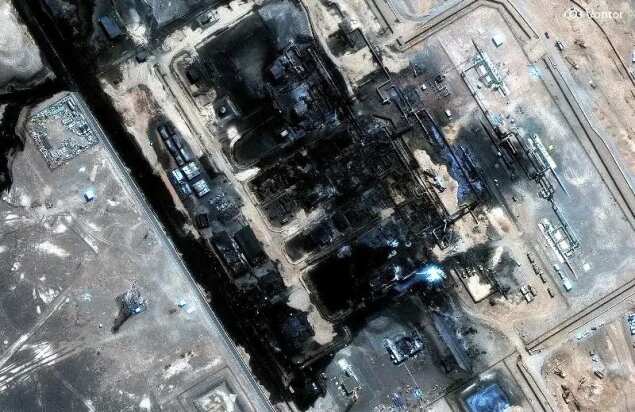
A satellite image shows a closer view of the damage at the Saudi Arabia East-West pipeline. (Reuters photo)
The shutdown of the East-West pipeline is particularly significant for India because the Red Sea port of Yanbu has supplied around 9% of the country’s crude imports since the war began.This brings the focus back to Russian crude oil.
Russian crude continues to be a mainstay, but for how long?
Experts note that Russian crude oil supply continues to be the biggest support for India at this moment, but the war with Ukraine is increasingly complicating the supply picture.There are full or partial outages at numerous refineries that still require maintenance. In theory, refinery outages should release more crude for export.However, Natalia Katona, Commodity Analyst points out that in practice, Russia cannot necessarily move all those barrels abroad.“The export infrastructure is already being used close to maximum capacity, while Black Sea shipments are being constrained by attacks, shipping risks and higher freight rates – currently freight from the Black Sea region is estimated at $20/bbl, while freight from Baltics (which is much farther) at around $13/bbl – all due to the named constraint,” she tells TOI.She believes that the reduction in Russian exports is somewhat disproportionate – and is mostly driven by the decline in loadings at the Black Sea terminals.“If refiners cannot process the crude and exporters cannot find sufficient port and tanker capacity (or do not want to risk sending it through the Black Sea), production eventually has to be reduced. Novak has acknowledged that Russian output will decline somewhat year-on-year,” she says.
Competition from China
China is the biggest importer of Russian crude, and experts see that as a big factor in the price of oil India has to pay. China’s demand for crude has been somewhat subdued, but once that rebounds meaningfully, India and China will be competing for the same Russian crude, pushing up costs.“This is probably the more immediate risk for India than an outright drop in Russian production. China’s seaborne imports of Russian crude increased from 1.40 million b/d in July to 1.69 million b/d in August, in addition to approximately 1 million b/d arriving through pipelines,” notes Natalia Katona.There is no broad Chinese oil-demand boom, yet: China’s total seaborne crude imports in August were still almost 40% below their pre-conflict level.Praveen Rai, Director, Grant Thornton Bharat believes that as Chinese buyers absorb a larger share of available cargoes, Indian refiners may have to pay higher premiums or source incremental volumes from alternative suppliers.“This does not necessarily mean a shortage of crude for India, but it does mean higher landed costs through a combination of higher crude prices, narrower discounts, and elevated freight costs. Consequently, the benefit that Russian crude has provided to India’s refining sector over the past few years could diminish considerably if Chinese demand remains strong,” he tells TOI.As Katona points out, China’s refineries are slowly coming back online, encouraged by stronger fuel margins across Asia. They are also running short of Iranian crude. Iranian tankers remain stuck inside the Gulf, while the cargoes that escaped before the blockade and waited near Singapore and China are gradually being used up.“With Gulf supplies still well below normal, Russia is one of the few producers that can fill the gap at scale. China also enjoys better freight economics for ESPO, Sakhalin and Arctic crude grades cargoes,” she says.During peak Northern Sea Route season, most Russian crude can reach northern China much more cheaply than India.“For Urals from Russia’s western ports, India remains an important destination, but right now we see some ships loaded with Urals going to China as well through the NSR and the Suez. That puts them into more direct competition with Indian refiners,” she adds.According to Katona, the likely consequence is not necessarily that India loses Russian crude altogether, but that it loses the discount! Urals delivered to India were offered at a premium of $1 to Dated Brent for September-October arrivals, compared with discounts of more than $10 earlier in July.“The grade subsequently moved to a premium in some transactions as export availability tightened. Therefore, even if Russian volumes into India remain close to 2 million b/d, the economic benefit may be significantly smaller,” she says.
What the current situation means for India
Multiple pressures are piling up: key global oil supply chains are disrupted, crude oil prices are rising, which in turn threaten economics back home for India.Pankaj Srivastava, Senior Vice President, Commodity Market – Oil at Rystad Energy says that limited alternatives mean Indian refiners are likely to remain dependent on relatively expensive Russian barrels.“Strong product cracks and elevated refinery margins are offsetting much of the impact of higher crude costs on refining economics. However, every $1/bbl increase in crude prices raises India’s import bill by approximately $5 million per day, assuming imports of around 5 million b/d. Additional supplies from Africa and South America should provide some diversification and ease pressure on crude availability,” he tells TOI.Natalia Katona says that Russian crude is and will remain India’s cheapest option. Even now, when Urals trades at a premium, its price range follows volatility in the differentials of competing grades, all of which remain more expensive. “Russian suppliers adjust flexibly to keep Urals the most attractive medium-sour barrel for Indian refiners,” she says.But for many experts, crude availability is less a concern, since India’s oil procurement basket is diversified enough with over 40 countries being a part of it.India also faces the possibility of fresh tariffs for its Russian crude oil purchases if the sanctions bill in the US passes through giving the Trump administration power to impose penalties.Praveen Rai of Grant Thornton Bharat says that India has one of the most diversified crude sourcing portfolios among major importing countries, which provides flexibility if Russian crude becomes less attractive economically. The optimal replacement strategy will depend not only on availability but also on delivered cost, freight economics, crude quality, and refinery compatibility.“From a cost and logistics standpoint, the most attractive substitutes are likely to remain Iraq, Saudi Arabia and the UAE, with Iraq being the closest replacement for Russian Urals because its medium-sour grades closely match the requirements of Indian refiners,” he tells TOI.The second cluster of alternatives comprises Venezuela, Brazil, and West African producers such as Nigeria and Angola; however, longer sailing distances and geopolitical risks can increase freight costs.“The United States remains an important diversification source for lighter crude grades. However, these barrels involve the highest freight costs and may not always deliver the best refining economics for refineries optimised for medium-sour crude,” he says.“Indian refiners would adopt a portfolio approach, increasing purchases from Iraq, UAE where possible, while supplementing requirements through selective imports from Venezuela, Brazil, West Africa, and the United States,” he adds.Finally, for India the biggest concern will emerge from the cost implications.As Sumit Ritolia, Lead analyst, Modelling and Refining at Kpler points out, the bigger risk for India is not only physical availability of crude, but the rising landed cost. Higher crude prices, freight, insurance and longer voyages all increase the delivered cost of barrels.“For India, that means a higher oil import bill, more pressure on the current account and rupee, and a greater inflationary risk if elevated energy costs persist,” he says.There is also a potential impact on OMC margins and the government’s fiscal position if domestic fuel prices are not allowed to fully reflect the increase in international crude and freight costs.So while its heavily diversified crude oil basket helps reduce supply disruption risk, it cannot fully offset the cost impact when several major oil routes are stressed at the same time.