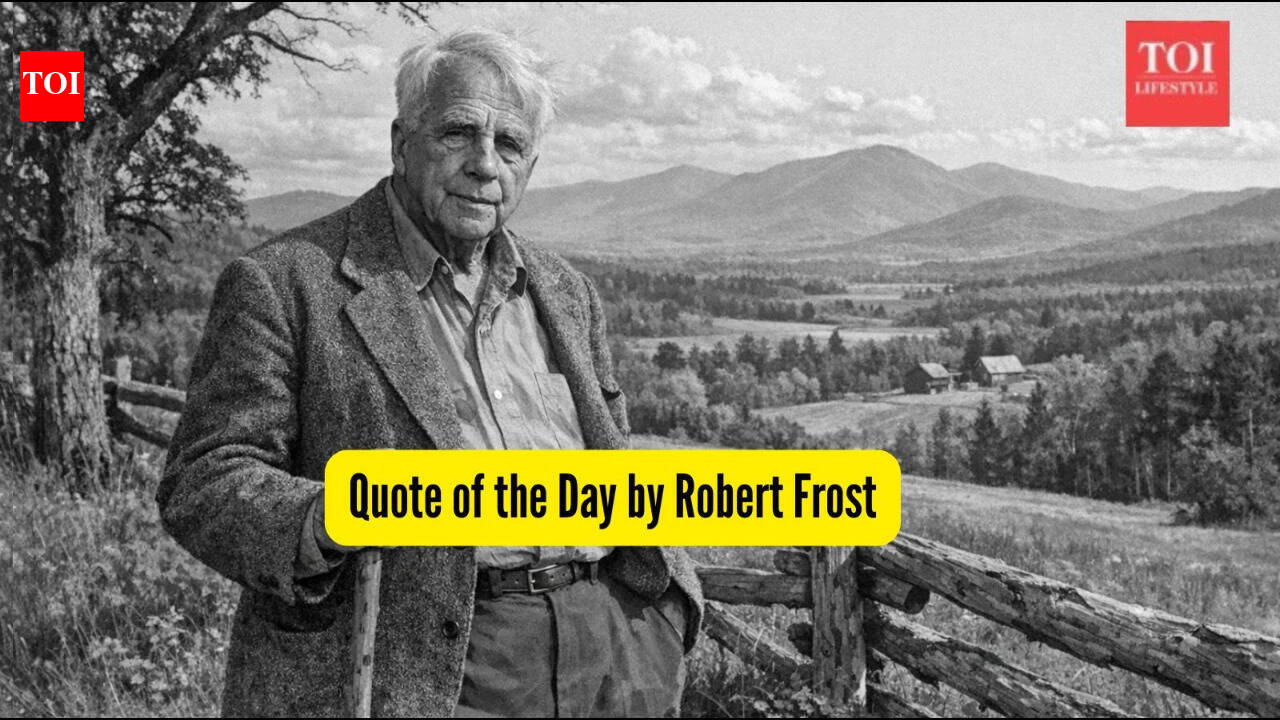
Robert Frost remains one of the most recognisable names in American poetry, a writer whose verses have become part of the cultural vocabulary of generations. His poems speak of woods, walls, roads, snow, farms, neighbours and the changing seasons, subjects that appear deceptively simple. Yet beneath these familiar images lie questions about choice, loneliness, mortality, relationships, responsibility and the uncertainty of being human.Born on March 26, 1874, in San Francisco, California, Frost did not begin life in the rural New England landscape with which he would eventually become so closely associated. His father, William Prescott Frost Jr., was a journalist and teacher, while his mother, Isabelle Moodie Frost, was a Scottish immigrant. After his father’s death from tuberculosis in 1885, when Frost was 11, the family moved to Lawrence, Massachusetts. It was there that his connection with New England began to shape the imagination that would later define his poetry.Frost graduated as co-valedictorian of his high-school class in 1892, alongside the woman who would become his wife, Elinor White. He briefly attended Dartmouth College and later Harvard, although he never completed a college degree. His path to becoming a celebrated poet was far from conventional. He worked as a teacher, farmer, newspaper editor and even a cobbler while continuing to write.His early literary life was marked by rejection. American publishers were not particularly interested in his poetry, and Frost eventually made a decision that would change his career. In 1912, at the age of 38, he moved with his family to England. There, he found an audience and publishers willing to take his work seriously. His first poetry collection, A Boy’s Will, appeared in 1913, followed by North of Boston in 1914.The success of these books transformed his literary fortunes. When Frost returned to the United States in 1915, he was no longer an unknown poet. He had established himself as a distinctive American literary voice.What made Frost unusual was his ability to make poetry sound like ordinary conversation while giving that conversation extraordinary depth. He often wrote in language that appeared simple and accessible, but his poems were rarely simple in meaning.Take The Road Not Taken. It is perhaps one of the most quoted poems in the English language, particularly for its famous image of a traveller standing before two roads. It is often treated as a straightforward celebration of choosing an unconventional path. Yet Frost’s poem is more complicated than that popular interpretation suggests. The two roads are described as being remarkably similar, and the speaker imagines that he will one day claim that his choice made “all the difference”.That ambiguity is characteristic of Frost. His poems rarely tell the reader exactly what to think. Instead, they present a situation and allow meaning to emerge from it. In Mending Wall, two neighbours meet each spring to repair a stone wall separating their properties. The deceptively ordinary task becomes an exploration of boundaries, relationships and the human desire to separate ourselves from others. The poem gives us the famous line, “Good fences make good neighbors,” while simultaneously questioning whether fences are actually necessary.Similarly, Stopping by Woods on a Snowy Evening presents a traveller pausing to admire a quiet, snow-covered forest. The scene is beautiful and peaceful, but beneath its tranquillity is a deeper meditation on temptation, weariness, duty and mortality. The speaker is drawn towards the woods, yet remembers that he has “promises to keep” and “miles to go before I sleep”.Nature, therefore, was never merely scenery for Frost. The woods, farms, snow and stone walls in his poetry become ways of thinking about human existence. The natural world reflects the conflicts within the human mind.This is perhaps one reason Frost’s poetry continues to resonate. He understood that ordinary experiences often contain the biggest questions. A walk through a forest can become a meditation on death. A wall can become a question about human relationships. A choice between two paths can become an exploration of regret and memory.Frost’s own life was considerably more complicated and painful than his public image as the genial New England poet might suggest. He experienced financial uncertainty in his early years, the deaths of several of his children, and the death of his wife Elinor in 1938. His family life brought profound grief, and these experiences inevitably coloured his understanding of loss and human vulnerability.Yet his poetry rarely becomes sentimental. Frost’s strength lies partly in his refusal to offer easy answers. His characters continue living despite uncertainty. They work, choose, regret, endure and move forward. His career eventually brought enormous recognition. Frost won the Pulitzer Prize for Poetry four times- for New Hampshire in 1924, Collected Poems in 1931, A Further Range in 1937 and A Witness Tree in 1943. He became one of America’s most celebrated literary figures and served as a cultural symbol of American poetry.In 1961, at the age of 86, Frost achieved another extraordinary distinction: he recited a poem at the inauguration of President John F. Kennedy. Frost had written a new poem, Dedication, for the occasion, but the bright sunlight made it difficult for him to read his manuscript. Instead, he recited The Gift Outright from memory.By the time he died on January 29, 1963, Frost had become much more than a successful poet. He had become part of America’s cultural identity.His influence, however, extends far beyond America. His poems are taught in schools and universities across the world, quoted in speeches and revisited by readers at different stages of their lives. Perhaps that enduring appeal comes from the fact that Frost wrote about experiences that do not become outdated: the difficulty of making choices, the boundaries between people, the pull of solitude, the demands of responsibility and the inevitability of change.His great achievement was to make these enormous questions feel intimate. He did not need grand historical events to write about the human condition. A snowy evening, a broken wall, an apple orchard or two paths in a wood were enough. And that may be the most lasting lesson of Robert Frost’s work: the extraordinary is often hidden inside the ordinary.His poetry reminds us that life rarely provides neat conclusions. We make choices without knowing where they will lead. We lose people and continue. We encounter beauty even in moments of sadness. We carry responsibilities even when we are tired. And we keep walking.Quote of the Day“In three words I can sum up everything I’ve learned about life: it goes on.”The above quote is often attributed to Robert Frost but there is no reliable evidence that he wrote or said this. These lines however, in the most beautiful and pragmatic manner, sum up life. Whatever many happen through the journey of life, the only eternal truth is, it goes on. It sounds rather sad, but is a very realistic take on life. We experience moments of immense happiness, heartbreak, loss, success, failure, love and disappointment. Some moments change us forever; some leave wounds that take years to heal. There are times when life feels as though it has come to a standstill, when a loss seems impossible to overcome, a dream seems beyond reach, or a chapter we desperately wanted to continue has come to an end.And yet, somehow, life moves forward. The sun rises the next morning. The world continues to turn. We wake up, go to work, meet people, make plans, laugh again, worry about something new and slowly begin to inhabit a life that may look very different from the one we imagined. There is something almost stark about the thought. Life does not necessarily pause because we are hurting. It does not stop because we have failed, nor does it remain suspended because we have lost someone or something we deeply loved. It simply continues — sometimes gently, sometimes brutally, but always forward.At first, that can sound rather sad. But perhaps there is comfort in it too. Because if life goes on, pain does not have the final word. A bad day is not the end of the story. A failure is not the whole of a life. Even grief, though it may permanently change us, eventually becomes something we learn to carry rather than something that completely define