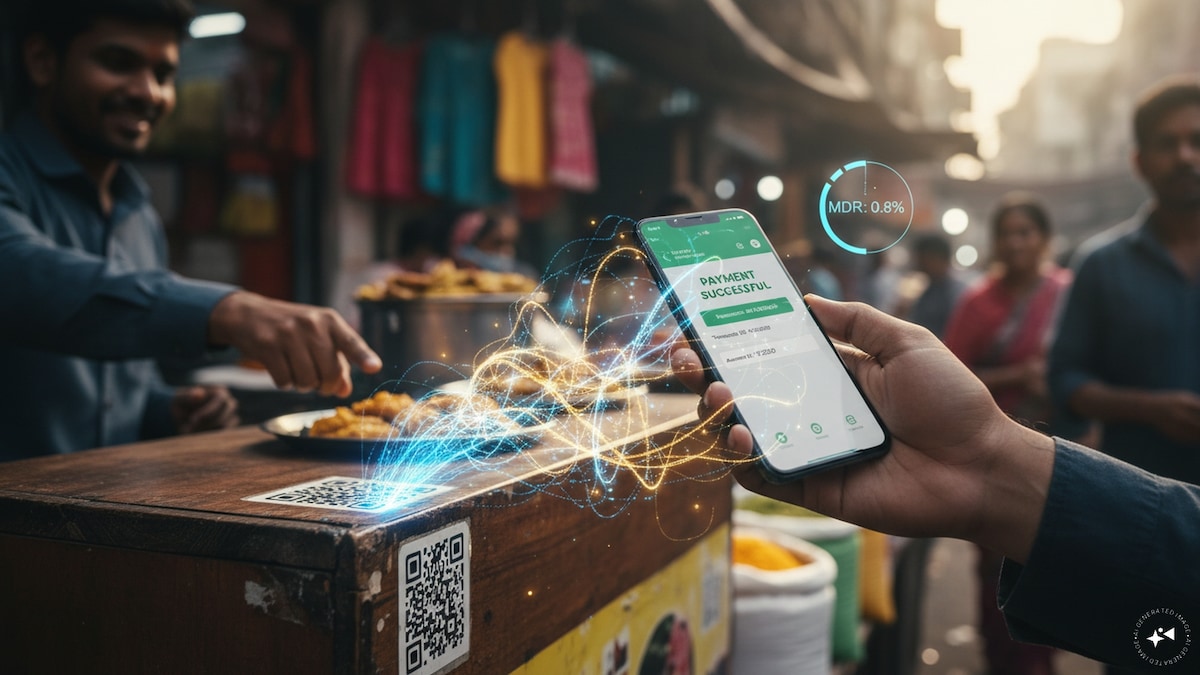
Under the standard framework, eligible UPI P2M transactions above ₹2,000 will attract an MDR of 0.4%, subject to a maximum charge of ₹300 for transactions of ₹75,000 or more. The charge is borne by the eligible merchant and cannot be passed on to the customer.
Here is how the fee is divided in the illustrative split provided for a ₹5,000 transaction.
What happens to the ₹20 MDR on a ₹5,000 UPI payment?
At 0.4%, a ₹5,000 transaction generates ₹20 in MDR.
The illustrative distribution sets aside 5% of the MDR, or ₹1, for the UPI Fund. The remaining ₹19 is distributed among the other participants in the payment ecosystem.
The split works out as follows:
| UPI ecosystem participant | Share of MDR | Amount on ₹20 MDR |
| UPI Fund | 2 bps | ₹ 1 |
| Issuing bank | 15.2 bps | ₹ 7.60 |
| Acquiring bank | 11.4 bps | ₹ 5.70 |
| TPAP/App provider | 7.6 bps | ₹ 3.80 |
| Payer PSP | 3.8 bps | ₹ 1.90 |
| Total | 40 bps | ₹ 20 |
The 2 bps allocated to the UPI Fund represents 5% of the total 40-bps MDR.
The remaining 38 bps is distributed among the issuing bank, acquiring bank, TPAP/app provider and payer PSP.
Who gets what?
The issuing bank is the customer’s bank — the bank from which the money is debited. In the illustrative ₹5,000 transaction, it receives ₹7.60.
The acquiring bank is the merchant’s bank, which receives the payment on behalf of the merchant. Its illustrative share is ₹5.70.
The TPAP or third-party application provider refers to the UPI app through which the payment is made, such as Google Pay, PhonePe or Paytm. Its illustrative share is ₹3.80.
The payer PSP is the partner bank of the UPI application that facilitates the transaction. It receives ₹1.90 in the example.
Separately, ₹1 goes to the UPI Fund, which is intended to support the UPI ecosystem.
Why is the MDR being introduced?
NPCI has said the MDR framework is intended to provide a source of funding for investments in infrastructure resilience, innovation, cybersecurity and customer service as UPI processes billions of transactions every month.
The framework is not applicable to every UPI payment. P2P transactions remain free, while eligible P2M transactions of ₹2,000 or less also carry zero MDR.
There are also concessional categories. Payments above ₹2,000 for areas such as railways, telecom, insurance and fuel will attract a flat ₹5 MDR instead of the standard percentage-based charge. Public utility payments and educational fee collections are also covered under the designated industry programme with a flat-fee structure.
What does this mean for consumers?
For consumers, the key point is that the MDR is an ecosystem-level merchant-side charge. NPCI has clarified that consumers will not be charged for making UPI payments, and merchants covered by the framework cannot pass the MDR on to customers.
So, in the ₹5,000 example, the customer pays ₹5,000, while the eligible merchant-side ecosystem generates ₹20 in MDR, which is then distributed as illustrated above.