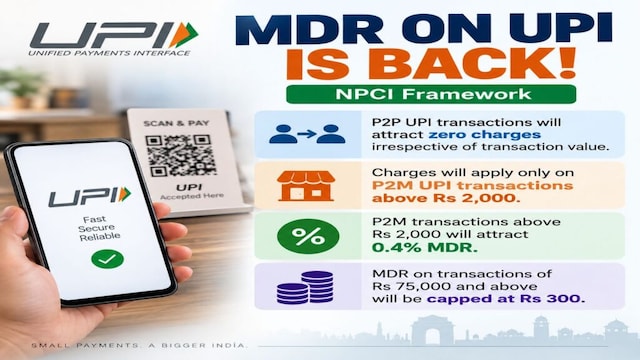
He said the 40-basis point MDR allowed on eligible transactions above ₹2,000 is higher than the 25–35 bps industry expectation, making it a positive development for payment intermediaries, processors and banks.
Among listed payment companies, One 97 Communications (Paytm) could see a significant earnings impact, with Aggarwal estimating a potential 30–50% increase in 2027-28 (FY28) earnings before interest, taxes, depreciation and amortisation (EBITDA). However, the final benefit will depend on the share of transactions eligible for MDR and how the revenue is divided among the various players.
“On the payment side amongst key listed stocks Paytm is one which has built a strong inroad on the merchant side of the total payment process,” he said.
Aggarwal expects Pine Labs to benefit as well, although the impact could be relatively lower than Paytm’s. He estimated a double-digit earnings impact for Pine Labs. The estimates are not final, as companies are still assessing the proportion of transactions that qualify for the new charges and how the revenue will be shared among the various players.
The allowed MDR of 40 bps is above the 25–30 bps range generally expected by the industry, with 35 bps considered the upper end of expectations.
“This change is looking out better than what we were thinking,” Aggarwal said.
He added that the new MDR places Unified Payments Interface (UPI) relatively close to debit card charges, which makes the development more favourable for payment companies.
However, exemptions remain. Utilities are exempted, while the charge is capped at ₹5 in certain cases. Transactions above ₹75,000 are also subject to a ₹300 cap, according to the discussion.
The revenue pool will be divided among the banks and payment intermediaries involved in processing UPI transactions.
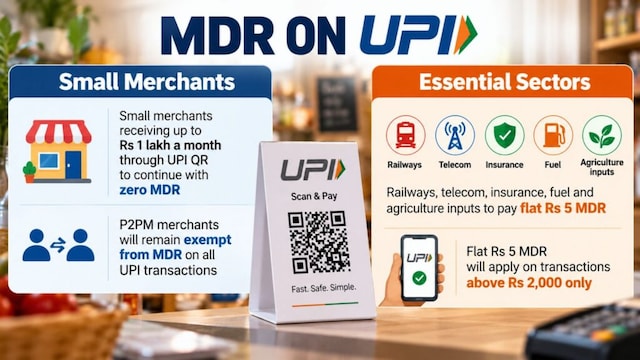
Aggarwal estimated that issuer banks could receive around 40% of the total MDR, while payment intermediaries or third-party application providers (TPAPs) could receive 15–30%.
He said it is too early to give precise figures for how much Paytm, Pine Labs, PhonePe or Google Pay could earn, as the actual share will depend on transaction eligibility and the revenue-sharing structure.
While some merchants could split transactions or shift to cash to avoid charges, Aggarwal does not expect this to significantly impact overall UPI growth.
“I don’t think that this will make too much of a dent on to the overall UPI growth and the volume increase over the years,” he said.
He pointed out that UPI charges remain relatively low, and a large number of lower-value transactions will continue without charges. For larger merchants, UPI payments were previously free, while other digital payment instruments carried higher charges.
On HDFC Bank, Aggarwal said investors are awaiting clarity on the bank’s leadership and the choice between an internal or external candidate. However, he said the key issue for investors will be how quickly the bank can return to its growth trajectory.
Watch the full conversation here

He noted that system growth is running at 19%, while HDFC Bank had earlier aimed to grow in line with the industry and subsequently ahead of it. The bank’s growth performance will remain an important factor for investors as the leadership transition takes shape.
Catch all the latest updates from the stock market here