NEW DELHI: Will UPI payments no longer be free? Will you have to pay extra for transactions above Rs 2,000? The new MDR rules have triggered a wave of questions over what exactly changes from October 15 and who will ultimately pay for it.The government has clarified that consumers will not be charged for using UPI. The change applies to specified merchant transactions above Rs 2,000, which will attract a 0.4% Merchant Discount Rate (MDR).But with merchants now having to bear a cost on some transactions, questions remain over whether they will absorb it or eventually factor it into prices.
What is changing from Oct 15?
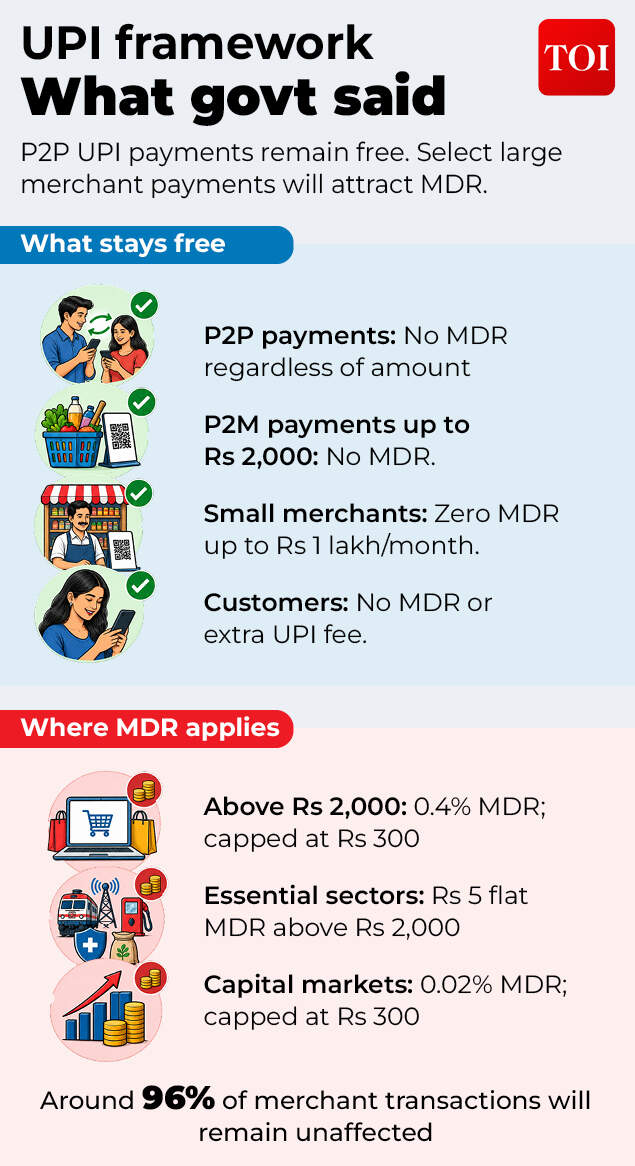
The National Payments Corporation of India (NPCI) has introduced a 0.4% Merchant Discount Rate (MDR) on specified person-to-merchant (P2M) UPI transactions above Rs 2,000. For transactions of Rs 75,000 and above, the MDR will be capped at Rs 300 per transaction. Person-to-person (P2P) UPI transfers will remain free.The Reserve Bank of India has backed the framework, saying it will help UPI continue to scale, innovate and serve consumers and businesses while supporting the long-term sustainability of the digital payments ecosystem.The MDR is deducted from the amount settled with the merchant. It is not a tax collected by the government. For transactions of Rs 75,000 and above, the maximum MDR will be Rs 300 per transaction.The new framework takes effect on October 15, giving banks, payment aggregators, fintech companies and accounting platforms time to update their systems.
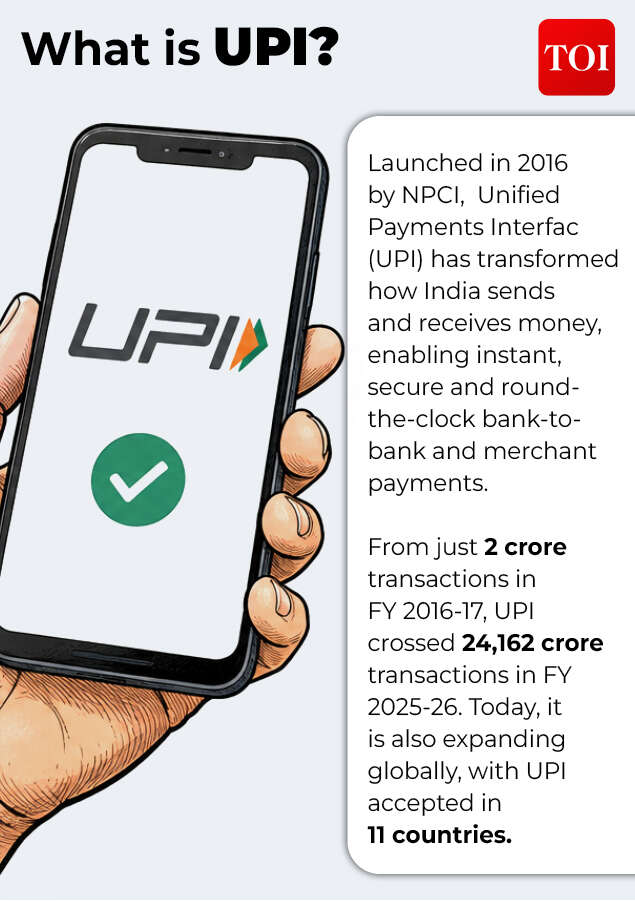
Unified Payments interface (UPI)
Will customers have to pay?
No, the government has explicitly said customers will not be charged MDR for making UPI payments. Banks have been advised to ensure merchants do not pass the MDR on to customers, while UPI application providers are prohibited from imposing platform fees or hidden charges on UPI payments.“Customers will not be required to pay any charge when making such payments through UPI,” the finance ministry said.Individuals will also continue to have unlimited free usage, with no monthly quotas, volume restrictions or tiered caps on free UPI transactions.This means a consumer scanning a QR code should not see an additional MDR line added to the bill simply because the payment exceeds Rs 2,000.However, whether some merchants eventually factor payment-processing costs into their overall pricing is a separate question. Industry executives have said large retailers and restaurants may absorb the cost, while some smaller businesses operating on thin margins could look for ways to manage the additional expense.
How much will the merchant actually pay?
| Transaction | MDR | Merchant pays |
| Rs 2,000 | 0% | Rs 0 |
| Rs 3,000 | 0.4% | Rs 12 |
| Rs 50,000 | 0.4% | Rs 200 |
| Rs 75,000 | 0.4%, capped | Rs 300 |
| Rs 1,00,000 | 0.4%, capped | Rs 300 |
The cap becomes important for high-value payments. A 0.4% charge on Rs 1 lakh would ordinarily be Rs 400, but the merchant will pay only Rs 300 because of the cap.
The new framework takes effect on October 15.
Which UPI payments will remain free?
The vast majority of everyday UPI payments will remain outside the MDR framework.Person-to-person paymentsAll P2P transactions will remain free, irrespective of the amount transferred. So if you send Rs 5,000 to a friend or transfer Rs 50,000 to a family member, there will be no MDR.Merchant payments up to Rs 2,000P2M payments up to Rs 2,000 will continue to attract zero MDR. According to the government, more than 95% of P2M UPI transactions by volume are below the Rs 2,000 threshold.
What about utility bills, fuel and insurance
Certain categories will have special MDR treatment. For specified essential and thin-margin sectors, including railways, telecommunications, insurance and fuel, among others, transactions above Rs 2,000 will attract a flat MDR of Rs 5 rather than the standard 0.4% rate.For example, a Rs 10,000 eligible insurance or fuel payment would attract a Rs 5 MDR rather than Rs 40.Electricity, water and other designated utility payments above Rs 2,000 will also fall under the concessional structure where applicable.Recurring automated payments through UPI mandates or AutoPay, including eligible utility bills, OTT subscriptions and recurring investments, will not attract the prescribed MDR transaction charge.
What about mutual funds & stock-market payments
Capital-market transactions have a separate MDR structure. Payments relating to mutual funds, securities, stockbrokers and dealers will attract an MDR of 0.02%, subject to a maximum of Rs 300 per transaction.The lower rate is intended to distinguish regulated capital-market payments from ordinary commercial purchases.
Why introduce MDR now?
UPI has grown from a relatively small payment network into the backbone of India’s digital payments system. NPCI data shows that UPI processed about 24,509 million transactions worth nearly Rs 29.82 lakh crore in August 2026 alone.The government and payment industry argue that operating a system at this scale requires continued investment in technology, infrastructure, cybersecurity, fraud prevention and customer support.The RBI said a fair distribution of MDR among participants could support further investment and expansion. “This, in turn, can enable wider UPI acceptance, deepen the customer base and support sustained growth in transaction volumes,” the RBI said.“RBI remains committed to ensuring that UPI continues to be safe, seamless, affordable, and accessible, while supporting the long-term sustainability and growth of India’s world-class digital payments ecosystem,” it added.
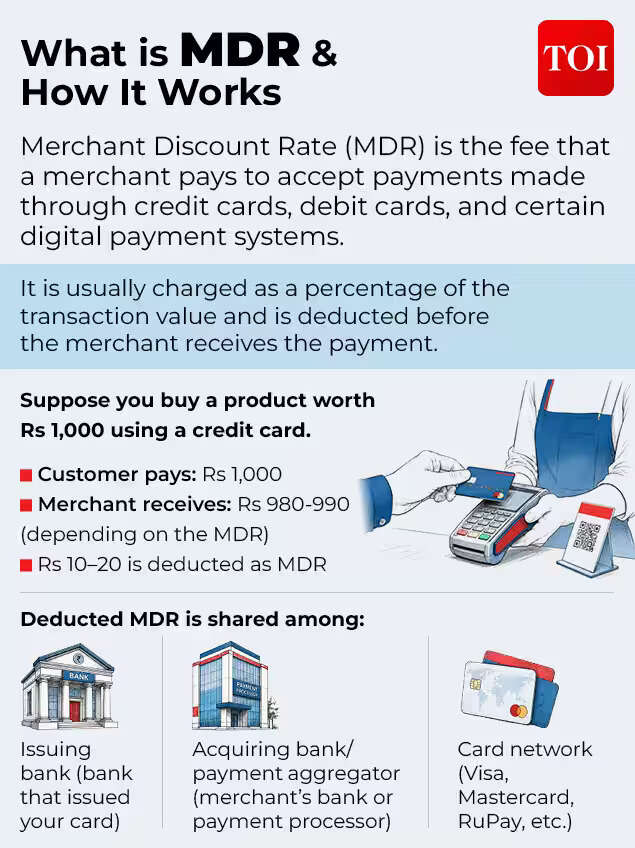
What is MDR?
Who gets the MDR?
MDR is not retained by a single company or by the government. It is distributed among participants in the payment ecosystem, including banks, payment service providers and UPI application providers, according to the applicable framework.According to Dharmender Jhamb, Partner and Fintech Industry Leader, Grant Thornton Bharat, “The introduction of a 0.4% MDR on UPI merchant transactions above Rs 2,000 is unlikely to have a significant direct impact on consumers, as the charge is borne by merchants rather than customers. However, some businesses, particularly those operating on thin margins, may gradually factor this cost into product pricing, resulting in a marginal increase in prices for certain high-value purchases.”“The biggest beneficiaries of the new MDR framework are likely to be banks, TPAPs , PSP banks, and the broader UPI ecosystem. The new revenue stream will help offset transaction processing costs and support continued investment in infrastructure, cybersecurity, fraud prevention, innovation, and customer service,” Jhamb told TOI.
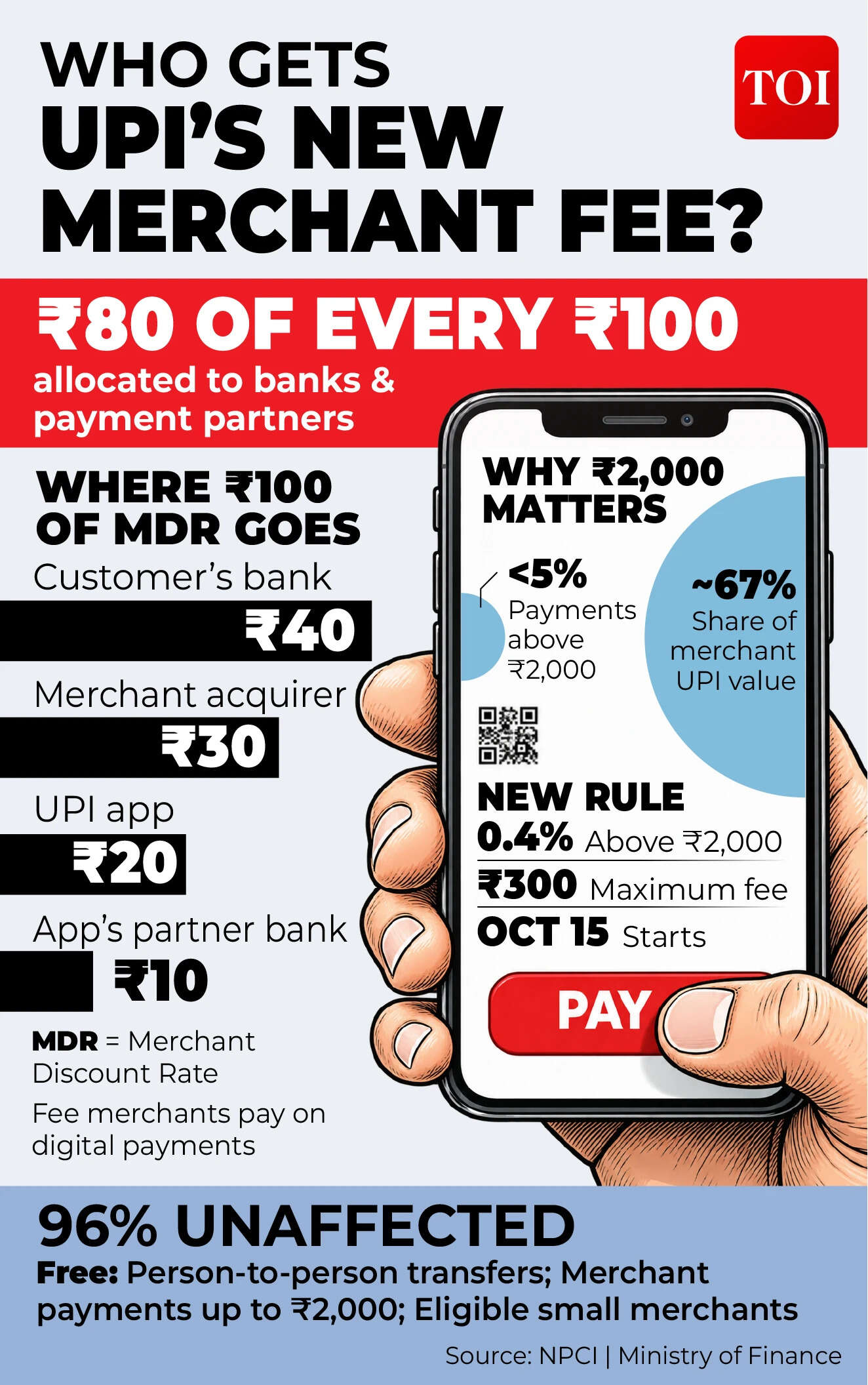
All P2P transactions will remain free, irrespective of the amount.
Banks likely to get ‘lion’ share
Banks with the largest number of customer accounts are expected to receive a significant share of the MDR pool, while third-party payment apps are also set to gain from the creation of a revenue stream around UPI transactions.Using debit cards as a proxy for savings accounts, SBI has a 25% market share, followed by Bank of Baroda at 8%, HDFC Bank at 6.2%, Canara Bank at 5.9% and Union Bank at 5.6%.For a Rs 2,000 transaction attracting 0.4% MDR, the merchant-side charge would be Rs 8. Of this, the issuing bank, the bank from whose account the money is paid, would receive Rs 3.20, while the acquiring bank, which receives the payment for the merchant, would get Rs 2.40.Of the remaining Rs 2.40, the third-party application such as PhonePe, Google Pay, Paytm, Amazon Pay or WhatsApp would receive Rs 1.60, while the bank processing the app’s transaction would receive 80 paise.The revenue is then distributed across several participants involved in processing a UPI transaction. These include the banks holding the customer’s and merchant’s accounts, processing banks at both ends, third-party payment applications and NPCI as the network provider.Third-party payment apps would also share part of their earnings with the banks that process their transactions. Banks also pay a small interchange fee to NPCI.For fintech companies, the change could be particularly significant because it creates a clearer route to monetising the enormous transaction volumes they handle.“The sector has long been viewed as one where scale has been built without a clear path to monetisation. A sustainable revenue model for UPI would alter that perception, improve investor sentiment and give the fintech ecosystem a significant boost,” Amrish Rau, CEO, Pine Labs told TOI.
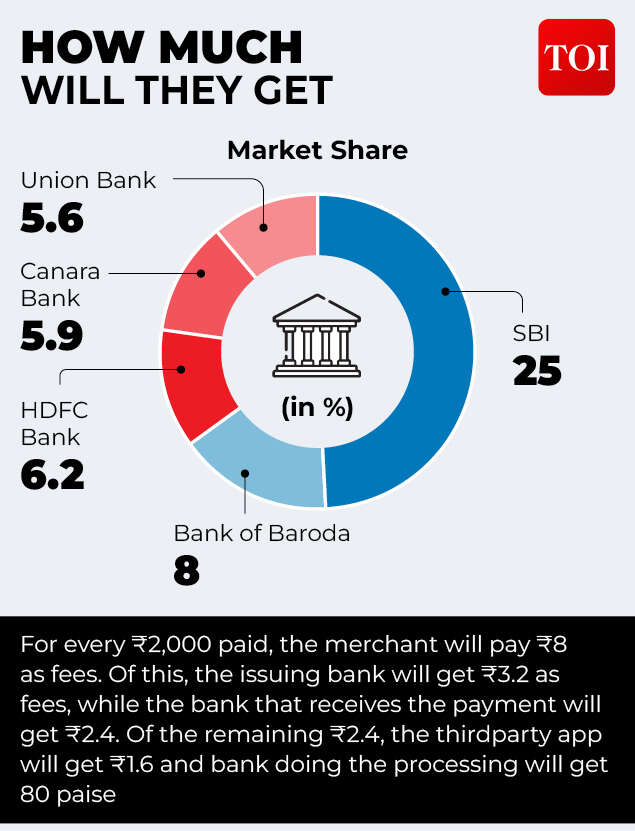
The biggest beneficiaries of the new MDR framework are likely to be banks.
What does it mean for small merchants?
The government has sought to protect small merchants through the P2PM zero-MDR framework. Eligible small merchants receiving up to Rs 1 lakh per month through UPI QR codes will continue to enjoy zero MDR.A dedicated fund is also proposed, with an amount equivalent to 5% of total MDR collections earmarked to support digital payment infrastructure and merchant adoption, particularly in smaller centres and among small businesses. The detailed framework for the fund is expected to be finalised in consultation with the RBI.
Could merchants increase prices?
The government has said merchants should not pass MDR directly on to customers. Large retailers, restaurants and other organised businesses may choose to absorb the cost as part of their operating expenses. Industry executives have also said the impact is likely to vary depending on margins and the proportion of UPI payments in a merchant’s business.“Large retailers can afford to bear the cost and the overall business impact for them should not be much. Credit cards always carried a charge. It will weigh on bottom-lines though,” an executive with a top electronics retailer told TOI.Some smaller merchants, though, may pass on at least part of the burden to customers, if not the full burden, executives added.“Small merchants will now think if they should accept cash or UPI,” said Kumar Rajagopalan, executive director & CEO at Retailers Association of India (RAI).Independent fintech analyst Parijat Garg has also raised the possibility of merchants splitting larger payments into multiple transactions to avoid MDR, while noting that enforcement could be challenging given the size of the merchant ecosystem.“Largely, it is a positive move and we don’t expect any dip in volumes as such. The challenge will be enforcement as the universe of merchants and retailers in UPI is much higher than in cards,” Garg told TOI.For instance, small merchants can create multiple IDs, making it difficult for regulators to keep track of payments, Garg added.
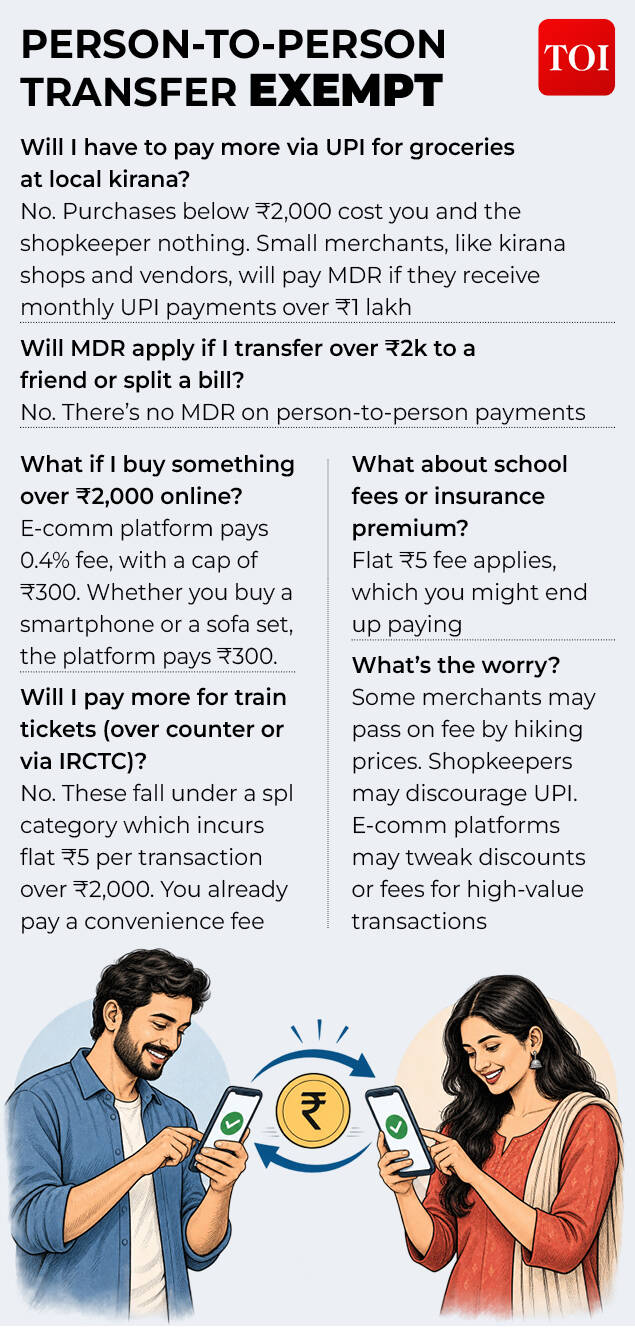
The detailed framework is expected to be finalised in consultation with the RBI within three months.
Will people return to cash?
The direct consumer cost of UPI remains zero, which reduces the incentive for users to switch back to cash. However, some merchants could encourage customers to use other payment methods for larger purchases if they want to avoid MDR.Jhamb said a major shift from UPI to cash is unlikely. “A meaningful shift back to cash is unlikely. UPI will remain free for consumers, transactions below Rs 2,000 will continue to attract zero MDR, and the convenience, speed, and widespread acceptance of UPI remain strong advantages over cash and other payment methods. While a small proportion of high-value transactions may migrate to bank transfers or other alternatives where merchants seek to avoid charges, UPI is expected to remain the preferred payment mode for most consumers and merchants,” Jhamb added.
Congress vs Centre
The revised UPI MDR framework has triggered a political clash, with the Congress alleging that the move could ultimately burden consumers, while the government and BJP have maintained that UPI users will not be charged.Leader of opposition, Rahul Gandhi alleged that Prime Minister Narendra Modi had given in to US pressure and demanded a rollback. “Modi ji, roll back the UPI tax. Now,” Rahul said, arguing that merchants could pass on the cost through higher prices.“The government says no fees will be charged to customers. But where will the fees imposed on shopkeepers ultimately come from? Added to prices, straight out of the customer’s pocket,” he added.Congress leader Jairam Ramesh questioned the 0.4% MDR and its possible impact on competition with US card companies.“Why 0.4% MDR? Is it because debit card MDR is also 0.4%? Is this being done to enable US card companies to compete with UPI?” he said.Congress spokesperson Supriya Shrinate also alleged that the move would eventually increase costs for consumers, while questioning why the government and RBI could not continue to fund the UPI ecosystem.The government rejected allegations of foreign pressure, saying the revised framework was driven by domestic priorities.The government has ruled out withdrawing the proposed 0.4% Merchant Discount Rate (MDR) on specified UPI merchant transactions above Rs 2,000, saying the framework will take effect from October 15.“There is no question of a re-think,” a senior government official told PTI.Finance minister Nirmala Sitharaman said most merchant transactions, including ordinary low-value payments, will continue to remain free. The government clarified that person-to-person UPI payments will not attract MDR, while around 96% of person-to-merchant transactions will remain unaffected.Rejecting allegations of foreign pressure, the finance ministry said the revised framework was driven entirely by domestic priorities.“The vast majority of merchant transactions, including ordinary, low-value transactions, will continue to remain free. Any future MDR will apply only to a limited category of merchant transactions above a prescribed threshold,” she added.
Present QR code, OTT payments & AutoPay? FAQs answered
Q. Why is this MDR being introduced now?According to NPCI, UPI processes billions of transactions every month. MDR revenue will be distributed within the UPI ecosystem to support investment in infrastructure, cybersecurity, innovation, resilience and customer service.Q. Will small-value UPI transactions be impacted?No. P2M transactions up to Rs 2,000 will remain free. More than 95% of P2M transactions by volume fall below this threshold.Q. How does UPI MDR compare with traditional debit and credit card MDRs?The 0.4% UPI MDR is lower than typical credit-card MDRs and some debit-card rates, keeping UPI a relatively low-cost option for merchant payments.Q. How does the new UPI MDR framework compare with international payment systems?While many digital-payment systems have revenue models to support their operations, India’s new framework continues to keep UPI payments free for consumers while introducing MDR for specified merchant transactions.Q. What is the dedicated fund for small merchants proposed from MDR collections?A fund equivalent to 5% of MDR collections is proposed to support digital-payment infrastructure and merchant adoption, particularly among small businesses and in smaller centres.Q. How will the dedicated fund help small merchants?The fund is intended to support merchant onboarding, digital-payment infrastructure and wider UPI acceptance among small businesses. The detailed framework will be finalised in consultation with the RBI.Q. Will ordinary consumers be charged for making payments via UPI?No. Consumers will not pay MDR. The charge applies within the merchant-payment ecosystem.Q. Is there any charge for UPI’s Person-to-Person (P2P) transactions?No. P2P UPI transactions will remain free, regardless of the amount transferred.Q. Will UPI apps start charging a platform fee on UPI payments?No. UPI apps are not permitted to impose platform fees or hidden charges on UPI payments.Q. Will consumer prices rise if merchants have to pay MDR?The government has said merchants should not pass MDR on to customers as a separate charge. Whether businesses absorb the cost or factor it into their overall pricing will depend on individual merchants and market conditions.Q. Will I have to pay a fee when scanning a QR code at a local vendor?No. Customers will not pay a separate fee for making a UPI payment through a QR code.Q. Are there any monthly limits on free UPI transactions for consumers?No. There are no MDR-related monthly quotas for consumers. Banks may impose transaction limits for security and risk-management reasons, but these are not charges.Does MDR apply to recurring payments such as utility bills, OTT subscriptions or mutual fund investments?Eligible recurring payments made through UPI mandates or AutoPay will not attract the prescribed MDR.Will small local vendors under the P2PM framework be charged MDR?No. Eligible P2PM merchants receiving up to Rs 1 lakh a month through UPI QR will continue to receive zero MDR.What is the P2PM framework and how does it protect small merchants?P2PM covers eligible small merchants accepting payments through UPI QR codes. Merchants within the Rs 1 lakh monthly threshold continue to receive zero MDR.Q. Do small merchants need to replace their existing QR codes?No. Merchants do not need to replace their existing UPI QR codes because of the new MDR framework.Q. What happens if a small merchant receives a payment above Rs 2,000?Crossing the Rs 2,000 threshold does not automatically make an eligible P2PM merchant liable for MDR. The merchant’s category and eligibility under the framework determine whether the charge applies.Q. When will the detailed framework for the dedicated small-merchant fund be finalised?The detailed framework is expected to be finalised in consultation with the RBI within three months.Q. How will acquiring banks identify small merchants eligible for zero MDR?Acquiring banks and payment service providers will track transaction activity and monthly UPI receipts to determine eligibility under the P2PM framework.Q. Does zero MDR apply to QR payments accepted in rural areas?Eligible P2PM merchants in rural and semi-urban areas can continue to receive zero MDR under the framework.Q. What MDR will apply to large commercial transactions?Specified P2M transactions above Rs 2,000 will attract 0.4% MDR, subject to a Rs 300 cap for transactions of Rs 75,000 and above.Q. Can enterprise merchants pass the MDR on to buyers?The government has said merchants should not pass MDR charges on to customers, and banks have been advised to ensure compliance.Q. What MDR applies to capital-market transactions through UPI?Qualifying capital-market transactions will attract 0.02% MDR, capped at Rs 300 per transaction.Q. Which capital-market transactions are covered?The framework covers qualifying payments involving capital-market entities, including mutual funds, securities, stockbrokers and dealers.Q. Are educational-institution payments exempt from the standard MDR?Educational payments fall under the applicable designated category. Payments up to Rs 2,000 remain free, while qualifying higher-value payments will attract the applicable rate.Q. Will electricity and water bill payments attract percentage-based MDR?Qualifying utility payments above Rs 2,000 will attract a flat Rs 5 MDR instead of the standard 0.4% rate.Q. Are insurance premium payments eligible for an MDR concession?Yes. Qualifying insurance-premium payments above Rs 2,000 will attract a flat Rs 5 MDR.Q. How will MDR work for fuel purchases at petrol pumps?Qualifying fuel payments above Rs 2,000 will attract a flat Rs 5 MDR. Payments up to Rs 2,000 will remain free.UPI was launched in 2016 and has expanded rapidly across India. NPCI’s latest statistics show more than 750 banks live on the platform, with monthly transaction volumes now running into tens of billions.The new MDR framework attempts to create a revenue stream for the ecosystem while protecting P2P payments, low-value merchant transactions and eligible small businesses.For consumers, the message for now is reassuring: UPI itself remains free. However, what happens next, whether merchants absorb the cost or reflect it in prices, will depend on how the new system plays out on the ground.