
Nihar Shah, Teqball India’s technical director, who is in Nagoya with the country’s three-athlete squad, remembers seeing each of those players when they were unable to land a service properly.
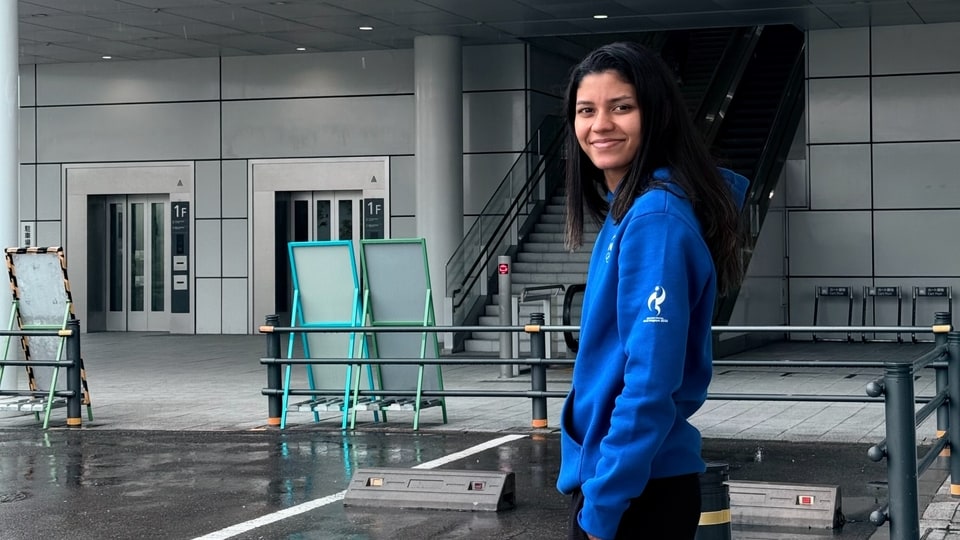
These first generation of “teqers” – as they are known and as he calls them – have landed within a step of a first medal at the Asian Games in this debut sport that blends football and table tennis.
Quimcy D’souza was five points away from an assured medal on Saturday, when she surrendered a 7-3 lead in the women’s singles semi-final decider as Indonesia’s Sumaya reeled off nine straight points for a 2-1 (7-12, 12-9, 12-7) win. Quimcy will have another crack at a medal on Sunday, against Japanese world No.7 Yuina Sakamoto, whom she stunned in the group stage. Quimcy and Mohamed Anas Baig will also fight for the mixed doubles bronze.
Mumbai-born Quimcy, 24, has had a solid run over the last couple of days. Ranked 24th in the world, she beat home favourite Sakamoto and Cambodia’s Dy Koemyean to top her group.
Quimcy, and the men’s doubles pair of Declan Gonsalves and Anas, are all self-taught and self-coached teqers who got fascinated by the sport once it came to the country. Instagram introduced it to Quimcy.
Invented in 2014 by three football enthusiasts in Hungary, Teqball’s first presence in India was in 2019, when Teqball India was formed.
After conducting their first athletes’ workshops and coaches’ seminars, the Covid-19 pandemic paused the sport’s early sightings. “The actual promotions and development started only around 2021-2022,” Shah told HT from Nagoya.
Shah’s own journey into teqball has been through football and futsal. Shah and his friends founded Ravens FC, a football club that competes in the Mumbai Football League. Intrigued by small-sided games, he also worked in futsal.
Shah saw teqball for the first time in Pune and took it back to his club players in Mumbai. “A couple of them told me they wanted to try this sport,” Shah said. “So I was like, chalo, karte hai isme bhi kuch (let’s do something in this too).”
India’s Asian Games teqers too have a football background. As does the majority of the 180-200 registered players in the country at the moment, according to Shah.
“The number is not a lot,” said Shah. “Most of them are freestylers, with a background in small-sided games and football.”
Those enthusiasts assemble for the nationals, which the association holds every year apart from the beach nationals. Competitions are held across sub-junior, youth and senior categories, with representation from around 25 states.
Most of the talent comes from Tamil Nadu, Gujarat, Maharashtra (specifically Mumbai) and Karnataka (Bengaluru). A lot more players from Northeastern states are coming in over the last couple of years, said Shah, with their sepaktakraw base.
“It’s a small community for now, but a good community,” said Shah.
The community is also largely club-driven. Quimcy moved to Bengaluru for academics and work, and founded Teqball Bangalore. Declan and Anas are part of the FSSA Teqball Club in Mumbai. All three of them have professional jobs, and trained together in Bengaluru in the lead-up to the Asian Games.
After their early exit in men’s doubles, Declan and Anas, along with Shah, sat in the coaches’ box for Quimcy’s singles matches. “The morale was down after the first day,” said Shah. “Quimcy rose to the challenge.”
Declan and Anas had risen to the 2024 World Championships podium with a bronze in men’s doubles. Those were the first signs that Indians can be competitive in this sport at the Asian and global level.
“A lot more people started asking about teqball after that. As a technical director, that’s what I am looking at,” said Shah, whose role in the body includes growing the sport and designing national tournaments and athlete training programs.
Teqball India is affiliated with the world body, FITEQ. It is hoping for recognition from the sports ministry and the Indian Olympic Association.
An Asian Games gig can lift the popularity of a sport, which, in Shah’s own words, is new and different. A medal can only drive it higher.
“The IOA and ministry gave us this opportunity. This is just a keyhole, and the whole door might open up with a medal,” Shah said.
“I’m happy that the sport has reached the public. Many still don’t know about it, of course. But somewhere, after this, a lot more people may have at least heard of teqball. And who better than the first generation of teqers from India to make that happen.”