
When Parth Mane video-called his coach Suma Shirur to show his first senior international medal — which happened to be an Asian Games 10m air rifle team silver — on Monday, his teammates Himanshu Dhillon and Rudrankksh Patil stopped by to convey their greetings to the former national rifle coach.
“It was so nice,” said Shirur, smiling, “because I’ve seen these kids grow up.”
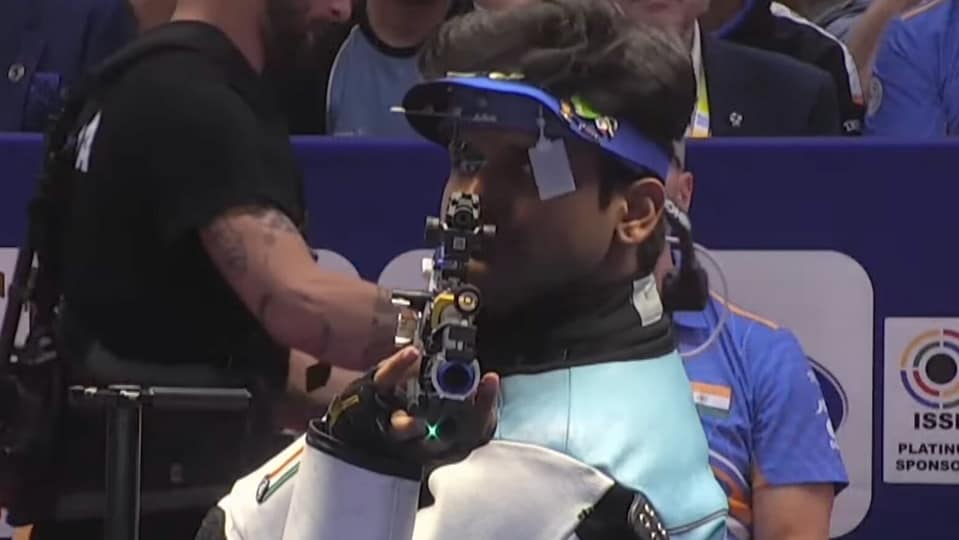
Particularly the 18-year-old Parth, whose shooting ambitions took him hustling from Solapur to Pune to Navi Mumbai. At Aichi-Nagoya, he reaped a medal at his debut Games and a fourth-place finish in the 10m air rifle mixed team with Elavenil Valarivan on Tuesday.
The Indian duo shot a solid 634.6 points in qualification, only behind China’s qualification world record score of 638.9. However, a slow start in the four-team final — in the earlier format, teams fought in gold medal and bronze medal matches — proved costly. Parth shot some solid inner-10s, Elavenil picked up a bit from an off-colour start but it came a little too late as India couldn’t catch up with Japan and South Korea.
Behind the bespectacled shooter’s development from being the 2024 junior world champion to an Asian Games medallist lies an athlete who is “very coachable”, as Shirur put it, and a teenager who is very decisive in his thinking.
“His understanding of the sport and what he wanted to do in it was there from when he was very young,” his father, Rakesh Mane, said. “This is all down to his dedication and hard work.”
And, adaptability, which Shirur, who first met Parth when he was 13, noticed as a standout quality.
“Apart from being talented, it’s important that an athlete is coachable. You know by the way they adapt to suggestions. And that’s the thing with Parth — he is always open, never rigid, and places trust in the coach,” said the Dronacharya awardee.
One such instance came last year, after his junior world title. With the teen’s body growing, a physical element had to be fixed, as it was hindering the alignment of the body which needs to be precise in the sport. Making the change would mean a performance dip for a period of time, which most young athletes can be wary of.
“When that change was made, Parth had a dip of three months. But he stuck to it,” said Shirur. “After that, we could see his performance go up again.”
Being adjustable was a trait in Parth from the time he started out.
Rakesh, an officer in Maharashtra’s Criminal Investigation Department, wanted his son to pick up any sport. Parth, after a summer workshop at a local shooting range in Solapur, chose his.
After a few months, Rakesh sent Parth to Pune for better coaching. A new weapon was also purchased before the pandemic-forced lockdown halted everything a month later.
With “jugaad” — an Indian fix for most problems — the father built a makeshift range at home, and through video calls the son continued practicing with the coach in Pune. As lockdown eased, Parth would dash to Pune (about 250km away from Solapur) and spend around 10 days a month there, while training at home the rest of the time.
“He went 8-10 months like that,” said Rakesh. “It was a lot of running around for him.”
Sensing this was unsustainable for the youngster, Rakesh applied for a transfer, which could usually be to any corner of the state. He gave two preferences in writing: Pune, where he had already zeroed in on a rental flat, and Mumbai.
He was transferred to the branch in Navi Mumbai’s Panvel, where, incidentally, Shirur’s Lakshya Shooting Club is based. The father’s plans changed, the son’s career was cultivated.
“When someone comes to you at 13, you know it’s for a long haul,” said Shirur. “You follow a long-term athlete plan to prepare them for this level.”
For Shirur, Parth is a “regular teenager” but with “a lot more maturity”. What struck the twice Asian Games medallist was his ability to make decisions by himself from a young age.
“Even in 9th grade, he was the one writing official e-mails,” she said. “That’s where I give credit to his parents too.”
“I wanted him to not get confused with different opinions,” said Rakesh. “From the beginning I told him that whatever you feel is right, in terms of planning or anything, do it. Even if it turns out to be wrong, no problem.”
Rakesh still resides in Panvel, while Parth shifted to the new residential setup in Shirur’s club last month that will soon operate a high performance centre.
Apart from the “competitive but positive” national team environment, Shirur felt it will keep him in the right space to continue learning and growing. “More importantly, learn how to perform under pressure. That comes a lot with experience.”