
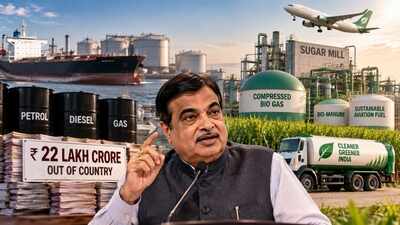
India imports most of the fuel it consumes – be it crude oil, LPG, or even LNG. Union Minister for Road Transport and Highways Nitin Gadkari has said that India’s agriculture sector can help drive down imported costs of fossil fuels, while at the same time using a combination of futuristic technology and a forward-looking vision if it is to become economically sustainable and help drive prosperity in rural India.Addressing the National Efficiency Awards ceremony organised by the National Federation of Cooperative Sugar Factories, Gadkari recently said producing sugar alone is no longer economically sustainable in view of global market conditions and the higher cost of production in India.
Make gas, ethanol, aviation fuel
Gadkari has called on sugar mills to expand into value-added by-products, particularly compressed bio-gas (CBG), ethanol, bio-manure and sustainable aviation fuel.“Instead of dumping waste into road embankments, if we convert it into gas – into CBG – our imports will decline. Understand this figure: Rs 22 lakh crore. We are sending Rs 22 lakh crore out of our country to import fossil fuels – petrol, diesel, and gas,” Gadkari said according to ANI.He pointed out that India’s sugar output is between 300 and 350 lakh tonnes, while domestic consumption ranges from 280 to 300 lakh tonnes. The resulting surplus has put pressure on sugar prices.At the same time, he said, countries such as Brazil have a significantly lower production cost, at Rs 23 per kg compared with India’s Rs 33 to Rs 34 per kg.“The future of plain sugar is mediocre at best. I won’t mince words: diversifying into complementary by-products guarantees a strong future,” the Minister said.According to Gadkari, making better use of sugarcane by-products could also improve returns for farmers. He said the additional value generated through these products could eventually enable sugar mills to pay farmers as much as Rs 6,000 per tonne of sugarcane, compared with the current Rs 4,000.Gadkari also underlined the scale of India’s agricultural waste and its potential as a source of bio-energy.Punjab and Haryana alone generate around 220 lakh tonnes of paddy stubble, he said. Five tonnes of stubble can produce one tonne of CBG, which he described as a way to address stubble burning and air pollution while simultaneously creating wealth in rural areas.“Technology has arrived, allowing us to produce CBG from stubble, bamboo, rice straw, bagasse, and Napier grass. The Government of India launched a dedicated scheme. Look at the numbers: 1,908 CBG plants have been registered across the country, with 132 already operational,” he said.India has the potential to produce 50,000 tonnes of CBG per day, Gadkari said, but present output accounts for only around two per cent of that capacity.The government has also introduced mandatory procurement obligations along with a fixed procurement price of Rs 106 per kg. He said the initiative could bring Rs 2.5 lakh crore into the rural economy and create as many as 15 lakh jobs.The Minister further called on the sugar industry to make greater use of artificial intelligence, precision farming and agricultural drones to reduce the cost of inputs and improve farm productivity.He cited the decision to permit ethanol production directly from corn as an example, saying the move had resulted in Rs 45,000 crore being transferred directly to farmers in Uttar Pradesh and Bihar.
Barrier free tolling to save fuel and costs
Meanwhile, India is moving to a FASTag-enabled barrier-free tolling system which will not only save time, but also fuel costs.The government could gain an annual benefit of as much as Rs 25,000 crore once the electronic toll collection system FASTag is fully implemented, Gadkari said recently.Gadkari said the government is targeting the removal of barriers from all toll plazas on national highways by March 2027 as part of its plan to make toll collection completely barrier-free.“When the system will go fully live, then our department alone would deliver a benefit of Rs 20,000-25,000 crore per year to the Government of India because of the use of FASTags,” Gadkari said at the Global Fintech Fest.The minister said FASTag adoption has already resulted in a 10% increase in toll collections, translating into an additional Rs 7,000 crore approximately. Total revenue generated at toll booths has consequently risen to more than Rs 82,000 crore, according to Gadkari.