
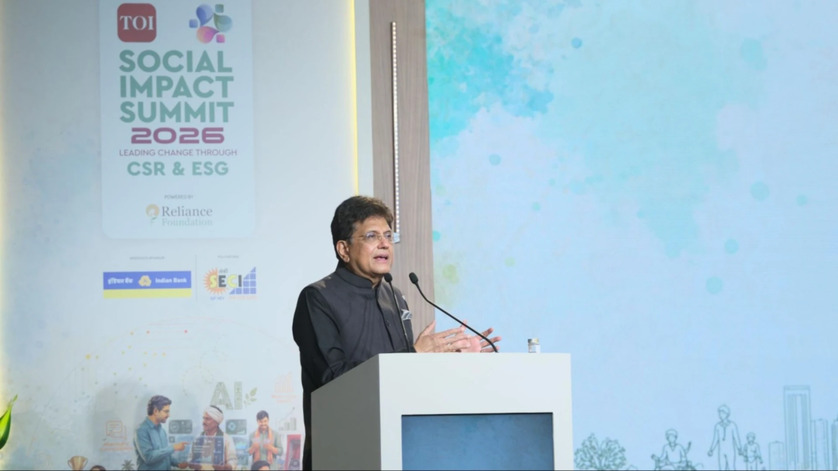
At the TOI Social Impact Summit 2026, government and business leaders discussed responsible growth, sustainable business models, philanthropy, ESG and the role of capital markets in creating social impact.India needs affordable, locally developed solutions to address some of its most pressing social and environmental challenges, Union Minister of Commerce and Industry Piyush Goyal said at the TOI Social Impact Summit 2026.Calling upon startups and innovators to develop cost-effective and sustainable technologies, Goyal referred to an ongoing lake rejuvenation initiative in his North Mumbai parliamentary constituency. He said India needed locally developed solutions such as low-cost machines for cleaning and maintaining water bodies.“Machines are internationally available but at a huge price. Maybe one of our startups will very easily be able to make it,” he said.Reflecting on India’s CSR framework, Goyal said he had initially believed that mandatory CSR spending could weaken the country’s traditional culture of voluntary giving.“When the Companies Bill was piloted about 13-14 years ago, bringing in the provision of mandatory 2% spend on CSR, we were in opposition,” he said. “I had felt we were actually doing a disservice to the Indian ethos, to the Indian way of life, because in India people do not do CSR out of compulsion.”However, he acknowledged that the policy had brought more funds into social development.Goyal also said government welfare initiatives, including affordable housing, had restored dignity, created household assets and helped expand the middle class. Rising dual-income households and improved living standards, he added, were also contributing to economic growth.“This is a very profitable proposition when you serve society,” he said.BCCL COO Mohit Jain added that national growth must be assessed not merely through output, investment and ambition, but through the lives strengthened by development.“A tree does not grow upward alone but underneath as well. So it is with the nation,” Jain said. “The true strength of a country is revealed at its roots — in the student who gains access to better education, the patient who receives timely care and the community that becomes resilient enough to face an uncertain future.”Sustainability must be part of the business modelITC Chairman and Managing Director Sanjiv Puri said sustainability and inclusive growth must be embedded in the corporate sector’s business model.“Economic progress cannot be seen in isolation from sustainability. Both have to go together,” Puri said. “Corporates must create economic value, because that creates the foundation to go beyond. But it must be both economic and societal value. And that is what we call responsible competitiveness.”He urged organisations to look beyond short-term shareholder value, pointing out that responsible business behaviour was increasingly being demanded by regulators, global trade bodies and conscious stakeholders.Puri said the world was facing a “perfect storm” of geopolitical turmoil, the weaponisation of tariffs and the climate crisis. These pressures, he noted, were affecting livelihoods, food security and nutrition, with vulnerable communities facing the greatest threat.He called for closer cooperation between the government, corporate sector and civil society to address climate change and support India’s low-carbon growth trajectory.Citing ITC’s own business model, Puri explained how the company had developed an ecosystem involving specialised research and development, the cultivation of climate-resilient trees requiring less water for its paperboards business, and partnerships with small farmers for its fruit juices operations.He also said CSR must be treated as a long-term business venture, with measurable outcomes and strong community capacity.“You have to first invest in building capacity at the community level so that the initiatives are sustained and built upon. Otherwise, over a period of time, they wither away,” he said.Fair practices are central to responsible enterpriseSpeaking at the inaugural session, MP Ahammed, Chairman of the Malabar Group, said ethical business practices, local compliance and transparency were central to responsible growth.Malabar Gold & Diamonds, founded in Kozhikode over three decades ago, operates across. Ahammed said the group’s operations were aligned with the vision of “Make in India, Market to the World.”He identified quality, warranty and guarantee as the three core principles guiding the company’s business. He also described employees as the company’s “biggest assets,” particularly those involved in crafting its jewellery.Ahammed announced that the Malabar Group would allocate Rs 200 crore, or 5% of its net trading profit, towards CSR initiatives in 2026-27.The key focus areas will include education, hunger alleviation, healthcare and women’s empowerment. Its ‘Hunger Free World’ initiative aims to provide food to vulnerable communities and contribute towards eliminating starvation.Making sustainability work for businessThe summit also featured a discussion on how companies are integrating sustainability into their core strategy, operations and investment decisions to create long-term value for stakeholders.The session, titled ‘Making Sustainability Work for Business, and Business Work for Sustainability’, featured Dr Neha Garyali, Vice-President, Centre of Excellence, VeARC Technologies, and Prabodha Acharya, Chief Sustainability Officer, JSW Group.The discussion placed sustainability within the wider context of business strategy, rather than treating it as a separate or standalone corporate responsibility function.Can the Social Stock Exchange transform social impact?Another session examined the role of India’s Social Stock Exchange in helping social enterprises access capital and improve accountability.The discussion, titled ‘From CSR to Capital Markets: Can India’s Social Stock Exchange Transform Social Impact?’, featured Mangesh Wange, Chief Executive Officer and Board Member, Swades Foundation; Riddhesh Shah, Deputy Vice-President, BSE; and Vineet Shastry, Associate Vice-President, NSE.The session looked at the relationship between social impact, capital markets and institutional participation, while examining whether new financial mechanisms can help scale organisations working on social challenges.Building a culture of givingAt the session on philanthropy, volunteerism and collective action, Sumit Tayal, CEO of Give, highlighted the changing culture of giving in India.“It is assumed that people start to give when they have made a lot of money, but 18- to 25-year-olds are giving as much as people older than them. Women make up 50% of donors,” Tayal said.The discussion focused on how philanthropy can become more participatory and collective, with younger donors, women and volunteers playing a greater role in supporting social causes.Gold and the circular economyGold, India’s second-largest import commodity by value, is increasingly becoming part of the domestic circular economy.The session on ‘Circular and Responsible Gold Value Chains: Unlocking Social and Environmental Impact’ examined responsible sourcing, recycling, organised credit and the financialisation of gold.Asher O, Managing Director – India Operations, Malabar Gold & Diamonds, said the company meets around 80% of its demand through people trading in their old gold.Kaushlendra Sinha, CEO of the Indian Association for Gold Excellence and Standards, said younger buyers were increasingly seeking information about the source of gold and demanding proof of responsible sourcing.Sachin Jain, Regional CEO India, World Gold Council, said responsible mining in India could help reduce excessive dependence on imports.Mayank Sharma, President and Head of Gold Loan at IIFL Finance, discussed the role of gold loans in improving credit access for households and MSMEs. Vikram Dhawan, Head Commodities and Fund Manager at Nippon India Mutual Fund, spoke about the growing financialisation of gold through gold ETFs.Together, the discussions highlighted the need for greater transparency, responsible mining, recycling and organised financial systems across the gold value chain.Disclaimer: This article is part of a brand initiative by TOI in partnership with Malabar Gold & Diamonds and Reliance Foundation.