
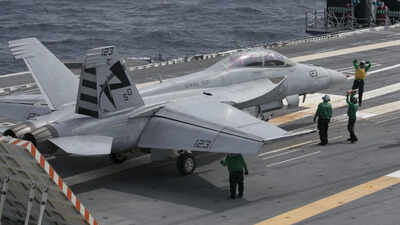
US President Donald Trump has ordered the US Navy to return to the old steam catapult for its future Ford-class aircraft carriers. But even as the administration pushes to revive the decades-old technology, the Navy appears to be continuing work on the electromagnetic launch system designed to power its newest carriers.According to Defense News, the Navy has recently awarded contracts related to the Electromagnetic Aircraft Launch System, or EMALS, including a $49.3 million contract to Kato Engineering for its energy storage subsystem. The Navy has also sought vendors for additional EMALS components, including recirculation pumps.The development comes after Trump ordered the Navy to prepare a plan to replace EMALS with traditional steam catapults on USS Doris Miller (CVN-81), the next Ford-class aircraft carrier under construction.In an August memo, Trump cited shipbuilding setbacks, cost growth and delays linked to what he described as overly complex designs and repeated design changes. The order also calls for the Ford-class carrier’s electromagnetic weapons elevators to be replaced with hydraulic systems.Why going back to steam is difficult for the NavyThe Ford-class was designed around electromagnetic launch technology, so bringing back steam would require changes to the carrier’s existing design and infrastructure.The problem is even bigger for USS Doris Miller, where nearly 50 percent of production was already complete when the change was ordered. General Atomics has warned that such a switch could add cost, delays and integration risks.The Navy also no longer has the same steam-catapult production base. The service has not ordered a new steam catapult in about two decades, with the last one ordered for USS George H.W. Bush, the final Nimitz-class carrier.The US Navy would have to rebuild the supplier network, manufacturing capacity and technical expertise needed to produce and maintain steam catapults.The Navy says EMALS provides smoother acceleration, more precise launch-speed control, lower maintenance and manpower requirements and the ability to launch aircraft across a wider weight range, including lightweight unmanned aircraft and heavy fighters.Returning to steam would therefore mean not only changing the hardware but also giving up some of the capabilities that the Ford class was designed to provide.The issue is also important for the future of carrier aviation. As the Navy adds more unmanned aircraft to its carrier air wings, it needs a launch system that can handle aircraft of different weights.According to the US Naval Air Systems Command (NAVAIR), EMALS is designed to launch a wide range of aircraft, from lightweight unmanned systems to heavy fighter jets.China is also betting on electromagnetic catapultsChina has also adopted electromagnetic catapult technology for its latest aircraft carrier, the Fujian. The carrier is equipped with three electromagnetic catapults, making it the first Chinese carrier to use the technology.China is taking electromagnetic catapult technology beyond its conventional aircraft carriers, with its Type 076 amphibious assault ship, or LHD, Sichuan, also equipped with an electromagnetic catapult and arresting gear.The move highlights how EMALS is becoming increasingly important not just for traditional carrier operations, but also for the next generation of drone and fixed-wing aircraft platforms.