
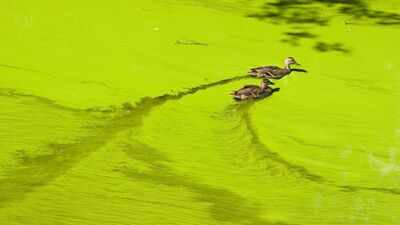
For more than half a century, scientists have used a small lake in northwestern Ontario to study why freshwater ecosystems develop harmful algal blooms. Lake 227, part of the Experimental Lakes Area, began receiving carefully measured additions of nitrogen and phosphorus in 1969. The experiment later changed dramatically. Researchers reduced nitrogen inputs during the 1970s and stopped adding nitrogen entirely in 1990, while phosphorus additions continued. Yet the lake remained highly eutrophic, with algal blooms continuing year after year. The International Institute for Sustainable Development describes Lake 227 as the world’s longest-running whole-lake experiment, while a peer-reviewed study in the Proceedings of the National Academy of Sciences found that nitrogen-fixing cyanobacteria compensated for the missing nitrogen. The decades-long experiment offered a powerful lesson: controlling phosphorus is central to controlling freshwater eutrophication.
A lake turned into a laboratory
Lake 227 is a small lake in the Experimental Lakes Area of northwestern Ontario, Canada. It covers about five hectares, has an average depth of 4.4 metres and reaches a maximum depth of approximately 10 metres.The Experimental Lakes Area was created as a place where scientists could study aquatic ecosystems at the whole-lake scale. Instead of collecting water in bottles or conducting short experiments in laboratory tanks, researchers could change conditions in an entire lake and observe the consequences over many years.That scale matters because lakes are complex systems. Nutrients move between water, sediments, plants, algae, microbes, fish and the atmosphere. A short experiment may capture an immediate response but miss changes that appear only after several seasons.Lake 227 became one of the most important examples of this approach. Scientists began fertilising it weekly during the ice-free season in June 1969. The initial experiment was designed to test how nitrogen and phosphorus affected algal growth and whether carbon limited productivity.The lake was not being polluted accidentally. Researchers were adding known quantities of nutrients so they could observe how the ecosystem responded.
What eutrophication means
Eutrophication occurs when a lake receives excessive nutrients that stimulate unusually high plant and algal growth.Nitrogen and phosphorus are essential nutrients. In appropriate amounts, they support aquatic life. But when too much enters a lake through fertiliser runoff, sewage, stormwater or other sources, algae can multiply rapidly.Dense algal growth can make water cloudy and reduce light penetration. When algae die, their decomposition consumes oxygen. This can create low-oxygen or oxygen-free conditions in deeper water, threatening fish and other organisms.Some blooms also contain cyanobacteria, commonly called blue-green algae, that can produce toxins or form unpleasant surface scums. These blooms affect drinking-water supplies, recreation, fisheries and the overall health of aquatic ecosystems.Lake 227 allowed scientists to watch these processes unfold under controlled nutrient additions. The results helped clarify which nutrients continued to drive algal production over the long term.
The first years of fertilisation
From 1969 to 1974, researchers added nitrogen and phosphorus at a nitrogen-to-phosphorus ratio of about 12 to 1 by weight. The purpose was to ensure that algae had sufficient supplies of both nutrients while scientists studied the role of carbon limitation.The lake soon became highly eutrophic. Phytoplankton blooms increased in proportion to the phosphorus being added.The early results challenged assumptions about what was limiting algal growth. Even though short-term tests suggested carbon could limit photosynthesis during parts of the summer, the total algal biomass continued to rise in response to phosphorus inputs.The experiment showed that a nutrient can limit a process temporarily without controlling the final amount of biomass produced over a full season or several years.That distinction became important later. Scientists wanted to know whether reducing nitrogen would reduce eutrophication or whether another biological process would compensate for the missing nutrient.
Nitrogen additions were reduced
In 1975, researchers reduced the nitrogen-to-phosphorus ratio in the fertiliser added to Lake 227 to approximately 4 to 1.The change favoured nitrogen-fixing cyanobacteria. These organisms can convert atmospheric nitrogen gas into forms that become available for biological use.Nitrogen fixation gave the lake a way to replace some of the nitrogen that scientists were no longer adding directly. As the cyanobacteria became more common, they helped maintain the nutrient supply needed for continued algal growth.The change also altered the composition of the algal community. Nitrogen-fixing cyanobacteria became dominant during parts of the summer, particularly in July and August.This was an important ecological response. The lake did not simply become less productive because one nutrient was reduced. Instead, organisms capable of obtaining nitrogen from the atmosphere gained an advantage.The experiment demonstrated that freshwater ecosystems may respond to nutrient reduction by changing which species dominate. A reduction in one form of nutrient can favour organisms with a biological way to replace it.
Nitrogen stopped in 1990
From 1990 onwards, researchers stopped adding nitrogen fertiliser to Lake 227 completely. Phosphorus additions continued at relatively constant levels.The decision created a powerful long-term test. If nitrogen were the main factor controlling eutrophication, removing it should eventually have caused a substantial decline in algal biomass and bloom intensity.Instead, the lake remained highly eutrophic. Algal biomass continued to remain broadly proportional to phosphorus inputs.The peer-reviewed PNAS study examined 37 years of the experiment and found that Lake 227 remained productive despite the complete removal of added nitrogen during the final 16 years.Nitrogen-fixing cyanobacteria became especially important under the new conditions. They supplied biologically available nitrogen and allowed phytoplankton biomass to continue developing.The results did not mean that nitrogen was irrelevant. Nitrogen availability affected which organisms grew and how the algal community was structured. But the absence of added nitrogen did not remove the fundamental driver of high productivity while phosphorus continued to enter the lake.
How cyanobacteria compensated
Nitrogen-fixing cyanobacteria have a specialised ability that many other algae lack.They can take nitrogen gas from the atmosphere and convert it into a form that supports growth. This process requires energy, but it provides an advantage when dissolved nitrogen in the water becomes scarce.In Lake 227, reducing and then eliminating nitrogen fertilisation created conditions that favoured these organisms. Their activity helped compensate for the loss of external nitrogen additions.The process did not happen instantly. The researchers’ analysis found that the adjustment to lower nitrogen availability took several years. Over time, however, nitrogen fixation helped maintain the lake’s nutrient balance.The cyanobacteria therefore acted as part of the ecosystem’s response to human manipulation. By continuing to add phosphorus, scientists maintained the resource that supported algal biomass. The lake’s biology found a way to obtain enough nitrogen to use that phosphorus.This helps explain why measuring only dissolved nitrogen can be misleading. A lake may show signs of nitrogen deficiency in short-term tests while still producing large blooms because nitrogen-fixing organisms are supplying the missing nutrient.
Phosphorus remained the key driver
The Lake 227 experiment strengthened the argument that phosphorus control is central to managing freshwater eutrophication.The International Institute for Sustainable Development says the experiment demonstrated a direct connection between phosphorus and algae. Even after nitrogen additions ended, annual blooms continued because phosphorus was still being supplied.The PNAS researchers reached a similar conclusion. They wrote that reducing nitrogen inputs did not control eutrophication because nitrogen fixation allowed biomass to continue in proportion to phosphorus.The lesson is not that nitrogen management never matters in any aquatic ecosystem. Different lakes and coastal waters can respond differently depending on their chemistry, hydrology, biology and sources of pollution.However, Lake 227 showed that reducing nitrogen alone may fail in a freshwater lake where phosphorus remains available. Nitrogen-fixing cyanobacteria can take advantage of the imbalance and continue supporting high algal production.For many freshwater management programmes, the practical implication is that efforts to reduce phosphorus inputs should remain a priority.
A lake that changed its algal community
The experiment changed not only the amount of algae but also the types of organisms present.Before nitrogen became limiting, nitrogen-fixing cyanobacteria were not detected in significant numbers. After the nitrogen-to-phosphorus ratio was reduced, species such as Aphanizomenon schindlerii appeared and became important parts of the summer phytoplankton community.After nitrogen fertilisation ended in 1990, nitrogen fixers generally made up more than half of total phytoplankton biomass, except during a later food-web experiment in 1996.Other groups, including chrysophytes, diatoms, cryptophytes and dinoflagellates, also became more prominent after the lake was temporarily made fishless.This shift shows why water quality cannot be judged only by measuring total algal biomass. The identity of the organisms matters. Some cyanobacteria can form surface blooms, alter water clarity and potentially produce toxins.A management action that changes the dominant algae without lowering overall biomass may not deliver the desired improvement for people or wildlife.
The role of the food web
Lake 227’s history included another major experiment involving fish and zooplankton.In 1993 and 1994, researchers added northern pike to the lake. By 1996, predation had eliminated the forage fish, and the lake became fishless after the pike were removed.Without fish feeding on zooplankton, large Daphnia became abundant. These animals grazed heavily on algae, and phytoplankton biomass fell sharply in 1996.The change was temporary. After the food-web manipulation ended, fish remained absent but other predators increased. Daphnia populations declined, nitrogen-fixing cyanobacteria returned to dominance and algal production rose again.This part of the experiment showed that nutrients are not the only forces shaping blooms. Predators and grazers can influence algae through a trophic cascade.It also demonstrated why whole-ecosystem research is valuable. A bottle experiment cannot fully reproduce the effects of fish removal, changing grazer populations, sediment nutrient movement and atmospheric nitrogen fixation.
Why the experiment lasted so long
Lake 227’s importance comes partly from its duration.Scientists fertilised the lake from 1969 through the period analysed in the 2008 study, allowing them to observe responses over 37 years. The experiment revealed processes that would have been missed in a short-term study.Nitrogen fixation took time to compensate for the reduced nitrogen supply. Sediment interactions and nutrient recycling also changed over multiple seasons. The food web responded to fish manipulation in ways that affected algal growth.These delays matter for environmental policy. A lake may not respond immediately after nutrient controls are introduced. Conversely, an apparent improvement in one season may not represent a lasting recovery.The PNAS authors concluded that experiments intended to guide nutrient management should be carried out at the whole-ecosystem scale and continue for several years.Long-term research can be expensive and difficult, but it provides a more realistic picture of how ecosystems adjust.
The wider lesson for lake management
Lake 227 helped challenge the idea that reducing nitrogen alone would reliably control freshwater algal blooms.When nitrogen additions stopped, nitrogen-fixing cyanobacteria became more important. They used atmospheric nitrogen to support continued production, while phosphorus remained available to fuel growth.The experiment therefore supports a nutrient-management approach centred on reducing phosphorus sources. Those sources can include agricultural runoff, wastewater, leaking septic systems, urban stormwater and soil erosion.Reducing phosphorus may not produce an instant transformation. Lakes can store phosphorus in their sediments, where it may return to the water under suitable conditions. Recovery can therefore require sustained reductions and continued monitoring.Managers also need to consider food webs, water mixing, temperature, oxygen levels and the species present in the lake.Lake 227 does not provide a universal formula for every lake. It provides something more useful: a long-term demonstration of how ecosystems can adapt when one nutrient is removed but another remains.
A scientific warning that lasted decades
The experiment began with a controlled addition of nutrients, but its most important lesson came from what happened after scientists changed the treatment.Nitrogen was reduced in the 1970s and stopped completely in 1990. Yet algal blooms continued for decades because phosphorus additions remained. Nitrogen-fixing cyanobacteria helped maintain the lake’s productivity, showing how nature can compensate for a missing nutrient.Lake 227 also demonstrated the limits of short-term testing. A brief experiment might suggest that algae are nitrogen-limited, but the full ecosystem can respond by changing species and increasing nitrogen fixation.More than 50 years after fertilisation began, the lake remains one of the clearest examples of the need for long-term, whole-ecosystem research.Its message is straightforward but important. If phosphorus continues to enter a freshwater lake, stopping nitrogen alone may not stop the blooms. To reduce eutrophication effectively, protecting water quality often requires confronting the nutrient that continues to drive algal growth.