
India’s badminton campaign at the 20th Asian Games culminated in a day of sheer heartbreak at the Ichinomiya City Municipal Gymnasium, spearheaded by the exit of the nation’s biggest star in the sport, PV Sindhu.
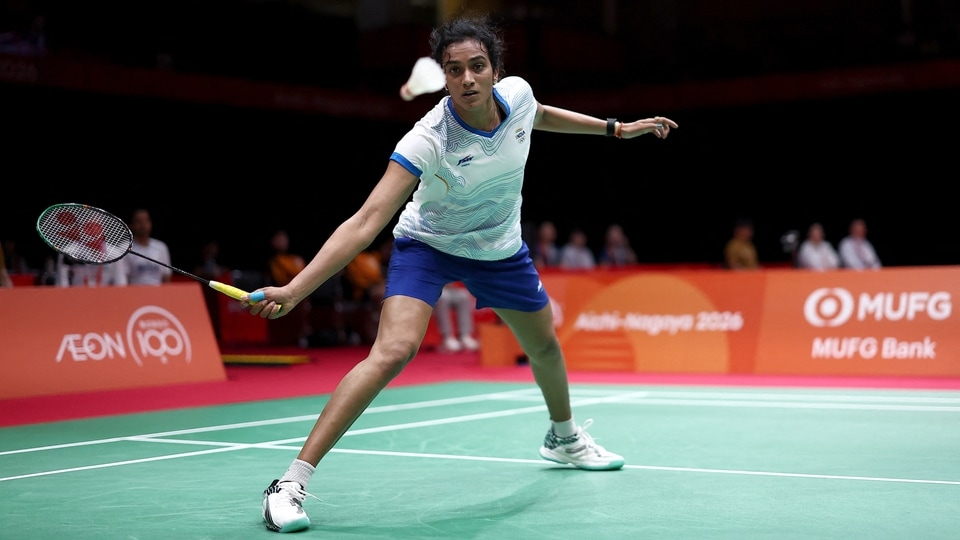
Carrying the weight of India’s last hope in badminton, the two-time Olympic medallist stepped on to the court on Sunday against 2021 Tokyo Olympics champion Chen Yufei in a high-stakes quarter-final that guaranteed a medal for the victor.
Sindhu entered the contest with a 7-9 career deficit against the world No.4, though she had previously overcome Chen when the Chinese player retired while Sindhu was leading in the Japan Open semifinals (which the Indian eventually won).
However, it wasn’t to be as the five-time World Championships medallist went down 21-11, 18-21, 10-21 in an hour and 15 minutes.
Initially, Sindhu looked unstoppable, surging to take the opening game 21-11 in just 19 minutes with a fair degree of comfort.
However, the shadow of extreme fatigue loomed large. Having played two matches on Saturday — with her Round of 16 clash ending around 1 AM early on Sunday — Sindhu had barely any time to recover.
Sindhu, who won silver at Jakarta 2018, fought fiercely through a very close half-an-hour second game, her shrieks echoing across the stadium as she took an 11-10 lead at the interval. But Chen’s endurance ultimately won out.
Chen, who won the women’s singles silver at the last Asian Games in Hangzhou, sneaked ahead in the second game, forcing the decider.
In the third game, despite closing the gap to a single point at one stage (8-7), a depleted Sindhu just ran out of steam at the end as she lost seven successive points from 10-14 to 10-21, watching her hopes of facing defending champion An Se Young slip away.
Slightly earlier, 19-year-old Unnati Hooda put up a courageous but exhaustion-inducing battle on her Asian Games debut. Facing three-time world champion Akane Yamaguchi, who had previously defeated her in straight games at the China Open in their only meeting yet in July, Unnati played with absolutely nothing to lose and delivered a gritty match.
After a dicey start, the Indian teenager found her rhythm, pushing Yamaguchi in long rallies and striking impressive winners before dropping the opener 16-21.
The second game became a masterclass in resilience. With some delightful backhand blocks that caught Yamaguchi on the backfoot, Unnati stayed toe-to-toe with the world No.3. Tied at 14-14, Unnati unleashed a run of seven straight points, aided by a lucky net cord to snatch the game 21-14.
The decider became a brutal test of wills which included an incredible 83-second rally that left both players gasping for air. Yamaguchi’s big-match temperament and pedigree eventually surfaced, looping a stunning backhand block over Unnati to take an 11-8 lead at the change of ends.
Despite pushing the three-time world champion to her absolute physical limits, Unnati bowed out 16-21, 21-14, 17-21 in a thrilling contest that lasted an hour and six minutes.
In women’s doubles, 2026 World Championships bronze medallists Treesa Jolly and Gayatri Gopichand, who beat world No.3 Yuki Fukushima and Mayu Matsumoto of Japan twice in the space of a week, squared off against world No.5 pairing of Pearly Tan and Thinaah Muralitharan of Malaysia.
The Indians fought desperately through a close first game but fell short at 18-21 allowing scoreboard pressure to completely fracture their rhythm. Mistakes increased rapidly in the second game, abruptly ending their campaign with a 9-21 defeat.
The mixed doubles quarter-final saw Dhruv Kapila and Tanisha Crasto take the fight directly to the world No.1 duo of Feng Yanzhe and Huang Dongping of China.
After dropping the first game 14-21, the Indian pair refused to quietly exit, battling back brilliantly to claim the second game 21-18 and forcing a tense decider. They pushed the top seeds to the brink, going down swinging in a 18-21 finish.
When the dust finally settled across the four quarter-finals, all of India’s shuttlers had been eliminated, leaving the contingent to depart the courts with just a single bronze medal from the men’s team event to show for their efforts.