
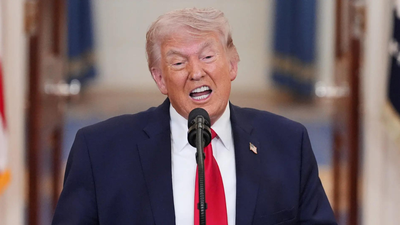
The TOI correspondent from Washington: The prime-time address was intended to reassure an anxious nation and steady jittery markets; instead, U.S President Donald Trump on Wednesday underscored the deep contradictions at the heart of his war in Iran, declaring that American objectives were “nearing completion” even as he threatened an intensification of military action.The speech, delivered from the White House on Wednesday night, marked Trump’s most comprehensive attempt yet to define the trajectory of a conflict that has escalated rapidly over the past month. Yet rather than offering clarity, it raised fresh questions about U.S. strategy, the risk of further escalation, and the durability of Washington’s alliances and partnerships.Trump struck a hubristic and triumphant tone, bragging about the greatness of the U.S military and asserting that American might has crippled Iran’s military capabilities, including its navy, air force, and missile systems. He suggested that the campaign could conclude within “two to three weeks,” framing the operation as a decisive success. In the same breath, he also warned that he was ready to hit Iran “extremely hard” in the coming weeks and expand strikes to critical infrastructure if Tehran failed to comply with U.S demands.The dual message—mission accomplished alongside threats of escalation—captured what analysts described as the central paradox of Trump’s Iran policy. While signaling closure, the president left open multiple pathways to a broader war, including continued aerial bombardment, the possibility of additional targets, and even a ground invasion. Notably absent in the speech was a clear exit strategy. Trump did not specify what political or military conditions would constitute a definitive end to hostilities, nor did he clarify how the U.S would secure long-term objectives such as curbing Iran’s nuclear program, which he acknowledged remains intact in part, and which some experts have suggested is a strawman bogey propped by Israel. Compounding concerns are reports that Washington is exploring plans to secure or seize Iran’s enriched uranium stockpiles, a move fraught with logistical and geopolitical risks. Such an operation would likely require either cooperation from Iranian authorities—currently unlikely—or a sustained military presence deep inside Iranian territory, raising the specter of a prolonged occupation. Experts warn that any attempt to physically control nuclear material in an active war zone could trigger retaliation, environmental hazards, and broader regional destabilization.Trump’s address also veered sharply into criticism of U.S. allies, particularly NATO members, whom he accused of failing to shoulder their share of the burden in confronting Iran. He reiterated calls for other nations, especially those reliant on Middle Eastern oil, to take responsibility for reopening the Strait of Hormuz, a critical global shipping lane that has been disrupted by the conflict. In a leaked remarks at a private Easter lunch earlier in the day, he taunted South Korea, Japan, and China for not helping keep Hormuz open, but conspicuously excluded India from the list of countries he wanted to intercede.The remarks reflect a widening transatlantic rift. European allies have largely refrained from direct military involvement, favoring diplomatic solutions and maritime security roles. Trump’s increasingly hostile rhetoric toward NATO, including suggestions that the alliance is no longer essential, has deepened concerns about U.S. reliability as a security partner.If Trump’s speech was aimed in part at calming financial markets—a longstanding preoccupation of the president—it appeared to have the opposite effect. Within minutes of the address, U.S. stock futures turned sharply negative and oil prices surged amid fears of prolonged disruption in the Strait of Hormuz. Analysts said the speech failed to provide the clarity investors had hoped for. Instead, it reinforced concerns about a drawn-out conflict with unpredictable economic consequences, including inflationary pressures driven by energy prices.The market reaction was particularly striking given Trump’s frequent invocation of stock performance as a barometer of his administration’s success. During the speech, he pointed to earlier market highs, but the immediate downturn underscored the fragility of investor confidence.At home, the address drew a mixed but increasingly critical response. Democratic lawmakers and some Republicans faulted Trump for failing to articulate clear objectives or a coherent strategy. Public opinion has also turned skeptical. Polls show a majority of Americans oppose the war and want it concluded quickly, with many expressing concern that the administration has not adequately explained its goals.