
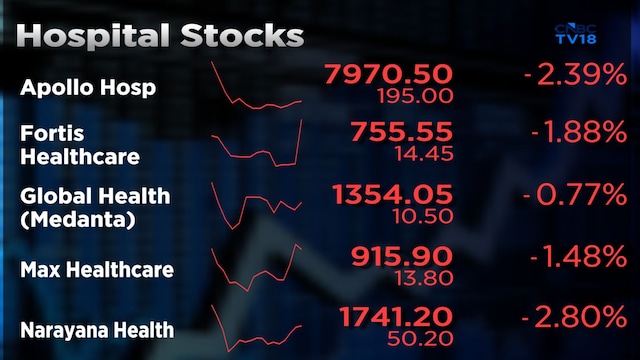
The sector witnessed a sharp sell-off, with many stocks dropping 5 to 7%, after the Supreme Court criticised high markups on medicines. The court cited a cancer drug sold at ₹27,000—a tenfold jump in pricing—and advocated for a 16% margin cap.
The profitability of hospitals should be assessed across the entire business rather than based on the margins of a single drug or one particular segment. While some parts of the business may have higher margins, others may have much lower profitability.
“In some cases, they may even be subsidising certain aspects of the business or certain sections of the patients,” he said, noting that the hospital business currently generates a decent return on capital (ROC) of around 20%, plus or minus.
Even if the government implements a 16% margin cap, Pathiparampil estimates the impact on the bottom line and earnings per share (EPS) will not exceed 5 to 10%.
He pointed out that valuations have become attractive because the stocks have undergone a time correction over the last one to two years, weakened from their six-month peaks, and corrected a further 6% in the recent session.
Addressing concerns about broader regulatory actions—such as comparisons between hospital room rents and three-star hotels—Pathiparampil acknowledged that some form of price control is likely. However, he does not expect drastic measures that would significantly impair profitability.
“Hospitals as a business is very difficult, very diverse and very complicated to put a simple price cap on top of it because there could be different types of procedures,” Pathiparampil explained, adding that varying cost structures and service levels make a uniform cap undesirable.
He concluded that even accounting for regulatory risks, the stocks remain attractive at current levels.
For the entire discussion, watch the accompanying video
