
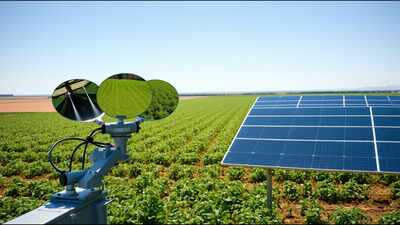
A student from Sydney has developed a solar-thermal system designed to control weeds without chemicals, using motorised mirrors to direct sunlight toward vegetation. Daniel Cox, a student at The Scots College in Sydney, developed the system, called SunRays, as part of a project titled “A Distributed Solar Photothermal System for Scalable, Chemical-Free Weed Control.” The project was entered in the Environmental Engineering category at the 2026 Regeneron International Science and Engineering Fair, where it received a Fourth Award of $600. According to the official project abstract, field trials achieved 92% weed mortality and 78% seedbank suppression after 45 seconds of treatment at temperatures between 60 and 70 degrees Celsius. The treatment produced effective heating over 2-metre-long zones without combustion, chemicals or tillage.
Daniel Cox and SunRays: how the solar-thermal weed-control system works
The SunRays project is based on using solar radiation as a source of heat rather than applying a chemical weed-control treatment. The project abstract notes that thermal weed-control approaches, including laser and solar optical systems, have previously faced limitations related to precise alignment, energy requirements and operating safety. Cox’s system uses a distributed heliostat design intended to provide controlled heating over a broader treatment area.The system consists of a 10-mirror heliostat array, with each mirror measuring 0.09 square metres, together with a mobile rover fitted with GNSS-RTK positioning and a thermal receiver measuring 1 metre by 0.1 metre. A control algorithm continuously adjusts the mirror angles to optimise the solar flux reaching the receiver. Instead of using a conventional point-focus arrangement, SunRays redirects non-concentrated optical flux toward the receiver mounted on the rover. According to the project abstract, this allows the system to maintain centre-weighted heating despite variations in terrain or weed distribution. The system is designed to deliver sustained temperatures above 60 degrees Celsius over a broad treatment zone. The project describes its approach as a combination of distributed mirror control, GNSS-RTK guidance and a receiver-defined thermal field, with the aim of producing controllable heating under changing field conditions. These features form the central engineering concept behind SunRays.
SunRays field trials recorded 92% weed mortality
The most specific performance figures in the project come from its field trials. According to the official ISEF abstract, exposure to temperatures of 60 to 70 degrees Celsius for 45 seconds resulted in 92% weed mortality. The treatment produced effective heating over 2-metre-long treatment zones without combustion, chemicals or tillage.The reported results show that the system produced a measurable weed-control effect under the conditions tested. However, the figures should be understood as results from the project’s reported field trials rather than evidence that SunRays has already been established as a commercial replacement for herbicides. The project abstract describes the system as a scalable framework, but broader agricultural deployment would require further testing under different field conditions and at larger scales. The project also identifies the wider problem it is attempting to address. Its abstract states that synthetic herbicides are widely used because of their effectiveness and low cost, while identifying concerns including water contamination, biodiversity loss and the development of resistant weeds. It presents solar-thermal weed control as one possible alternative area of research.
From a school project to international science fair recognition
Cox’s work was presented at the 2026 Regeneron International Science and Engineering Fair, where the project was listed under Environmental Engineering with the project number ENEV010. The Society for Science’s official database identifies Cox as a student of The Scots College in Sydney, Australia. The project received a Fourth Award of $600 in Environmental Engineering. The Society for Science’s official awards announcement lists Cox and SunRays among the Fourth Award recipients, while the Australian Science and Engineering Fair separately confirmed the award and prize amount. The award recognises the engineering work demonstrated by the project, but it does not establish that the system is ready for widespread agricultural use. For now, the documented results show a student-built solar-thermal system capable of producing substantial weed mortality under the tested conditions, while its potential for larger-scale use remains an area for further development and testing.