
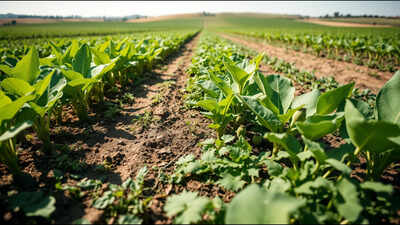
A seventh-grade student in Puerto Rico has found a new use for plantain peels discarded by her school cafeteria, turning them into a bioplastic mulch that reduced weed growth by up to 53% in a four-week experiment. Wileidy Enid Feliciano-Rivera, a student at Escuela Intermedia Rafael Irizarry Rivera in Peñuelas, developed the material as part of her EcoMusa project, which investigates whether food waste can be converted into a plastic-like material for agricultural use. According to Society for Science, the two EcoMusa versions reduced weed growth by 47% and 53%, respectively and were comparable to commercial black plastic mulch used in the experiment. The plantain-based material also kept soil one to three degrees Celsius cooler than uncovered soil and helped retain moisture. Her project has now earned her a place among the 30 finalists in the 2026 Thermo Fisher Scientific Junior Innovators Challenge.
From plantain peels to an agricultural material
Feliciano-Rivera’s project grew from her concerns about plastic waste, particularly the amount of plastic used in agriculture. Plastic mulch is commonly placed over soil to control weeds, but conventional plastic films can contribute to plastic pollution in agricultural environments. She became interested in whether materials with plastic-like properties could instead be made from fruits and vegetables. Her project, titled “Evaluation of the Effect of EcoMusa: Bioplastic Mulch Based on Musa paradisiaca for Weed Control (Phase II),” focuses on plantain peels as the main raw material. Society for Science says the idea was inspired by the possibility of creating plastic-like materials from plant-based sources, leading Feliciano-Rivera to investigate whether discarded plantain peels could be transformed into mulch.
How EcoMusa was made
To create the material, Feliciano-Rivera processed plantain peels into a mixture containing water, acetic acid, glycerin and cornstarch. She prepared the mixture and subjected it to heat before allowing the resulting material to dry in trays. The process produced two formulations, named EcoMusa 1 and EcoMusa 2. The two formulations were then spread over the ground for testing. Feliciano-Rivera compared their performance with unprotected soil and commercial black plastic mulch. Over four weeks, she monitored how the different treatments affected weed growth, while also recording soil moisture, soil temperature and the breakdown of the plastic material.
EcoMusa reduced weed growth by up to 53%
Society for Science reports that the two EcoMusa formulations reduced weed growth by 47% and 53% respectively during the experiment. The profile does not specify the exact baseline used to calculate those two percentages, nor does it give a corresponding percentage for the commercial black plastic mulch. It does state that the two plantain-based materials were comparable to the plastic sheeting in the experiment.The mulch also affected conditions in the soil beneath it. According to the finalist profile, the plantain-based material kept soil one to three degrees Celsius cooler than uncovered soil and kept the soil moist. The findings do not establish that EcoMusa can replace commercial agricultural mulch on a large scale. No field-scale results or detailed degradation rate have been reported, and the four-week experiment does not establish how the material would perform across a full growing season, with different crops or in different agricultural environments.
What research says about biodegradable mulch
The idea behind EcoMusa comes amid wider research into alternatives to conventional agricultural plastics. In a review published in Science of the Total Environment titled “Biodegradable plastic mulches: Impact on the agricultural biotic environment,” researchers described biodegradable plastic mulches as a promising alternative for reducing polyethene pollution. The review also reported that some biodegradable mulches can affect cultivated plants and alter soil microbial communities, while calling for more in-depth research into their environmental effects. The review notes that agricultural mulching can improve crop yields, reduce pesticide inputs and save irrigation water. At the same time, research has raised concerns about the environmental consequences of plastic mulches and the need to better understand the effects of alternative materials.A separate critical review by Campanale and colleagues, published in Trends in Analytical Chemistry in January 2024, also identified gaps in understanding the long-term effects of biodegradable plastic mulch films on soil ecosystems. The authors called for more long-term studies and increased on-site experiments under agricultural conditions. That wider research context does not prove that the same concerns apply to EcoMusa. Instead, it places Feliciano-Rivera’s results within a broader area of research in which the longer-term performance and environmental effects of biodegradable mulch materials are still being investigated.
From Puerto Rico to the Junior Innovators Challenge
Feliciano-Rivera’s project has now moved from school research to a national competition. Society for Science selected her as one of 30 finalists in the 2026 Thermo Fisher Scientific Junior Innovators Challenge. The competition brings together middle-school students working on science, technology, engineering and mathematics projects, with the finalists scheduled to travel to Washington, DC, for Finals Week from October 23 to 28. More than $100,000 in awards are available, and every finalist receives a $500 cash award.The EcoMusa project is only one part of Feliciano-Rivera’s interests. She also enjoys drawing, painting and crafting. Outside environmental research, she has an interest in astronomy and space. Society for Science reports that she received her first telescope at age eight and hopes to become an astrophysicist. On a trip described in her finalist profile, she travelled from Puerto Rico to Florida to visit the Kennedy Space Centre. This experience further strengthened her ambition to work at NASA.