
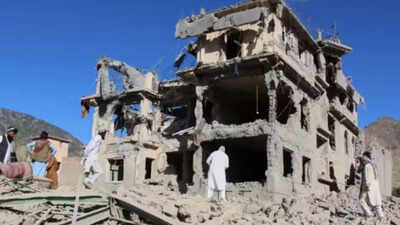
Pakistan and Afghanistan have, over the years, repeatedly exchanged fire along their international border, including in clashes since October last year.Pakistan has overwhelming military superiority over the Taliban regime. Yet, as in previous periods of conflict, Islamabad has stopped short of launching a full-scale ground offensive into Afghanistan. Instead, it has relied primarily on air strikes against targets inside Afghan territory.This raises a central question: why has Pakistan relied on air power rather than launching a ground offensive in Afghanistan?
Pakistan and Afghanistan: Tensions despite cultural ties
The two countries are more than immediate neighbours. They share deep ties rooted in religion, ethnicity, food and social traditions. Pakistan is also home to a large population of Afghan refugees and asylum seekers. According to the UNHCR, around 1.5 million Afghans were living in Pakistan as of early 2025, most displaced by decades of war, political instability and economic hardship.Yet these longstanding ties have not prevented repeated clashes along the Durand Line, the Pakistan-Afghanistan border that the Taliban does not recognise. The current tensions are particularly notable given that Islamabad initially reached out to the Taliban after the hardline Islamist movement once again seized power in Afghanistan, within days of US-led coalition troops completing their withdrawal in 2021 after nearly two decades in the country.
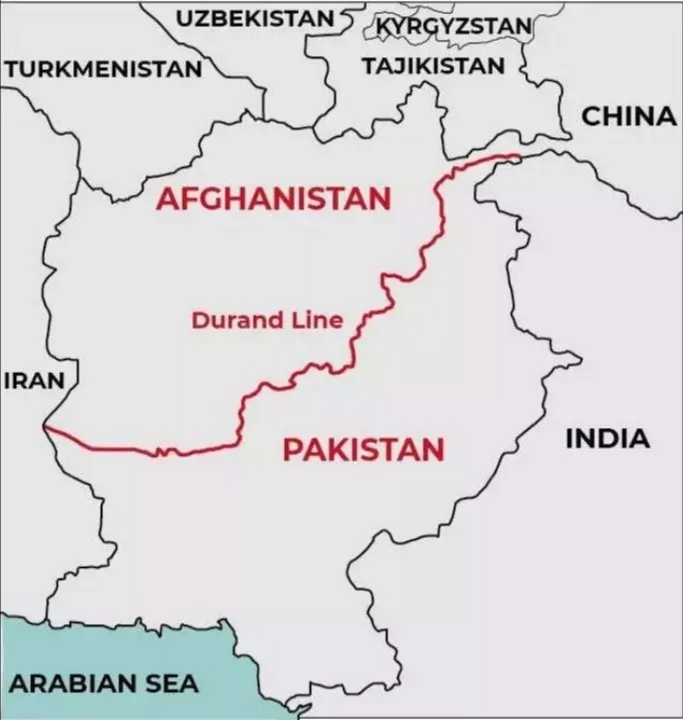
Taliban doesn’t recognise the Durand Line
The current conflict, like previous episodes of tension, centres on Islamabad’s allegation that elements hostile to Pakistan operate from Afghan territory — in this case, specifically the Tehreek-e-Taliban Pakistan (TTP). Kabul denies the allegation and has accused Pakistan of attacking Afghan civilians.On October 9, 2025, the Pakistan Air Force (PAF) struck several alleged TTP hideouts in Afghanistan, prompting a Taliban retaliation. Intermittent fighting has continued since, with Pakistan relying on air power against what it describes as TTP targets inside Afghanistan.
Pakistan and Afghanistan: A clash of unequals
The Taliban’s lack of an air force is one of the first reasons cited for Pakistan’s preference for air strikes inside Afghanistan. This gives the PAF, the world’s seventh-largest air force, the ability to hit targets inside Afghanistan and return to Pakistani airspace safely and swiftly.
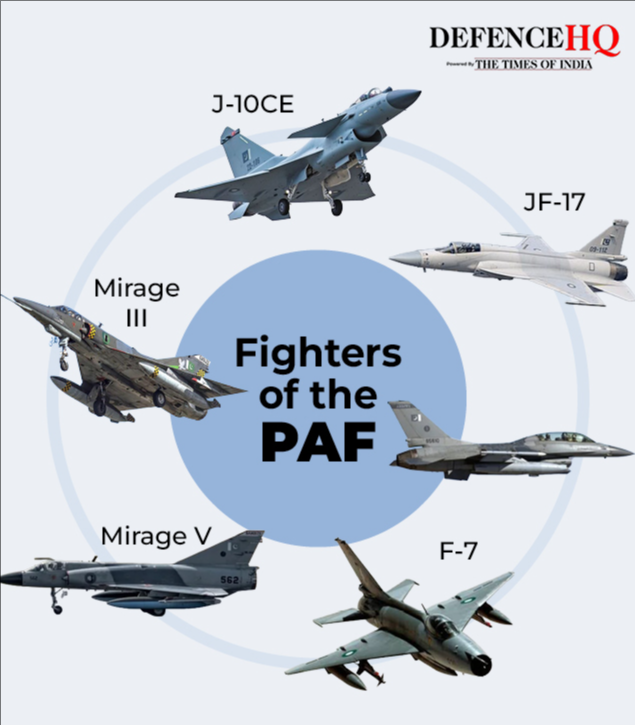
PAF has an inventory of several advanced fighter aircraft
Yet air power is only one dimension of the stark disparity in military power between Islamabad and Kabul.According to the Global Firepower Index, Pakistan is a top-15 military power, ranking 14th among 145 countries. It also possesses nuclear weapons, making it one of only nine countries — and the only Muslim-majority state — to have nuclear bombs.
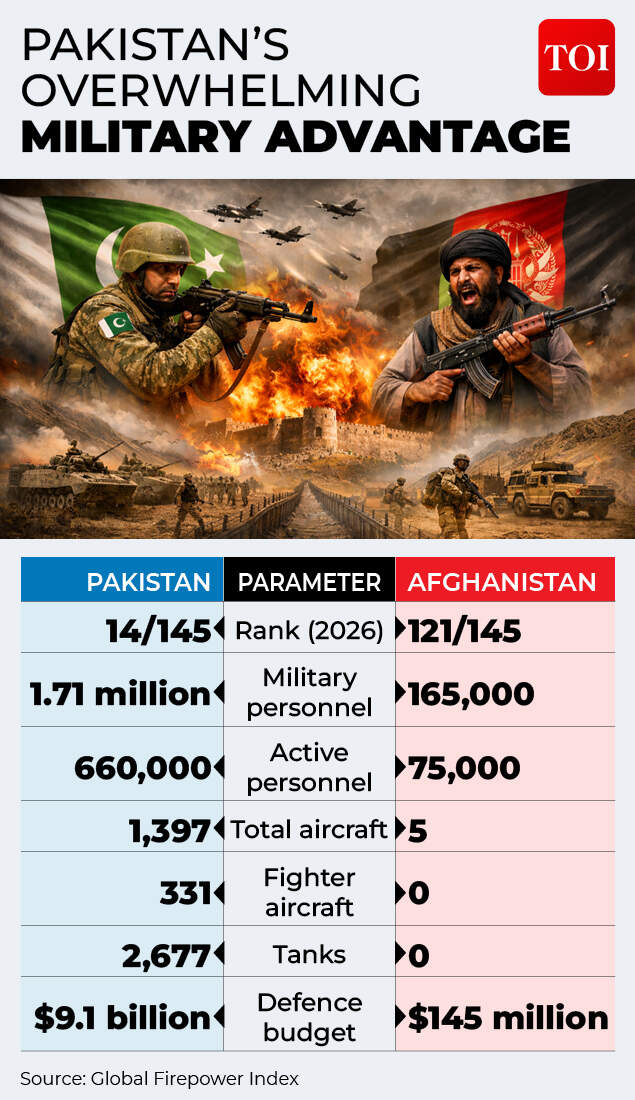
Pakistan has overwhelming military advantage over Afghanistan
Unsurprisingly, Afghanistan features among the lowest-ranked countries on the Global Firepower Index, at 121st. Taliban fighters rely largely on military equipment left behind by the departed US-led coalition forces and the former Afghan army that operated under the Washington-backed civilian governments of Hamid Karzai and, later, Ashraf Ghani. The Taliban also deploy guerrilla warfare tactics to fight their adversaries.Given this stark imbalance, air power also helps Islamabad avoid the optics of a stronger state invading or seeking to capture territory from a weaker adversary, as would be the case with a land offensive.
Imposing costs, not capturing territory
The PAF also offers Pakistan distinct operational advantages beyond the simple fact that Afghanistan lacks air power.Pakistani analysts argue that the objective is to impose significant costs on the TTP rather than capture Afghan territory. Pakistan can therefore conduct precision strikes deep inside Afghanistan without deploying ground forces, hitting individuals it describes as terrorists without taking on the far greater commitment of a ground operation.
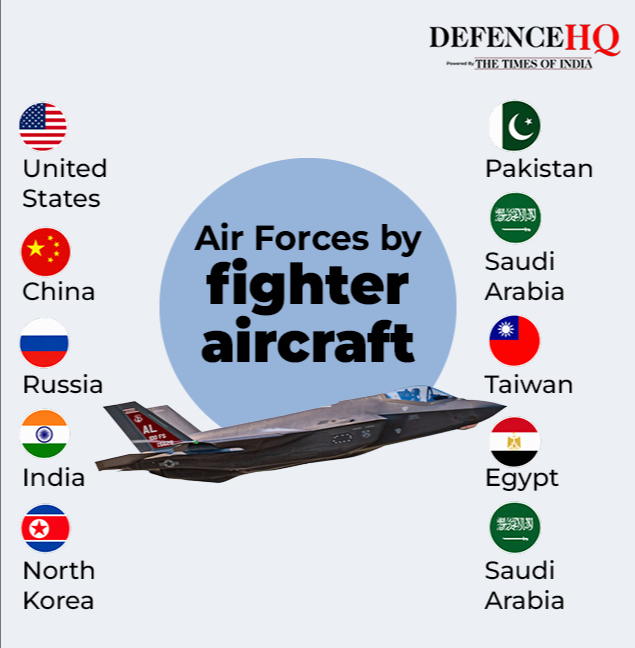
PAF is world’s seventh-largest air force
Air power also allows Islamabad to limit the scale of its operations while simultaneously signalling its intent. The PAF can carry out limited strikes against specific targets and then disengage, rather than becoming drawn into a sustained military campaign.A ground offensive, on the other hand, could risk turning the conflict into a full-scale war, with potentially far greater political and diplomatic consequences for Pakistan, including increased international pressure and the possibility of sanctions.
A ‘graveyard of empires’
Afghanistan is often described as a “graveyard of empires”, a relatively modern moniker referring to how major powers have failed in establishing and sustaining control over the country. Among them are the British, the Soviet Union and, more recently, the United States.That narrative is rooted partly in the geographical challenges posed by the region’s rugged and mountainous terrain. The Hindu Kush mountain range runs across much of Afghanistan, while the Safed Koh range extends along parts of its eastern border with Pakistan.According to experts, such terrain not only makes it difficult for conventional forces to move through and hold territory, but also provides favourable conditions for guerrilla warfare.Hence, this works in favour of the Taliban, which, in addition to its knowledge of local geography, has decades of experience fighting militarily superior adversaries through guerrilla and other asymmetric tactics. The group could inflict significant casualties on Pakistani troops while making it harder for Islamabad to sustain a ground offensive in unfamiliar and difficult terrain. Pakistan could therefore face a prolonged campaign against combatants well versed in hit-and-run attacks.Air power presents a fundamentally different proposition. With aerial strikes, Pakistan can hit locations inside Afghanistan without requiring large numbers of soldiers to physically enter and hold the terrain. While mountainous geography can also pose challenges for the air force, Islamabad could still avoid the far greater logistical and military burden of a ground campaign.
Should Pakistan consider launching a ground offensive in Afghanistan?
3k+ users shared opinion today
5k+ users already voted today
3k+ users shared opinion today
The human and financial cost of a ground war
For Pakistan, a ground offensive would also come with significant human, financial and logistical costs. The experience of the US-led Operation Enduring Freedom in Afghanistan illustrates how a campaign that began with overwhelming military superiority eventually evolved into a prolonged conflict. Between 2001 and 2021, the United States spent an estimated $2.26 trillion on the war in Afghanistan, according to Brown University’s Costs of War project.But the financial burden was only one part of the toll. The US lost 2,461 service members during the two-decade conflict, while thousands more were wounded. The war also required a sustained deployment of troops, extensive logistical networks and significant resources to maintain military operations thousands of kilometres from the United States.For Pakistan, with its struggling economy, the financial burden of sustaining a prolonged ground campaign would be significant. Analysts agree that neither side has the “will or capacity to engage in protracted wars.”Logistically, Pakistan, as an immediate neighbour of Afghanistan, would not face the same geographical and financial burdens as the United States. Nevertheless, a ground offensive would require Islamabad to deploy and sustain troops inside Afghan territory, protect supply lines and military positions, and potentially absorb casualties over an extended period. The longer such an operation continued, the greater the demands on Pakistan’s military and economy would become.Against these costs, air strikes offer Islamabad a way to pursue its military objectives without committing to the financial and logistical demands of a prolonged ground campaign.
Air power: Pakistan’s strategic calculus?
For Pakistan, the choice between air power and ground forces ultimately comes down to the nature of the response it wants to mount. Air strikes allow it to respond to developments along its Afghan border without fundamentally changing the character of the confrontation. A ground offensive, on the other hand, could trigger a major escalation, with consequences extending well beyond the battlefield.This distinction may help explain why Pakistan has so far stopped short of sending ground troops into Afghanistan.For now, therefore, Islamabad appears to be pursuing a strategy of pressure without occupation. Whether this can produce the desired changes in the behaviour of the Taliban — or even the TTP — remains an open question. But its continued preference for air strikes suggests that Pakistan sees value in keeping the confrontation limited rather than allowing it to develop into a wider war.