

Jeffery Archer’s passing almost feels like a personal blow to millions. He wasn’t just an author, but an enigma with which many associated. Jeffrey Archer lived a life that could itself have been lifted from one of his novels. There was ambition, wealth, politics, glamour, betrayal, financial ruin, prison, reinvention and, finally, extraordinary literary success. For millions of readers, however, Archer will be remembered less for the scandals that surrounded him than for the books that made him one of the world’s most commercially successful storytellers.Archer died on October 5, 2026, at the age of 86, just before the release of what was described as his final novel, Adam & Eve. His career had stretched across nearly five decades and produced novels, short-story collections, plays and non-fiction. His official website puts his international sales at more than 300 million copies, with his books published in more than 100 countries and translated into more than 40 languages.From athletics to politicsJeffrey Howard Archer was born in London in 1940 and grew up in Somerset. He attended Wellington School before going to Brasenose College, Oxford, where athletics became an important part of his early life. He earned an Oxford athletics Blue, became president of the university athletics club and represented Great Britain as a sprinter. Archer was elected to the Greater London Council and, in 1969, became the Conservative Member of Parliament for Louth at the age of 29. His political career initially appeared promising.But financial problems changed the direction of his life. After investing heavily in a Canadian company that subsequently collapsed, Archer was left with substantial debts. He resigned from Parliament in 1974 while facing bankruptcy. According to his official biography, he was determined to repay his creditors and, at the age of 34, began writing his first novel, Not a Penny More, Not a Penny Less.That decision effectively created the second and far more successful half of his career.The book that changed everythingNot a Penny More, Not a Penny Less was published in 1976. It did not immediately become a sensation. Archer himself later recalled that the first edition sold only around 3,000 hardbacks and that there was no immediate bestseller-list success. But the book travelled through word of mouth. Readers recommended it to friends, and its popularity grew steadily. By the end of the decade, it had become a bestseller and eventually sold millions of copies. Three years later came Kane and Abel, the novel that would establish Archer internationally.Kane and Abel became one of his signature works and introduced generations of readers to his particular brand of commercial storytelling.The politics of ambitionArcher never completely abandoned politics. His experiences in Westminster became material for First Among Equals, a political novel published in 1984. The book follows four politicians competing for the highest office in Britain and draws on Archer’s first-hand understanding of political life. His political career itself had another dramatic chapter. He returned to prominence within the Conservative Party and was appointed deputy chairman in the 1980s. In 1992, he was made a life peer.But his public career eventually collapsed again. A 1987 libel case and a subsequent perjury conviction became the most damaging episode of his life. In 2001, he was sentenced to four years in prison for perjury, serving just over two years. Even prison became part of his literary story. Archer subsequently wrote A Prison Diary, documenting his experiences in prison. The work gave readers an unusually personal view of the man behind the bestselling novels and demonstrated another defining characteristic of his career: his ability to turn even extraordinary personal setbacks into material for storytelling.What made Jeffrey Archer’s writing distinctive?Archer was not primarily interested in literary experimentation. His great strength was storytelling. His novels are generally built around highly accessible themes: ambition, money, power, love, revenge, social mobility, family and betrayal. His characters frequently occupy worlds that fascinate readers -politics, banking, business, art, law, journalism, aristocracy and international crime. He also understood the importance of a strong premise.That clarity is one reason his books have travelled so successfully across cultures. His writing is also deliberately fast-paced. Chapters tend to move the story forward rather than dwell extensively on description or philosophical reflection. Dialogue, reversals and revelations keep the narrative moving. Above all, Archer mastered the cliffhanger. He frequently ended chapters or sections at precisely the point when the reader most wanted an answer. The technique is simple, but difficult to sustain across hundreds of pages. Archer made it central to his storytelling identity.His short stories demonstrate another side of his craft. Collections such as A Quiver Full of Arrows, A Twist in the Tale and Twelve Red Herrings became known for their reversals and surprise endings. His official biography notes that several stories from A Quiver Full of Arrows were adapted for television.A storyteller who wrote for the readerOne of Archer’s greatest achievements was understanding the psychology of the popular reader. He did not write as though readers were sitting an examination. His books were designed to entertain. He wanted readers to become emotionally invested in characters and impatient to discover what happened next. This approach sometimes placed him at odds with literary critics. Archer was a commercial novelist rather than a writer primarily associated with literary prestige. Yet the scale and durability of his readership are difficult to dismiss.His official website says he became the only author to reach number one with fiction, short stories and non-fiction, while his career accumulated dozens of international bestsellers. His later work showed that his storytelling instincts had not diminished with age. At 70, he embarked on The Clifton Chronicles, a seven-book family saga beginning with Only Time Will Tell. The series follows generations of two families through much of the 20th century.The first book reached number one in India and the subsequent volumes became major international bestsellers.His special relationship with Indian readersArcher had a particularly strong readership in India. For many Indian readers who grew up in the 1980s and 1990s, his books offered an accessible doorway into worlds that seemed distant: British politics, American business, international finance, espionage, elite universities, art and high society.His books were widely circulated and recommended by word of mouth. Kane and Abel, The Prodigal Daughter, Not a Penny More, Not a Penny Less and later The Clifton Chronicles became familiar titles among generations of Indian readers.The cultural impact went beyond sales. Archer’s books helped create a particular kind of aspirational popular reading: stories about ordinary or disadvantaged people attempting to cross boundaries of class, wealth and circumstance. An Indian Express remembrance described his novels as a window for India’s 1980s generation into worlds of power, wealth and international institutions.The complicated man behind the booksArcher’s legacy cannot be separated entirely from his controversies. His public image was flamboyant and sometimes larger than life. His political career was repeatedly damaged by scandal, and his conviction for perjury resulted in imprisonment. His life contained the very ingredients , ambition, deception, reversals and dramatic consequences, that populated his fiction. That contradiction became part of his fascination.The man who wrote relentlessly about characters attempting to escape impossible circumstances had repeatedly reinvented himself in real life. Politician became novelist. Disgraced public figure became bestselling author again. Prisoner became author of prison diaries. A writer who had already achieved extraordinary success continued producing books deep into his eighties.His lasting impactJeffrey Archer’s greatest contribution may be his demonstration of the power of storytelling itself. He showed that a novel did not necessarily need to be stylistically revolutionary to become culturally significant. A compelling plot, memorable characters, emotional stakes and relentless narrative momentum could create an enormous global readership. He also demonstrated the international portability of a good story. His novels moved across countries and languages because their central themes were universal: ambition, family, love, betrayal, wealth, rivalry and the desire to change one’s circumstances.His influence is therefore less about a particular literary school and more about popular narrative technique. For aspiring writers, Archer’s career offers an important lesson: readers keep turning pages when they care what happens next. That was his great gift.
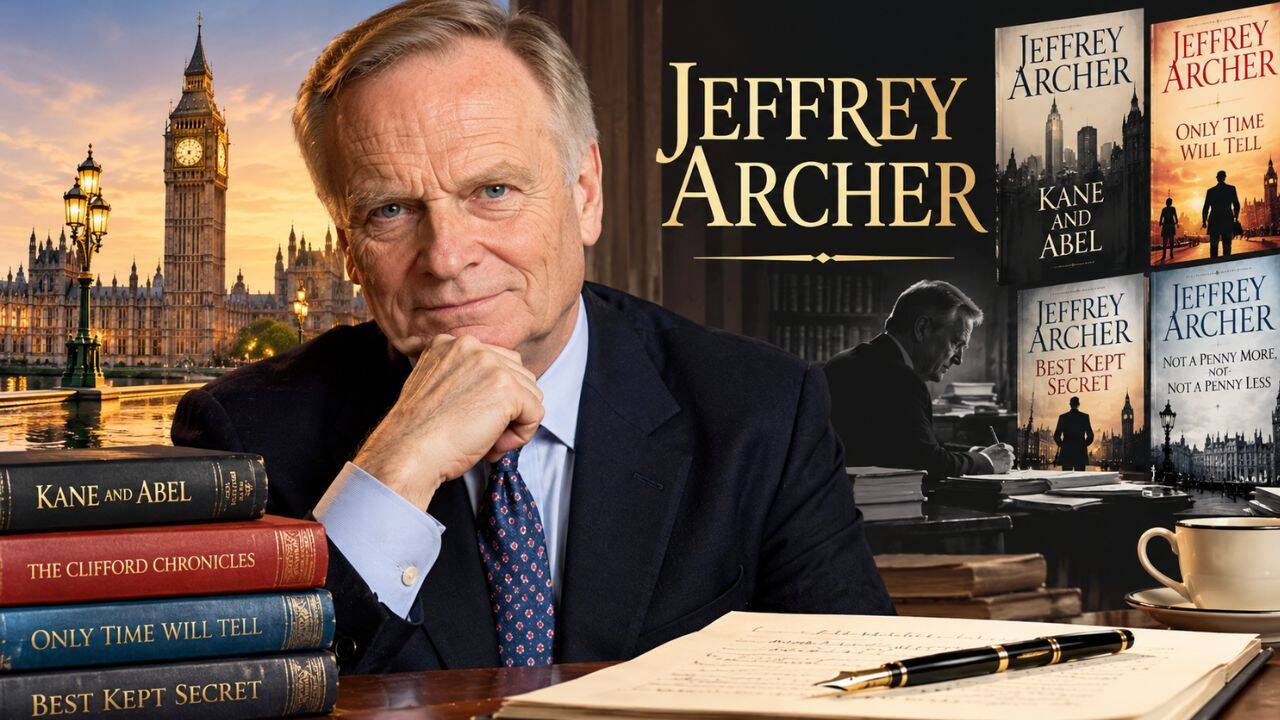
Jeffery Archer
Whether writing about rival businessmen in Kane and Abel, politicians in First Among Equals, con artists in Not a Penny More, Not a Penny Less, prisoners in A Prison Diary, families across generations in The Clifton Chronicles or detectives in his William Warwick series, Archer understood the architecture of suspense.His final novel, Adam & Eve, returns to another of his enduring interests: two people from radically different worlds whose lives become connected by history and circumstance. The official site describes it as a story beginning on Armistice Day in 1918, when a shepherd’s son and an Earl’s daughter are born within hours of each other.It is an appropriate final chapter for a writer whose own life was defined by unlikely turns. Jeffrey Archer was never simply a novelist, and he was certainly never simply a politician. He was a public personality who turned his extraordinary experiences, successes as well as failures, into stories. His books may not have always satisfied literary critics, but they achieved something arguably more difficult: they made millions of people want to keep reading. And that is why, decades after Kane and Abel first appeared, Jeffrey Archer remained what he most wanted to be remembered as: a master storyteller.Quote of the DayOne of the most iconic quotes of Jeffery Archer is, “A strong man who has known power all his life may lose respect for that power. But a weak man knows the value of strength.The meaning of “A strong man who has known power all his life may lose respect for that power. But a weak man knows the value of strength.”The quote, “A strong man who has known power all his life may lose respect for that power. But a weak man knows the value of strength,” explores a paradox about power, privilege and human nature. At its heart, it suggests that people who have always possessed strength may take it for granted, while those who have experienced vulnerability understand its importance far more deeply.A person who grows up with power rarely has to think about what it means to live without it. Strength becomes an ordinary part of life. A powerful person may have influence, money, physical ability, social status, authority or confidence. Because these advantages have always been available, they can begin to feel natural rather than extraordinary. Over time, the person may stop recognising their value.This is the first idea contained in the quote: familiarity can create indifference.Imagine someone who has always been financially secure. They may never have experienced the anxiety of choosing between paying a bill and buying food. As a result, they might not fully understand what financial security means to someone who has struggled. Similarly, a person who has always been physically strong may not appreciate how frightening physical vulnerability can feel. Someone born into influence may not understand how difficult it is for an ordinary person to make their voice heard.Power can therefore become invisible to the person who possesses it. The second half of the quote presents a striking contrast. “A weak man knows the value of strength.” Someone who has experienced helplessness is often intensely aware of what strength could change. A person who has been ignored understands the value of having a voice. Someone who has been dependent understands the importance of independence. A person who has experienced failure may appreciate confidence and opportunity more than someone who has always succeeded.Weakness, in this sense, does not necessarily mean physical weakness. It can mean vulnerability, disadvantage, insecurity or lack of control. The quote therefore asks us to consider an important question: Do we value something because we possess it, or because we know what life would be like without it?