
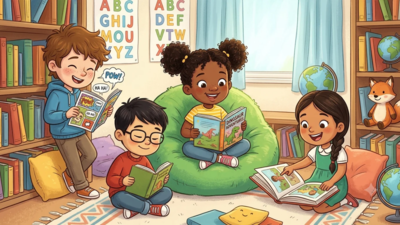
In a village library in Karnataka, a librarian opens a picture book and starts to read. She changes her voice for each character. She stops at the pictures. She asks what happens next.The children who used to walk past the door are sitting on the floor. Within minutes they are interrupting, guessing, laughing.
5 Oct 2026 | 12:06
Parents, when your child refuses to greet relatives, do you make them say hello or respect their choice?
The next week, they come back.We tend to think of early literacy as a sequence: recognise letters, connect sounds, read words, build sentences. All of it matters. But something has to happen before any of it. A child has to decide that language is interesting, that the story belongs to her, that the book is a place she wants to go.By the time we start counting, the gap has already opened. The OECD’s 2025 International Early Learning and Child Well-being Study assessed 23,000 five-year-olds across eight jurisdictions: Korea, England, Malta, the Netherlands, the Flemish Community of Belgium, the UAE, and parts of Brazil and Azerbaijan. India was not among them, and the systems it covers look nothing like ours. What it found travels anyway: socio-economically advantaged five-year-olds scored 60 to 70 points higher than disadvantaged children in emergent literacy and numeracy. That distance exists before a single year of formal schooling is complete.Whatever narrows it has to happen early, and it has to happen outside the classroom as much as inside it.This is the premise behind the early-literacy and Read-Aloud work in our ecosystem and the initiatives of Adhyayan Foundation, Librarians of India, Pratham Books, Room to Read and so many more. The method is almost embarrassingly simple: put good books into children’s hands, and help the adults around them make those books come alive.The adult need not be a school teacher. A librarian is perfect. So is a Anganwadi worker, a parent, a grandparent, a neighbour who volunteers, a community worker, anyone!A Read-Aloud guide titled “How to Read Aloud – A Guide” is a practical resource developed by Adhyayan Quality Education Foundation that is meant for librarians, parents, grandparents, caregivers and anyone who wants to introduce children to books through reading aloud. The guide asks adults to do things almost anyone can do.Look at the children while you read. Change pace and expression. Pause. Ask curiosity questions. Let the conversation wander.None of it sounds revolutionary. But we adults have a habit of turning a story into a lesson.What colour is the ball? What is the moral of the story? Spell elephant. Now tell me what you learnt.Ask enough of those, and the story stops being fun.Reading aloud offers the alternative. A child notices something in a picture the adult missed. She predicts a wildly different ending. She laughs at a character without having to explain why. She retells the whole thing in her own words.This is how literacy starts.Every Story, Every Reader, an activity toolkit for the early years, pushes that further. It begins from a definition of reading far wider than decoding: “talking, wondering, making, moving, creating, questioning, imagining, and connecting.”What I like is how ordinary the activities are. A story becomes a Story Walk, where children move from one illustrated page to another and reconstruct the narrative. A word from the book becomes a game of Clap the Syllables. A character’s expression opens a Feelings Circle where children learn to name what they feel. The toolkit explicitly welcomes children’s home languages and code-switching, and is built for classrooms, libraries, book clubs and community spaces alike.The story does not end when the last page is turned. It spills into play, movement, conversation and imagination. The lesson: don’t ask children to leave childhood at the door in order to learn to read. Use childhood itself as the way in.
What happened to the librarian
Karnataka’s Gram Panchayat libraries show the idea at scale. What began as an effort to help librarians run read-aloud sessions became something larger: thousands of libraries turned into places where children could meet books and stories regularly. Bachpan Manao network documentation records around 5,900 libraries revitalised, engaging roughly 118,000 children.The number is not the interesting part. The librarians changed. Programme accounts describe people who had seen themselves as custodians of books beginning to see themselves as capable of gathering a community around reading.A librarian in Kodagu described children arriving to register themselves, and families asking what was happening at the library. In Tumakuru, M.K. Sheela described children’s visits rising after the training, and the community beginning to see the library — and her role in it, differently.It went far enough that the librarians’ own experiences turned into a children’s story: Kathe Chikkappa, or Story Chikkappa.It is worth asking why a library, rather than more hours in a classroom, might be where this happens. The OECD study found that longer participation in early education is associated with stronger outcomes — but no more so for disadvantaged children than for advantaged ones. Since disadvantaged children attend less, in less quality-assured settings, the system as it stands is not positioned to close the gap. More of the same, delivered evenly, keeps the distance intact. What a library session can do is change something a school timetable does not measure: a child’s relationship with reading.The child’s language, inside the child’s bookChildren do not arrive at literacy empty. They arrive carrying songs, phrases, jokes, family conversations and entire worlds, in the languages spoken around them. Making early-reading material available across languages — and enabling people to translate and adapt stories themselves — tells a child something she needs to hear early:Your language belongs inside a book too.None of this makes phonemic awareness, decoding, vocabulary or fluency optional. They are essential. And rising participation is not evidence of improved learning. We need long-term measurement of what these approaches do to comprehension and reading ability, and we do not yet have enough of it.But we might also measure what we currently ignore.Does she reach for a book without being told? Does she ask for the story again? Does she tell it to someone else? Does the library feel like hers?The OECD data suggests these are not soft questions. Even among disadvantaged five-year-olds, roughly 15% performed strongly in emergent literacy and numeracy — children the study calls developmentally resilient. The ceiling disadvantage imposes is not fixed. Something in some children’s early lives is already doing the work we are trying to design at scale.It usually begins with something ordinary. An adult opens a book. A few children shift closer. A question reels them in.“What do you think happens next?”Deepika Mogilishetty is Chief of Policy and Partnerships, EkStep Foundation