
Workday, an enterprise AI platform, is pitching a replacement for the traditional artificial intelligence (AI) interface with an autonomous AI layer—while warning the enterprise world against “lawless” AI. This is a pivotal moment for an agentic AI vision in a workplace where AI agents will increasingly anticipate needs, coordinate with other agents as necessary, and carry out much of the work themselves. So much so, Workday is shifting terminology from copilots to autopilots.
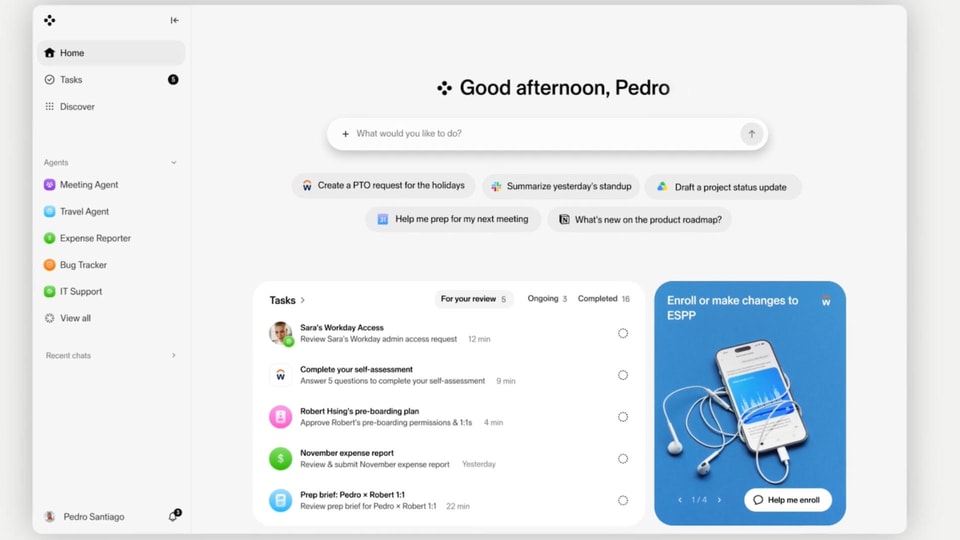
The company warns that while a 10% productivity gain from an AI chatbot is no longer enough, the upgrades must be implemented responsibly because ungoverned AI agents are a liability. That is the foundation for Workday’s new AI capabilities. At the centre is Sana, the AI platform Workday acquired last year, which will become the default home screen for its enterprise software.
“These are not bolted on. They’re built into the platform, grounded in our data, business contacts, and designed to work within the guardrails. So customers can put AI to work, and they know it’s done in a safe and trusted way,” says Aneel Bhusri, CEO of Workday, in a briefing on the sidelines of their annual Workday Rising keynote.
Bhusri returned to the role a few weeks ago, after a stint as Chairman, and framed the culture as the biggest attraction. “They’re bringing that startup energy and passion that is very exciting for me and brought me back out of the Chairman role, back into the CEO role. It’s actually the energy that is required at this moment in time,” he says about the teams developing the tech that will be announced at the Rising keynote.
“The key principle for us is we don’t believe AI is a game of quantity. It’s not going to be about who has the most AI, but who is going to put it best to work,” explains Gerrit Kazmaier, President, Technology and Product, at Workday. Kazmaier’s distinction between incremental improvements and a fundamental restructuring of processes is central to the company’s strategy.
The new approach builds with workforce intelligence and decision intelligence. “We don’t believe in the bolted-on model. We don’t believe in side assistants and basically make everything you do 10% better. We believe in a 10X transformation of every process,” he says. Workday insists humans in an organisation would spend less time navigating applications and managing routine administrative processes, and more time reviewing outcomes, making decisions and handling exceptions.
The first tangible illustration of this approach is Sana itself. Sana is Workday’s agentic experience and orchestration engine. Workday intends to replace the familiar interface of menus, forms and separate workflows with an AI-first experience that understands employees’ roles and the business context in which they operate. That doesn’t mean conventional interfaces disappear altogether. Rather, Sana can dynamically assemble an interface suited to the task, including scheduling meetings and approving requests.
“AI is the new UI”
Joel Hellermark, Chief AI Officer at Workday demonstrated Sana’s new dynamic user interface powered by a high-speed classification model from TypeSafe AI called Jev. This model was released in September, and has caught attention as a decision model with a unique architecture that outputs structured probabilities Instead of a static UI, Jev can generate the interface in real-time. For instance, as an employee types a query about a pay-check, an org chart, or a vacation request, the interface moulds itself before the sentence is even finished—rendering interactive date pickers, calendar views, or approval buttons on the fly.
Beneath the workflow automation lies a deeper structural thesis about how enterprises are reorganising around AI. Yasmine Ahmad, Senior Vice President and General Manager of Data Cloud at Workday, argues that most companies struggle to measure AI’s impact because they are still looking at static org charts.
For instance, an employee can query Sana inside Microsoft Copilot to model a planning decision. Sana will then check for permissions, contextualise with company data to compare the choices, and prepare a plan with a full audit trail. For any approvals needed along the way, Sana gathers context and suggests a clear recommendation for further human action.
A new capability called Workday Work Intelligence breaks down an organization’s roles into granular tasks. It is a planning as well as reasoning experience built for decisions that may otherwise be complex and cross-functional. Workday says that every organisation using AI must periodically ask whether it is working.
Workday says self-service with Sana is generally available now in Google Cloud Gemini Enterprise, Microsoft Copilot, Microsoft Teams, and Slack. Sana in Claude Cowork is available today in early access, while Sana in Copilot Cowork is expected to be available in early access later this year.
“Headless can’t mean lawless”
Workday warns against using third-party workspaces, centralizing analytics in platforms like Snowflake or Tableau, and connecting enterprise software via custom Model Context Protocol (MCP) servers or exported data lakes.
In a demonstration, Workday showed how someone using a naive custom MCP connector in Claude or querying an exported Snowflake data lake could accidentally view sales department job requisitions, expose the CTO’s salary, or transfer an account executive to an engineering team without triggering a single approval workflow. “This is really important. Pointing an agent at a lake feels like the obvious next step for every company with a data strategy. But what’s happening is it’s quietly turning a governed system like Workday into an ungoverned one,” noted Gabe Monroy, Chief Technology Officer, Workday.
“You can export the data but you cannot export the rules that govern the data,” Monroy summarises. “Headless can’t mean lawless,” he says.
For Bhusri, the bigger picture—encompassing 80 million users, processing more than 1.4 trillion transactions in just the last year, and a platform built for over 20 years—is clear: foundation models may be commodities, but twenty years of clean, permission-driven enterprise context is not.
“It’s important that whatever AI does in the enterprise has the right permissions, the right security, and the right business rules, that customers depend on,” he says. For businesses adopting the next generation of AI in the workplace, an important question is not simply how much work can be automated but whether every agentic action is explainable, whether there is an authority monitoring those actions and what happens when judgement goes wrong.