
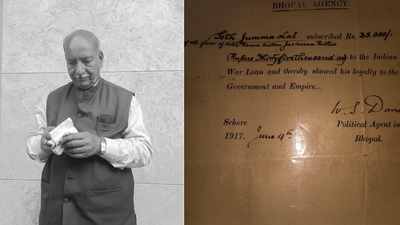
BHOPAL: The UK’s Debt Management Office (DMO) has said it can find no evidence that a 109-year-old Indian War Loan, in which a Bhopal merchant invested Rs 35,000 in 1917, was or is an obligation of British govt, leaving a Madhya Pradesh family’s claim unresolved. The office did not say whether the money was repaid.“We have investigated and can find no evidence that the loan you refer to was or is an obligation of the UK govt,” DMO said in an email dated Oct 16.It was replying to Shreyansh Raniwala, legal counsel for the family of Vivek Ruthiya (63) of Sehore.Although the email is not a judicial finding on the family’s claim, and DMO has not acknowledged any outstanding debt, the reply has drawn a sharp reaction from social activist Vinay Ruthiya, who asked why the British authorities had given no account of the loan’s repayment or settlement.Ruthiya said the family had authenticated the available records and sent them through its counsel. He argued that British govt should clarify whether the subscription appears in historical financial records and, if so, how the liability was accounted for.“If the loan was repaid, there should be a record showing when and how it was settled. We submitted the documents they asked for, including the historical certificate. We want a clear answer on what happened to the money,” he said.The family had sought repayment of the Rs 35,000 subscription made to Indian War Loan. It maintains that the amount was never repaid and has been seeking an official account of what became of the investment.The claim rests on a certificate dated June 4, 1917. It records the subscription by Seth Jumma Lal Ruthia of the firm Seth Rama Kishan Jaskaran Ruthia, in the princely state of Bhopal, and bears the signature of W S Davis, then political agent in Bhopal.According to the family, the instrument carried interest at 5.5%, and the certificate has remained among its papers for more than a century.Seth Jumma Lal Ruthia died in 1937, a decade before British rule in India ended.The certificate gives the family a documentary basis for its claim. By itself, however, it does not prove that a debt remains outstanding or that present-day UK govt is legally liable for it. The family estimates that the original sum, compounded at 5.5% a year for 109 years, could run to several crores of rupees today.A calculation based on the rise in gold prices, it suggests, could exceed Rs 10 crore.War loans in British India were govt-issued debt instruments floated to raise funds from the public to finance military expenditure, especially during World War I.Marketed as patriotic investments, they encouraged citizens, traders and institutions to lend money to colonial govt for war efforts including military supplies and troop payments in return for fixed interest.During the British era, a political agent was a key administrative and diplomatic representative of the Crown in princely states.These officers managed relations with local rulers, supervised governance matters and ensured alignment with British authority. Historians also note that W S Davis, who had signed the bond certificate, had literary associations in Bhopal.He apparently had translated Hayat-i-Qudsi: Life of the Nawab Gauhar Begum, a biography written by Sultan Jahan Begum and published in 1918.