
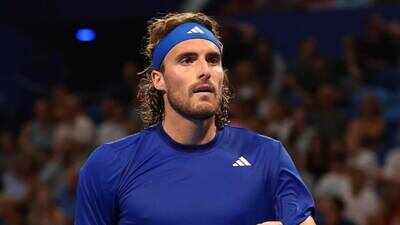
ALMATY: Stefanos Tsitsipas folded his 6 ft 4’ frame into a sofa in a busy corridor at the Almaty Open.The 28-year-old, once ranked as high as No. 3 in the world and now at No. 39, acknowledged that his road back began with letting go. Letting go of the pressure, the tension and the expectations that have weighed on him. And, most importantly, allowing his father to be a father again, rather than having to be both father and coach.Tsitsipas, who finished in the Top-10 for five consecutive years, from 2019 to 2023, believes he is playing better tennis now than he was a few years ago, when he reached two Grand Slam finals, at Roland Garros in 2021 and the Australian Open in 2023.The dip in form began with his body, a back problem that had been troubling him for some time, compounded by a strained coaching relationship with his father, Apostolos. The combination took its toll on his confidence, and by June his ranking had plummeted to No. 88.Just before Wimbledon, Tsitsipas told Greek media that he was ending his professional relationship with his father for good.“I love my father, and I love him as a father,” he said in Almaty. “I want to keep the professional part out of my relationship with my father. My relationship with him has improved now that he’s not my coach. It was very difficult for me to separate the coach and the father. I had reached a point where I could not avoid being triggered.”“We’re still in touch, and I really like the way things are right now,” he added.That separation appears to have given Tsitsipas something he had been missing, room to breathe. The weight of expectation and the tension of a relationship complicated by professional demands had produced disturbing scenes at tennis tournaments around the world, a father in his fifties hurling instructions at his son, sometimes leading to heated exchanges between the two.“Eliminating the pressure factor does help,” he told TOI at the Almaty Open. “Before, I felt pressured a lot of the time. There were a lot of things piled up within me, and certain people triggered me in a negative way. Removing some of those triggers, and having people around me who keep me calm and help me be more forgiving (on myself) when things don’t work out, allows me to experiment more and not be afraid to try things.”For Tsitsipas, that freedom is essential for growth.“When you feel judged, you tend to go for the safe options. And safety is not always where growth is. You need a team that isn’t going to judge you for what you do, but will analyse it and support you, because it’s all part of the process.”The numbers suggest that the process is beginning to pay off. Across his first 16 events of the season, Tsitsipas went 16-14. In the 10 tournaments since Wimbledon, he has gone 21-8, winning the title in Gstaad in July to end a 16-month drought.Now working with Thomas Perrin, and with Patrick Mouratoglou overseeing the process, he believes his tennis is better than it has been in years.“I’m playing better now than I played a few years back,” he said.“I feel like I was kind of stuck in the past. Certain aspects of my game weren’t properly structured, and there wasn’t really a base to build on.”Since August, he has beaten Arthur Fils, No. 11 (then ranked), Jiri Lehecka, No. 19, Tomas Etcheverry, No. 30, Luciano Darderi 21, and Taylor Fritz, No. 12.One of the most revealing signs of that progress concerns his backhand. One of only three players in the top 50 to use a single-handed backhand, alongside Lorenzo Musetti and Denis Shapovalov, Tsitsipas has increasingly found opponents targeting that side of the court.“My backhand is probably even better than my forehand right now. I’ve played some really good matches and used it as an actual weapon on court. Against (Daniil) Medvedev recently, I used it to approach the net, slice, change pace and rhythm, play down the line and open up the court. There’s more variety now, whereas before it felt like one-way traffic.”Range matters. Tsitsipas knows opponents will continue to target his backhand, but he feels better equipped to respond, using changes of pace, depth and direction to keep them guessing rather than allowing them to dictate play.For Tsitsipas, the way forward is about rediscovering the freedom to play on his own terms, with a clearer mind and a game he believes in again.