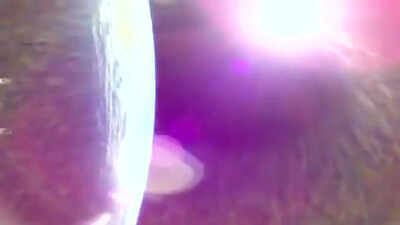
A new video released by Nasa captures a defining moment of the Artemis II mission, the ignition of the Orion spacecraft’s main engine. The footage posted on social media by the space agency shows the service module engine firing in deep space, marking a crucial step as the spacecraft begins its journey toward the Moon.The Orion spacecraft ignited its main engine for nearly six minutes, producing about 6,000 pounds of thrust. This powerful maneuver placed the astronauts on a precise path toward the Moon and set up a ‘free return trajectory,’ allowing them to loop around the Moon using its gravity and safely return to Earth.After receiving a “Go” from mission control, Orion fired its engine for five minutes and 50 seconds to complete the translunar injection (TLI) burn. This critical maneuver pushed the spacecraft out of Earth’s orbit and onto a trajectory toward the Moon.At the time of the burn, Orion weighed about 58,000 pounds and used nearly 1,000 pounds of fuel. The engine’s thrust is so powerful that it is comparable to accelerating a car from 0 to 60 miles per hour in just under three seconds, according to Nasa’s release. This moment is significant because it marks humanity’s return to deep space travel beyond low-Earth orbit for the first time since 1972.
Life on board Orion during the journey
While the engine burn set the course, life inside Orion continues to focus on keeping the crew healthy and mission-ready. Astronauts are using a compact flywheel exercise device to maintain fitness in microgravity.Unlike the International Space Station, which houses large and heavy workout equipment, Orion carries a much smaller system. Weighing only about 30 pounds and roughly the size of a carry-on suitcase, the device still allows astronauts to perform exercises like rowing, squats, and deadlifts, generating resistance based on their effort.At the same time, ground teams are closely monitoring Orion’s life-support systems to ensure the cabin remains breathable and comfortable. Even minor issues, such as a brief communication loss after reaching orbit, were quickly identified and resolved without impacting the mission.
Preparing for a historic Lunar Flyby
Following the engine burn, Nasa’s lunar science team began planning what the astronauts will observe during their flyby of the Moon. During a six-hour observation window, the crew will study features such as craters, ancient lava flows and surface fractures that hold clues to the Moon’s formation and the history of the solar system.One of the most remarkable events during this phase will be a solar eclipse lasting nearly an hour. As the Sun moves behind the Moon from Orion’s perspective, the crew will witness a darkened lunar surface and may even observe meteoroid impacts, dust movement and distant planets. They will also get a rare view of the Sun’s outer atmosphere, known as the corona.Artemis II is not just another spaceflight. It carries four astronauts: Reid Wiseman, Victor Glover, Christina Koch and Jeremy Hansen on a journey nearly 248,000 miles from Earth.The mission will last around 10 days, taking the crew thousands of miles beyond the Moon before looping back to Earth using the Moon’s gravity.
Why does this Engine burn matter?
The ignition of Orion’s main engine is more than just a technical milestone. It is the moment that transforms Artemis II from an Earth-orbit mission into a true deep-space journey.This burn validates the performance of the Space Launch System rocket and Orion spacecraft, both of which are designed to carry humans farther than ever before since the Apollo era.It also tests critical systems such as navigation, propulsion, and life support, all essential for future missions.The success of this maneuver lays the groundwork for upcoming missions that aim to land humans on the Moon again and eventually send astronauts to Mars.