
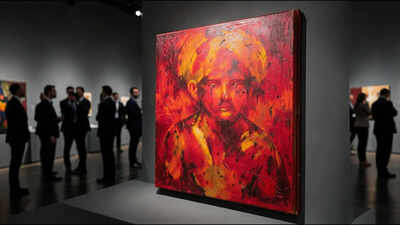
A Mark Rothko painting on paper acquired by Theodore and Ruth Baum in 1983 is set to co-lead a Sotheby’s auction in New York this November, more than four decades after it entered their collection. The red-and-orange 1967 work carries a $10 million to $15 million estimate, matching the estimate for Ed Ruscha’s Dimple (1964). The Rothko marked the beginning of the couple’s contemporary-art collecting, which grew to encompass postwar abstraction, Pop Art and experimental European works. Sotheby’s will offer more than 20 works from the collection in a dedicated evening auction on November 16, followed by a day auction on November 17. The auction house estimates that sales from the wider collection will exceed $100 million, with additional works scheduled to be offered through 2027.
Mark Rothko’s 1967 painting became a turning point in the collection
The Rothko painting was the Baums’ first contemporary-art acquisition, according to Sotheby’s. The auction house describes the work as a catalyst for their contemporary collecting, although their broader collecting activity had begun earlier. The painting’s red and orange composition reflects Rothko’s exploration of colour and abstraction. Its place in the collection also connects it to a wider group of works that trace the couple’s interest in artists who challenged established approaches to painting and visual expression.The collection includes Ed Ruscha’s Dimple (1964), a work associated with Ted Baum’s interest in wordplay, as well as Joan Mitchell’s Green Book of Barbara Guest (1960). The Mitchell work had remained in the collection for decades and is among the pieces scheduled for the November sales.
A collection spanning postwar abstraction, Pop Art and European experimentation
The Baums’ collection developed across several artistic movements. Works by Joan Mitchell, Sam Francis and Hans Hofmann reflect their interest in postwar abstraction, while later acquisitions included pieces by Pop Art figures Tom Wesselmann and Roy Lichtenstein. Andy Warhol’s The Scream (After Edvard Munch) (1984) is another work in the collection. Its subject draws on Edvard Munch’s well-known composition, while Warhol’s version brings the image into his own practice of reworking familiar cultural imagery.The collection also extends beyond American art. It includes works by Piero Manzoni, Lucio Fontana, Yves Klein and Alberto Burri, artists associated with different approaches to material, space and the possibilities of art after the Second World War. Among the works are Burri’s GA1 (1954) and Fontana’s Concetto Spaziale, Attese (1960). Together, the works show the range of the Baums’ interests rather than a collection confined to one movement or national tradition. Sotheby’s has presented the collection as a decades-long pursuit shaped by curiosity about artists working across different generations and geographies. The couple lived with their collection in several homes, including in Palm Beach, Southampton, New Jersey and New York. In Sotheby’s account of their collecting, Ruth Baum said they “love the process and love living with the works,” describing an interest in both finding art and living alongside it.
Sotheby’s New York auction dates and exhibition details
Sotheby’s has scheduled a dedicated evening auction for November 16, 2026, followed by a day auction on November 17. The evening sale will include more than 20 works from the collection. Additional pieces are expected to be offered through 2027. The collection’s estimated total of more than $100 million applies to the wider group of works being sold across the planned auctions, rather than only to the November evening and day sales. Sotheby’s New York exhibition for the collection opens on November 7, with further public viewing dates scheduled through November 15. Details, including sale information and exhibition timings, are available on the official auction page. Ted Baum died in 2021, and Ruth Baum died in 2026, according to ARTnews. The collection’s upcoming sale brings works that remained in their possession for decades to auction, including the Rothko painting that became a defining moment in their contemporary-art collecting.