

NEW DELHI: Five years after govt allowed the Employees Provident Fund Organisation (EPFO) to invest in alternate investment funds (AIFs), the retirement savings body is now working to come up with guidelines to enable its investments in these high-growth asset classes and startups.A proposal to allocate up to 3% of its fresh annual accretions into category I and category II AIFs regulated by the Securities and Exchange Board of India (Sebi) was discussed in the investment committee (IC) meeting last Thursday, TOI has learnt. In Sept, department for promotion of industry and internal trade (DPIIT) wrote to EPFO seeking participation in the recently-launched Startup India Fund of Funds 2.0.
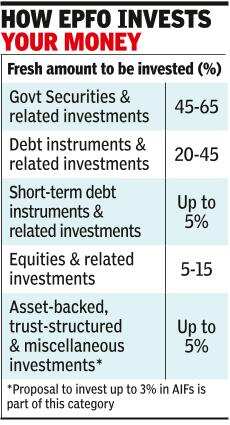
That provided the context to examine the broader approach towards AIF investments, persons privy to the discussions told TOI.Initially, the plan is to channel worker capital through institutional giants such as National Investment and Infrastructure Fund (NIIF) and Sidbi’s Startup India Fund of Funds 2.0. The proposal will now be discussed by the central board of trustees (CBT), led by labour minister Mansukh Mandaviya in Nov.This move marks a shift from traditional, ultra-safe debt instruments towards risk capital, aiming to potentially generate higher long-term returns for crores of its salaried subscribers. According to the pattern of investment notified by the finance ministry, EPFO can invest up to 5% of its fresh accretions in asset-backed and trust-structured investments. It is yet to make any investments in category I and category II AIFs regulated by Sebi. EPFO currently manages around Rs 30 lakh crore belonging to nearly 30 crore members.Category I AIFs are development-oriented funds that support sectors with positive economic spillovers, such as startups, small and medium enterprises (SMEs), infrastructure, social ventures, and venture capital, while Category II AIFs include private equity (PE) funds, real estate funds, and private debt funds that do not fit into Category I or III and do not use leverage or borrowing.To protect workers’ funds against market volatility, the proposal embeds strict risk safeguards such as a mandatory minimum AIF corpus of Rs 100 crore, single-fund exposure caps, strict prohibitions against foreign-incorporated investments, and a requirement that fund managers remain independent of promoters.