
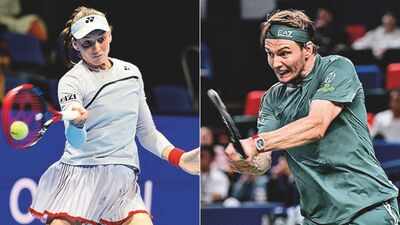
At the Almaty Arena, children as young as five waited with their parents to meet Alexander Bublik. He was delayed due to a miscommunication. Two hours after the scheduled time, they were still waiting. When Kazakhstan’s leading male tennis player finally arrived, he spent 40 minutes signing autographs, staying until every child had his signature on a cap, a ball or a jacket. A decade ago, when Kazakhstan took a chance on the 6-foot-5-inch Bublik, he was ranked around No. 500. Last week, children queued up at a luminous arena for a moment with him. “At the beginning I came here as a guest, as a foreigner,” Bublik said, replying to a question from TOI. “I was just a guy who was brought to the team, in a way, and along the way I developed an emotional connection with the people, with the country.”That journey from recruit to someone a country cheers as its own is at the heart of Kazakhstan’s tennis story. Its leading man, Bublik, and women’s world No. 1 Elena Rybakina were both born in Russia. Rybakina became the first player representing Kazakhstan to top the world rankings in Sept. Their beginnings were less grand. For Rybakina’s family, the dilemma was one many Indian parents would recognise: pursue an uncertain sporting career or secure an education? In a 2020 interview with the WTA Insider, she recalled having about 15 offers from American universities. Her father wanted her to take that route. Money was tight; an injury could undo everything. “My dad really wanted me to go,” she said.Then Kazakhstan offered support, making the decision easier. She switched allegiance in 2018, well before becoming a Grand Slam champion. Rybakina and her parents flew to Kazakhstan to meet federation president Bulat Utemuratov, the businessman behind its tennis boom. The backing helped turn a precarious ambition into a sparkling career. She finished 2018 ranked No. 191; a year later, she was No. 37. Wimbledon followed in 2022, and 2026 brought two more major titles. Bublik, who began playing at age two under his father and childhood coach, Stanislav, joined Kazakhstan in 2016. “I needed support, I needed people who would care about me, and Kazakhstan gave me all that,” he said. The strategy paired two ambitions: to give promising players the backing to compete internationally, and to give Kazakhstan’s children heroes they could watch and emulate. Recruiting talent offered a quicker route to the first goal while courts, coaching and junior programmes developed at home.According to KTF vice-president Dias Doskarayev, the country had 60 courts 19 years ago in 2007 – the year Utemuratov took over as president of the association – with many of them in disrepair. Today, it has 412. More than 25,000 children play tennis regularly, he says, while the federation fully funds over 1,000 children, including their coaching, equipment and travel. Eva Korysheva, 16, from Aktobe in western Kazakhstan, studies Rybakina’s composure as closely as her strokes. “I admire the way she carries herself on court. She stays calm and focused,” she said.“Elena’s serve is her biggest weapon. I would love to have a serve as powerful as hers!” Kazakhstan is not alone in finding sporting success through talent born elsewhere. Qatar naturalised athletes like Saif Saaeed Shaheen and Femi Ogunode, among others. Singapore’s China-born Feng Tianwei helped its women beat China to become world team table-tennis champions in 2010. Her route to Singapore began with a sports scholarship.The harder question is what follows the imported success. Kazakhstan’s recent results at the junior level offer evidence of progress. Between 2022 and 2026, 17 Kazakhstani players competed in junior Grand Slam tournaments. Significantly, all were born in Kazakhstan. India, once an Asian powerhouse, had just nine players compete in the same period. That is an important distinction for a federation that initially relied on recruiting established players from abroad. Can admiration become participation, and participation produce champions developed at home? Kazakhstan’s investment in a grassroots programme and modern infrastructure gives that ambition a spine. For now, the connection is visible: a teenager studying a serve, a player making a junior Grand Slam semifinal, children waiting for an autograph. “I’ll do everything I can for the children, the federation and the fans,” Bublik said.