
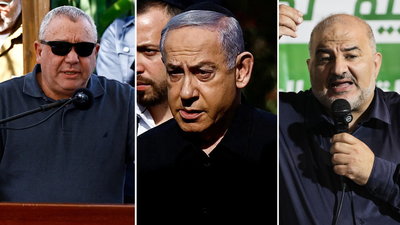
Israel is facing weeks, and possibly months, of political uncertainty after the final election results showed that neither Prime Minister Benjamin Netanyahu‘s bloc nor the opposition secured the 61 seats needed to form a government.The results have left the country with a hung parliament, with Arab-led parties potentially holding the key to the next government.According to CNN, the results released by election officials early Friday showed Netanyahu’s right-wing bloc winning 53 seats in the 120-member Knesset, while the opposition, led by centrist Yashar party leader Gadi Eisenkot, secured 48 seats. Arab-led parties won the remaining 19 seats.
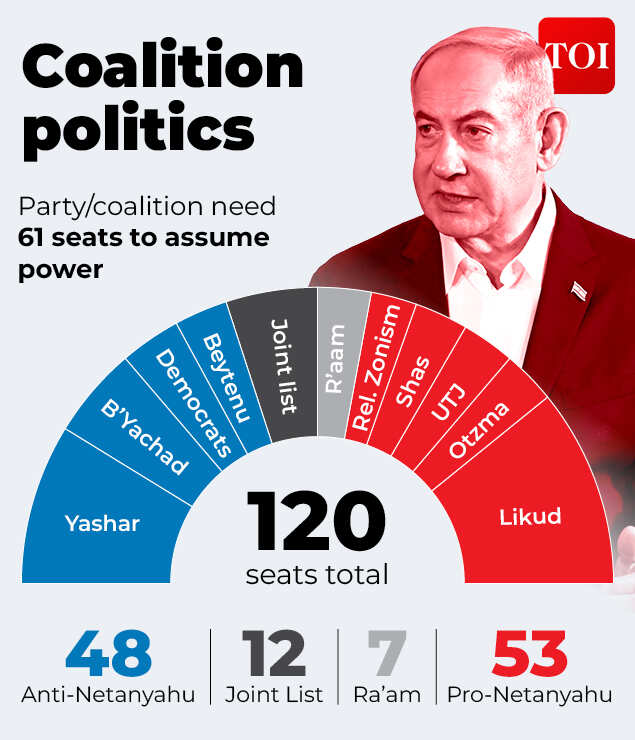
What’s next for Israel?
The opposition has accused the longest-serving PM Netanyahu of targeting the Arab population and attempting to undermine the election’s credibility after the historic performance by Arab-led parties.If the opposition joins hands with the Arab parties, it could potentially secure a parliamentary majority. However, such an arrangement would be politically challenging, given the differences within the opposition bloc over working with Arab parties.CNN outlined four possible scenarios that could shape Israel’s political future.
1. Opposition govt with Arab party support
On paper, the opposition’s clearest route to replacing Netanyahu is through cooperation with Arab-led parties. However, this could prove difficult.Two right-wing opposition leaders, former prime minister Naftali Bennett and former defence minister Avigdor Liberman, have opposed forming a government that depends on the support of the two Arab parties in parliament, the Joint List and Ra’am. They are against both joining a coalition with the parties and relying on their support from outside.Their positions have hardened since the October 7, 2023, Hamas-led attack on Israel.Only one government in Israel’s history has included an Arab party as a full coalition partner. In 2021, Ra’am joined an eight-party coalition that succeeded in removing Netanyahu from power. However, the government collapsed after just over a year.Even if the opposition fails to form a government, its parties could work together in parliament to replace the Knesset speaker and other key officials. This could limit the powers of Netanyahu’s caretaker government.However, forming a coalition to replace him would remain a complicated political task.
2. A national unity govt
Another possibility is the formation of a national unity government, with parties from both the Netanyahu-led bloc and the opposition joining hands.Such an arrangement would involve Netanyahu’s Likud party, some of its existing coalition partners and at least one party from the opposition.Netanyahu is believed to be willing to part ways with far-right National Security Minister Itamar Ben-Gvir. However, he is not expected to give up his alliance with far-right Finance Minister Bezalel Smotrich and the ultra-Orthodox parties.Eisenkot, however, has ruled out joining a government led by Netanyahu. Any change in that position could also anger voters who want to see Netanyahu leave office.
3. Netanyahu forms govt with oppn defectors
Netanyahu could also try to attract lawmakers from opposition parties to secure the numbers needed to form a government.However, all four opposition leaders, Eisenkot, Bennett, Liberman and Yair Golan, have ruled out joining a government led by him.With Netanyahu’s bloc eight seats short of a majority, he would need to persuade at least eight opposition lawmakers to switch sides. This could prove difficult given the leaders’ firm positions.
4. Israel heads for another election
If none of the political arrangements work, Israel could be forced to hold another election.President Isaac Herzog is expected to hold consultations with the leaders of parties that have entered the Knesset. After hearing their views, he will ask one of them to try to form a government.Arab parties are expected to support Eisenkot, which could put the Yashar leader in line to receive the first opportunity.The leader chosen by the president will have 28 days to form a government. The period can be extended by another 14 days if required.If the attempt fails, the president can give another leader 28 days to form a coalition. If that also fails, a majority of Knesset members can ask the president to nominate a third candidate, who will have 14 days to put together a government.If all three attempts fail, the country will have to return to the polls.
Netanyahu could benefit from prolonged deadlock
According to CNN, Netanyahu may be in a position to benefit from the lengthy government formation process.As caretaker prime minister, Bibi can remain in office while political parties try to reach an agreement. If Eisenkot gets the first opportunity to form a government but fails, the mandate could eventually pass to Netanyahu.
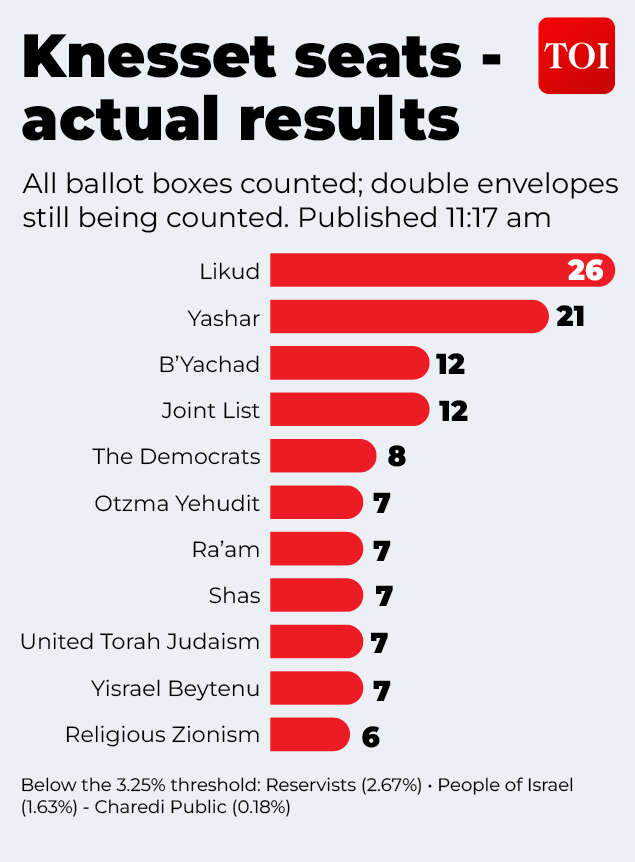
Seats and actual results in Israel’s Parliament
If Netanyahu also fails to secure a majority, Israel could be headed for another election.A fresh election, which could take place no earlier than next spring, is a real possibility.