
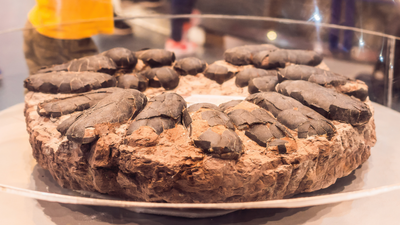
We imagine dinosaurs as enormous creatures roaming prehistoric forests, hunting for food and laying eggs in hidden nesting grounds. Although these creatures disappeared around 66 million years ago, their fossilised remains are still discovered in concealed areas that were once riverbeds and reveal interesting details about life on Earth millions of years ago.Interestingly, some of the most unique dinosaur discoveries are not restricted to the famous fossil-rich landscapes of Argentina, Canada or the United States.Other places on the globe also hold an extraordinary prehistoric legacy. One such location is southern France, where researchers have been discovering fossilised dinosaur eggs for decades.Recently, around 100 dinosaur eggs dating back approximately 70 million years were unearthed during an excavation, giving a glimpse into the reproductive habits and diversity of prehistoric dinosaurs.
70 million years old 100 dinosaur eggs discovered in southern France
This discovery was made near Mèze, a town in the Hérault department of southern France, located between Montpellier and Béziers. According to Futura, paleontologist and geologist Alain Cabot and his daughter Marina discovered an excavation campaign that began in October 2025.Cabot, who founded the Dinosaur Museum-Park in Mèze, first discovered dinosaur eggs in the region in 1996. The latest excavation, however, revealed an unusually large concentration of eggs.Speaking to Futura, Cabot expressed his astonishment, saying, “Until now, we had only found nesting sites separated by several dozen meters, containing an average of four to six eggs, sometimes ten at most. But a hundred? I’d never seen anything like it!”The discovery is particularly important because the fossil deposit extends across approximately 50 square kilometres and contains evidence of dinosaur activity dating to the Late Cretaceous period.
Titanosaurs may have laid these eggs
According to Cabot, studies of eggs collected from the Mèze region over several decades suggest that most belonged to large herbivorous dinosaurs resembling titanosaurs.Titanosaurs were enormous, four-legged sauropods and included some of the heaviest land animals to have ever existed. Certain species could grow approximately 12 metres long.However, identifying the exact dinosaur species responsible for laying the eggs remains ambiguous. The region has also yielded fossils of rhabdodonts, herbivorous dinosaurs with distinctive beaks, and dromaeosaurs, smaller carnivorous dinosaurs.
What the eggs reveal about dinosaur extinction
The discovery could also contribute to discussions about the extinction of dinosaurs. According to Futura, around 95% of the eggs found at the site had already hatched, making it difficult to establish a direct connection between particular eggs and their parent species.Scientists would ideally need fossilised embryos inside unhatched eggs or preserved remains of newborn dinosaurs to confirm their origins.Another interesting observation involves the diversity of dinosaurs in the region. Fossil-bearing geological layers suggest that the number of different dinosaur species laying eggs may have gradually declined during the millions of years before the mass extinction approximately 66 million years ago.The extinction is widely associated with the asteroid impact that created the Chicxulub crater in present-day Mexico. However, volcanic activity in India’s Deccan Traps is also considered a possible contributing factor.
A prehistoric island where dinosaurs returned to nest
The discovery also offers clues about what southern Europe looked like millions of years ago. According to Futura, geological studies, including magnetostratigraphic research, have helped scientists reconstruct the region’s ancient geography.During the Late Cretaceous, much of Europe was an archipelago, with large areas submerged beneath the sea. Present-day southern France and parts of Spain formed a substantial landmass known as the Franco-Iberian Island.Alain Cabot believes that titanosaurs may have travelled in herds across its extensive river plains and returned periodically to established nesting grounds, much like modern turtles.Over millions of years, river sediments buried these eggs, preserving them as fossils. The formation of the Pyrenees subsequently brought some of these ancient geological layers closer to the surface, making their discovery possible today.