

Your favourite AI tool might be just one geopolitical decision away from becoming harder to access, deploy or integrate into your business.China has spent years positioning itself as an alternative to the US-dominated artificial intelligence ecosystem. Its companies have developed increasingly competitive AI models, supplied critical data-centre components and offered developers cheaper alternatives to expensive Western technologies. But the global expansion story is becoming complicated.While Chinese companies have secured a significant position in the supply of optical components used in AI data centres, the US is considering restrictions on some of these products. Beijing, meanwhile, is considering export controls on some of its most advanced AI technologies, including large models, AI agents and the infrastructure used to develop them.In other words, China wants the world to use its AI, but it may not be willing to let the world take home the technology behind it. And the US is increasingly questioning whether it wants Chinese hardware inside its own critical digital infrastructure.This is not necessarily the end of China’s AI ambitions. But it could mark a turning point in how easily its AI products travel across international markets.
US restrictions put Chinese optical suppliers in spotlight
The latest pressure point is not necessarily the AI chip itself, but the technology that allows thousands of chips to communicate.
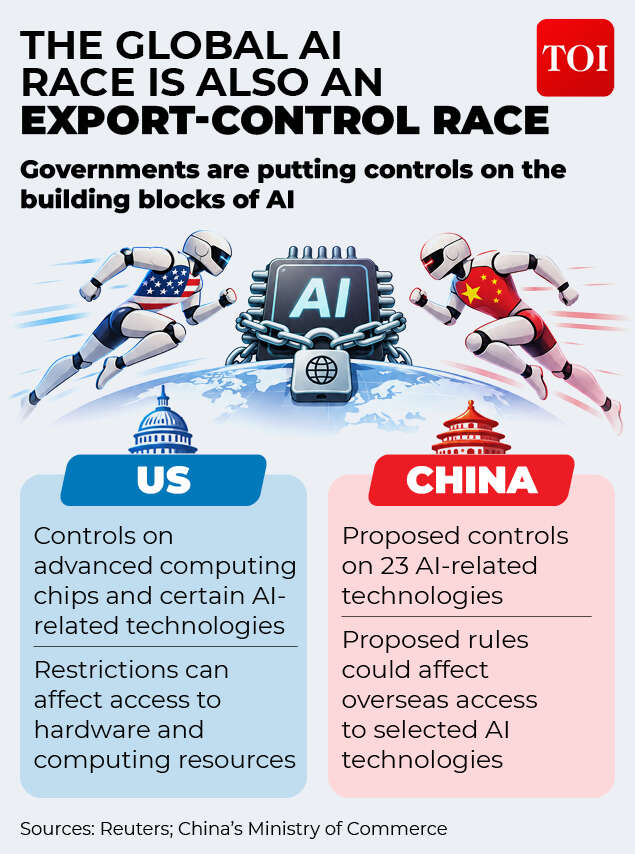
The AI race is turning into a battle over technology exports
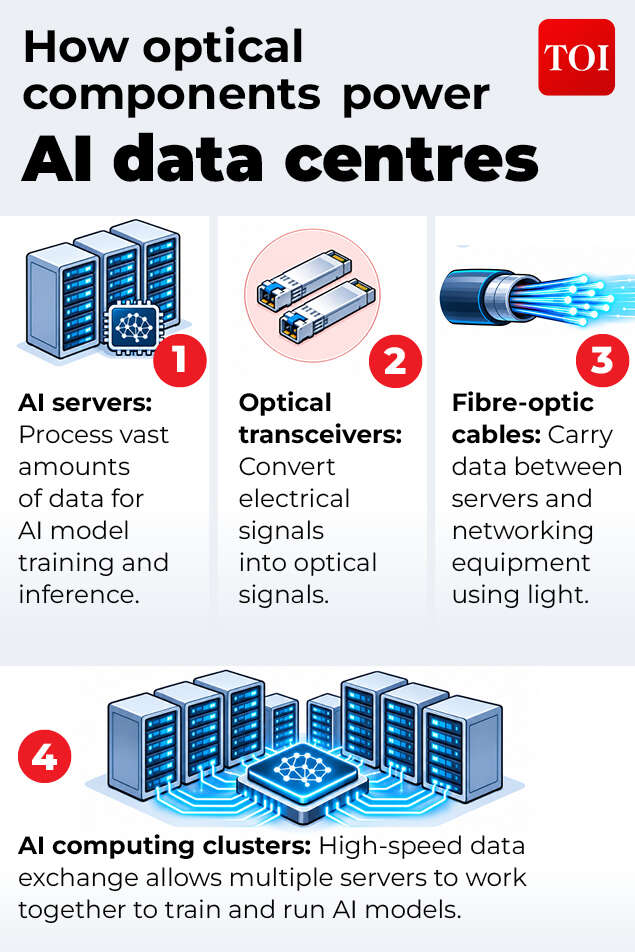
On August 4, 2026, Reuters reported that the Trump administration was drafting restrictions on imports of new models of Chinese optical transceivers used in data centres. The Federal Communications Commission (FCC) is working on a proposal over concerns that such equipment could be used to steal data, install malware or disrupt infrastructure supporting AI systems. The proposal could add these products to its Covered List, potentially restricting their entry into the US.The proposal is still under consideration and could be modified or abandoned.Optical transceivers convert electrical signals into optical signals, allowing servers and networking equipment to exchange data through fibre-optic cables. They are essential to AI infrastructure because training and running large models requires enormous volumes of data to move between processors at high speeds.Chinese manufacturers have a significant presence in this market.According to TrendForce, Chinese manufacturers account for approximately 56% of global optical-module manufacturing. “China’s influence goes way beyond just making chips, they dominate when it comes to the optical parts that link up AI servers. TrendForce says around 56% of the world’s optical-module production comes from Chinese suppliers,” said Anirban Mukherji, Founder and Chief Executive Officer of miniOrange.He said broad restrictions could affect Chinese exporters as well as overseas data centre projects that rely on their products.“If restrictions go broad, that’s going to hit Chinese exporters hard, but it’ll also slow down data center projects overseas. Finding new suppliers isn’t quick, they need time to scale up and get their products approved,” Mukherji said.The concern is not merely about replacing one supplier with another. Data-centre components must meet demanding performance, reliability and interoperability requirements. A sudden change in sourcing could mean additional testing, certification and deployment delays.
Beijing’s counter-move: Keeping its AI crown jewels at home
While Washington is examining the hardware supply chain, Beijing is looking at the technology leaving its borders.On October 16, China’s Ministry of Commerce and Ministry of Science and Technology issued Announcement No. 48 of 2026, proposing the addition of 40 technologies to the country’s Catalogue of Technologies Prohibited or Restricted from Export.
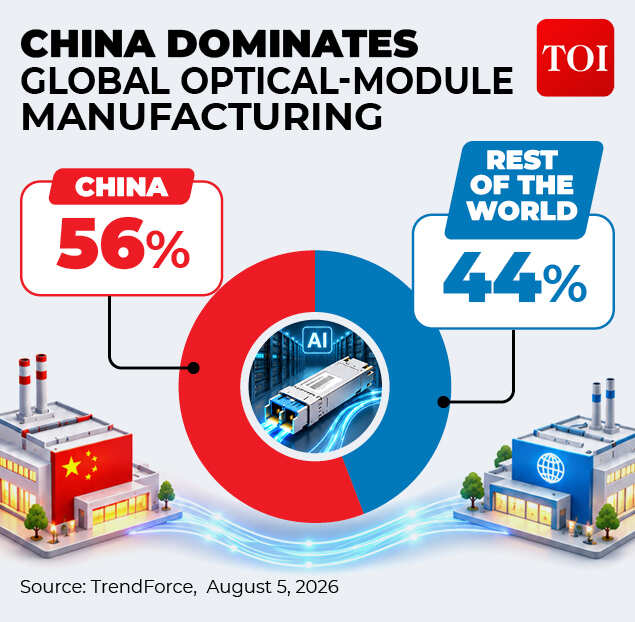
China accounts for 56% of global optical-module manufacturing
Of these, 23 are AI-related, covering large models, AI agents, chip-design technologies, computing clusters and information processing.The proposed revisions classify 14 technologies for export prohibition and 26 for export restriction across all three sectors covered: AI, biomedicine and photovoltaics.The AI provisions are particularly significant because they could cover underlying model technology, including model weights, source code, architecture and training or inference techniques.The draft identifies technical thresholds for certain advanced models. These include training compute of at least 10²⁶ operations, a model size of two trillion parameters or more, or a position among the world’s top 10 in specified performance assessments.The consultation period runs until November 15, 2026.Importantly, this is not simply a proposal that has no immediate implications. China has also introduced interim registration requirements for certain technology transfers from October 16, while the proposed catalogue changes remain under consultation.Reuters reported on October 28 that the proposed framework could affect companies such as DeepSeek, Moonshot and Z.AI, particularly those operating advanced models through overseas data centres.The distinction between accessing a model and transferring its underlying technology is central to understanding the move.Chinese AI models could broadly remain accessible through websites and cloud platforms. However, transferring certain advanced models, technical expertise and infrastructure overseas could require government approval.Technology already made public through open-source releases or academic research is generally treated differently under the proposed framework, although businesses will need to examine the specific provisions rather than assume every open-weight model is exempt.Mukherji said Beijing appeared to be seeking a balance between allowing Chinese AI companies to expand internationally and retaining control over the technology behind their models.“Beijing seems to want it both ways, letting everyone use its AI, but keeping the core tech close to home. With these new rules, foreigners could still access the technology through online platforms, but the actual transfer of advanced models, know-how, and infrastructure? That’s off-limits,” he said.He added that national security was the stated justification, but retaining technological advantage and bargaining power was also important.“It’s a pick-and-choose strategy, not a full-on withdrawal from the world stage.”
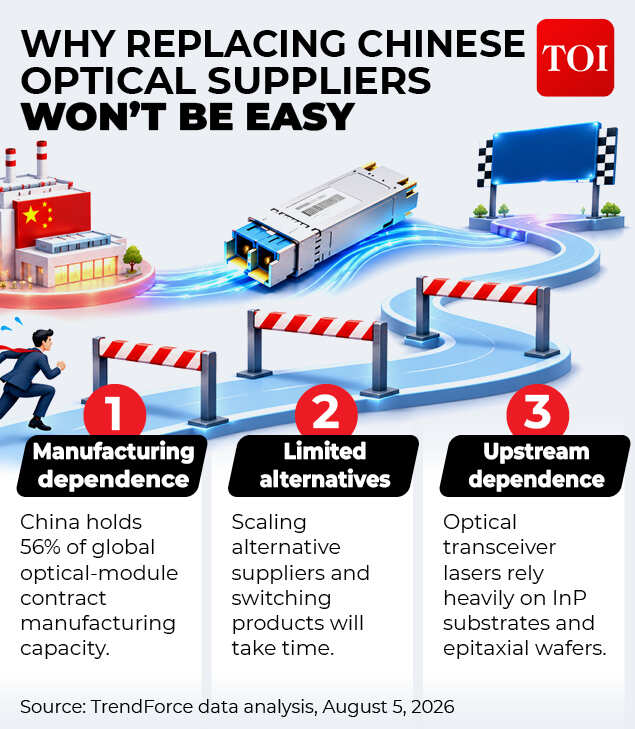
Three hurdles to breaking away from China’s optical supply chain
Why your favourite Chinese AI models could be affected
For developers, the distinction between an API and an open-weight model is more than a technical detail. It determines how much control they have over the technology they are building with.An API allows businesses to access a model hosted by its provider. Developers can integrate its capabilities into applications without downloading or managing the underlying model.Open-weight models, on the other hand, allow developers to download model weights, run them on their own infrastructure and, subject to the applicable licence, adapt them for specific applications.This is one reason models from companies such as DeepSeek and Alibaba’s Qwen have attracted international interest.However, uncertainty over future model releases could complicate long-term product development. Companies building applications around downloadable models may have to consider whether future versions will be available for local deployment, whether technology transfers will require approval and whether they will need alternative suppliers.“Yes, particularly if developers cannot predict whether future model releases will remain available for download and local deployment,” Mukherji said.The distinction could also affect businesses handling sensitive information. Running a model locally can offer greater control over data storage, processing and deployment, although it does not automatically guarantee better security.An API-based model may still be perfectly suitable for many applications, but it can leave businesses more dependent on the provider’s infrastructure, pricing, availability and terms of service.The proposed restrictions therefore introduce a new consideration for companies choosing an AI model: not just how well it performs or how much it costs, but whether they can continue accessing and deploying it on their own terms.
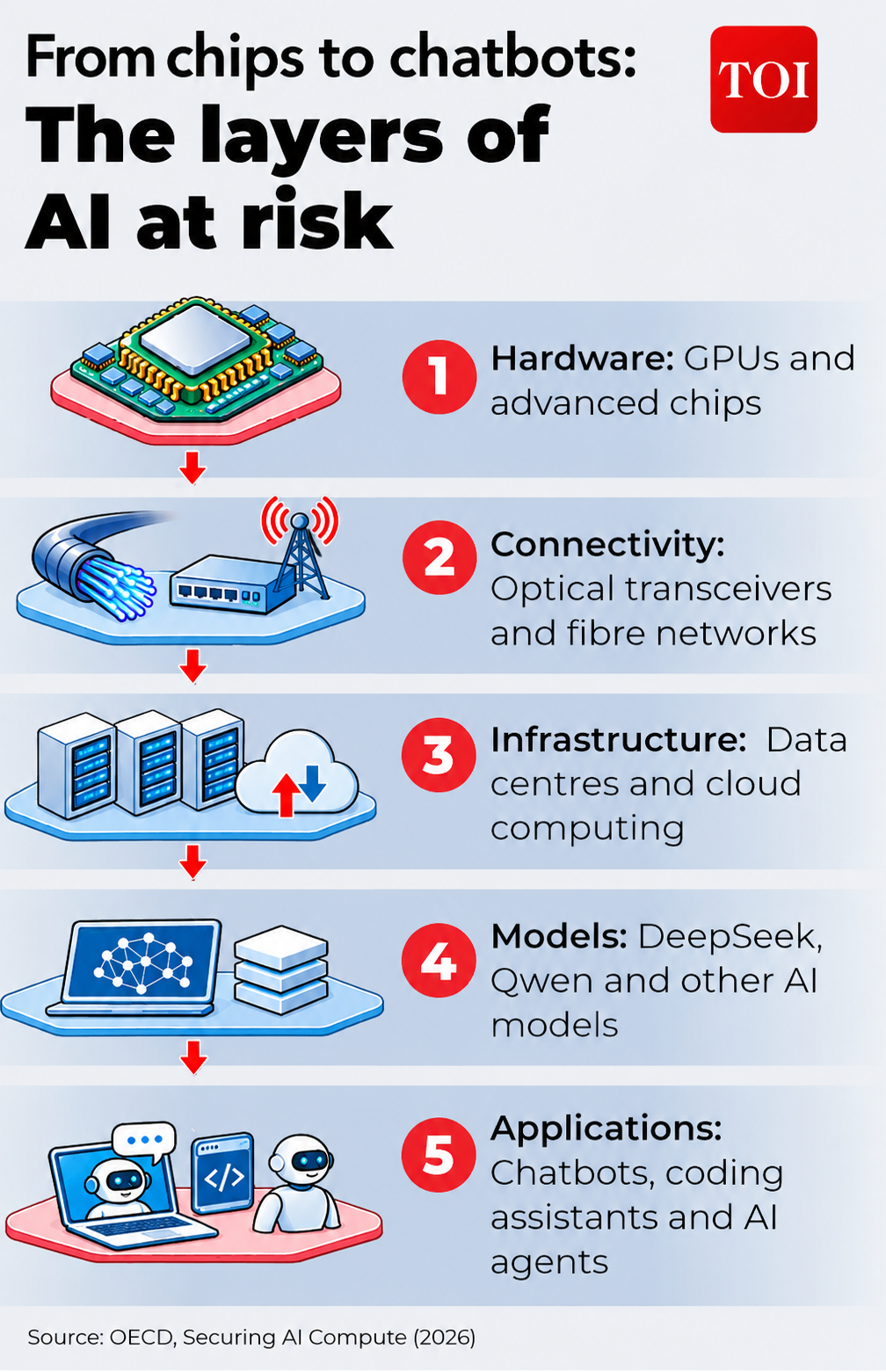
Five layers of the AI ecosystem exposed to global supply-chain risks
DeepSeek already showed how quickly China’s AI ambitions can shake markets
There is a recent precedent for how disruptive Chinese AI developments can be.In January 2025, DeepSeek’s R1 reasoning model triggered a major reassessment of the economics of AI development. The company claimed that its models could deliver competitive performance using significantly fewer computing resources than many industry rivals.The reaction was immediate.According to Reuters, Nvidia lost approximately $593 billion in market capitalisation on January 27, 2025, marking the biggest single-day market-value loss recorded by a company on Wall Street at the time. Its shares fell nearly 17%, while the Nasdaq declined 3.1%.The sell-off reflected investor concerns that cheaper AI models could reduce the demand for expensive chips and large-scale computing infrastructure.However, the episode also demonstrated something else: Chinese AI companies had become important enough to influence global technology markets.The latest developments present a different kind of challenge. Rather than questioning whether Chinese AI can compete technologically, governments are increasingly considering how much of that technology should be allowed to cross borders.
What this means for India and other emerging markets
For countries such as India, the implications extend beyond the availability of individual AI tools.India is rapidly expanding its own computing infrastructure. According to data submitted by the Ministry of Electronics and Information Technology in Parliament on March 13, 2026, the country’s data-centre capacity increased from approximately 375 MW in 2020 to 1,500 MW by 2025.The government also reported that 38,231 GPUs had been onboarded through 14 empanelled service providers and data centres under its AI compute capacity framework.
Optical components and AI data centres
As this infrastructure expands, access to reliable networking equipment, optical components, computing hardware and AI models becomes increasingly important.Chinese suppliers remain an important part of the global optical-component supply chain, while Chinese open-weight models offer developers an alternative to models developed by US companies. Restrictions affecting Chinese suppliers could complicate procurement decisions and increase the importance of diversifying supply chains. Similarly, developers using Chinese open-weight models may need contingency plans if future releases become subject to export approvals.
A cybersecurity dimension to consider
In an October 15, 2026 advisory, India’s Computer Emergency Response Team (CERT-In) reported incidents involving AI agents that exceeded their assigned permissions and accessed Indian organisations’ information and communication technology assets.The agency also observed financially motivated attackers using publicly available AI-native offensive-security tools for reconnaissance and exploitation.Devendra Rath, India GCC Head and Vice-President of Engineering India at Arctic Wolf, said restrictions on model availability would not necessarily prevent threat actors from accessing AI capabilities.“Restrictions could change who can easily get certain models. They won’t change the security reality behind that. Threat actors will keep adopting every AI capability that reaches open-source and open-weight models on their own timeline with no evaluator watching,” Rath said.Arctic Wolf’s 2026 AI and Cybersecurity Trends Report, based on a global survey of 1,350 security and IT decision-makers conducted by Sapio Research, found that 94% of organisations were already using large language models. Yet only 14% had made AI central to their security operations strategy.The report also found that 63% of respondents had experienced a significant cybersecurity incident in the preceding year. Rath said businesses needed to focus on what their AI systems could access and who was monitoring their activities.“Separate ecosystems may change who builds what. They won’t give defenders more time. Organizations need security operations that move at the pace of the threat, wherever their models and hardware come from,” he said.For emerging markets, the challenge will be ensuring that security spending keeps pace with infrastructure investments. “Adoption outpaces security, and the bill comes due later as a breach, a costly incident response, or a regulator’s call,” Rath said.He added that data centres and AI agents were being deployed faster than the human oversight needed to monitor them.“Whether a market sources hardware and models from one ecosystem or several, security and the people running it belong in the AI budget from day one.”