
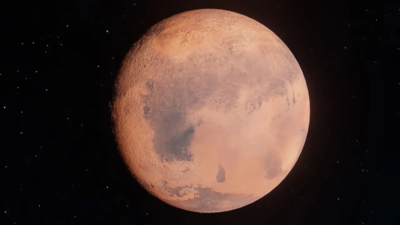
An international team of scientists has identified a completely new type of rock on Mars and, for the first time, found the mineral garnet in a Martian sample. The discovery came from a fragment of the Martian meteorite NWA 8171, held in the Royal Ontario Museum’s collections, and was led by Tanya Kizovski of Brock University. According to the University of Portsmouth, the find offers a rare glimpse into the planet’s ancient past and could help researchers piece together its 4.5-billion-year geological history. Its Martian origin has not yet been confirmed.
How did scientists identify garnet on Mars for the first time
The team found garnet, a mineral that had not been identified on Mars until now. On Earth, garnet is a dark-red gem that was popular with the Ancient Egyptians, Romans and the Victorian elite, and it is the birthstone for January. The university also describes it as a cornerstone mineral in geology.Garnet provides a record of the tectonic forces, ore-forming processes and fluid-rock interactions that shape Earth’s crust and mantle. In its account of the Martian find, the garnet is described as a new geological time capsule. It preserves clues about the temperatures, pressures and processes that shaped the planet billions of years ago.
How did scientists discover garnet in the NWA 8171 Martian meteorite
The research was led by Tanya Kizovski, Assistant Professor of Earth Sciences at Brock University. She and colleagues at the ROM learned of the garnet while analysing a fragment of a Martian meteorite known as NWA 8171, which is held in the ROM’s collections. Kizovski set out to identify the fragment’s minerals and chemical composition.The university reports that Kizovski found the section of meteorite interesting and the chemistry slightly unusual. The team first assumed the mineral was pyroxene, which is very common, but decided to look again. The analysis used the University of Portsmouth Electron Microscopy and Microanalysis Unit and the ROM’s specialised laser equipment, and the team was surprised to find garnet. Professor James Darling of Portsmouth’s School of the Environment and Life Sciences was part of the research team.
What geological processes may have created garnet on Mars
The team analysed the fragment’s chemistry and mineralogy and speculated about where the garnet came from. According to Kizovski, garnet is a classic example of a mineral often found in metamorphic rocks on Earth. Metamorphism transforms igneous or sedimentary rocks into a new form through exposure to extreme heat, high pressure or hot fluids.Kizovski said that on Mars, the heat and pressure needed to produce garnet through metamorphism could have come from a meteorite impact on the surface, from magma rising into the Martian crust, or from both. The university quotes her as saying the garnet-bearing rock type could give clues to how Mars has changed through its history. She also said it could give new insights into the ancient environments that may have formed the garnet and related minerals.
How will scientists determine whether the garnet-bearing rock originated on Mars
According to the University of Portsmouth, Kizovski cautions that the research does not definitively show whether the garnet-bearing rock formed on Mars. It may instead have been delivered to the planet and incorporated into its surface in a meteorite landing, which leaves open the possibility of an “extra-Martian” origin. Scientists now need to study the garnet’s isotopic signatures to check whether it was produced on Mars or on another planetary body.Kizovski said measuring oxygen isotopes from the rock itself would help confirm a Martian origin or an exotic meteorite impactor. That process would destroy some of the sample, which has been avoided so far because of its rarity. Kizovski added that it may be the only garnet-bearing Martian rock available for study. ROM curator Kim Tait and Research Assistant Jessica Tomacic are continuing to study the sample together with Professor Darling. Kizovski said she hopes further work and more comparisons with rover and orbital data will reveal more about the origin and history of garnet on Mars.The project is funded in part by the Government of Canada’s Natural Sciences and Engineering Research Council (NSERC) and the Killam Trusts Dorothy Killam fellowship. It also receives Science and Technology Facilities Council (STFC) funding at Portsmouth.