
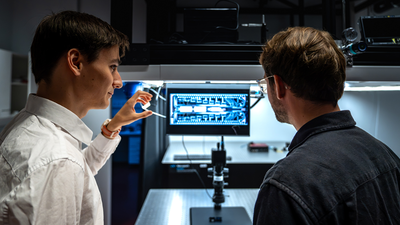
Light is something we rarely think twice about. It enters our homes through windows, illuminates the streets at night and helps us capture everything from a beautiful sunset to the tiniest details under a microscope. But what if the light reaching our eyes isn’t as simple as it appears? What if it is several sources sending out light waves that overlap, interfere with one another and arrive at slightly different times?Most cameras record this mixture as a single image. In the process, however, they can lose information that is hidden within the light itself.Researchers at Stanford University, along with collaborators in Austria and Italy, have now found a way to tackle this problem. They have developed a tiny chip, roughly the size of a fingernail, that can take mixed light and separate it into individual, clean beams. The technology addresses a problem scientists have been thinking about since the 1980s, but which had not been demonstrated in this physical form before.
Why is mixed light so difficult to work with?
Not all light behaves in the same way. Consider a laser pointer and a light bulb. Although both produce light, the way their light waves behave is quite different. A laser produces what scientists call coherent light. Its light waves move in a coordinated manner, almost like a group of swimmers following the same rhythm. When these waves meet, they can reinforce one another or cancel each other out, creating distinct patterns. A regular light bulb, on the other hand, produces light whose waves are largely out of sync. They do not follow the same rhythm, which is why the resulting light appears more scattered and diffuse.Most light we encounter in the real world falls somewhere between these two extremes. Scientists describe it as partially coherent, meaning that some of its waves may be organised while others are not. This creates a bit of a problem. When light from different sources overlaps, it becomes difficult to distinguish one contribution from another. The resulting interference can also make optical instruments less effective.But the Stanford researchers believe this seemingly messy behaviour could actually be useful. Instead of treating partially coherent light as something to get rid of, they wanted to understand whether its individual components could be separated and studied.
How does the tiny chip work?
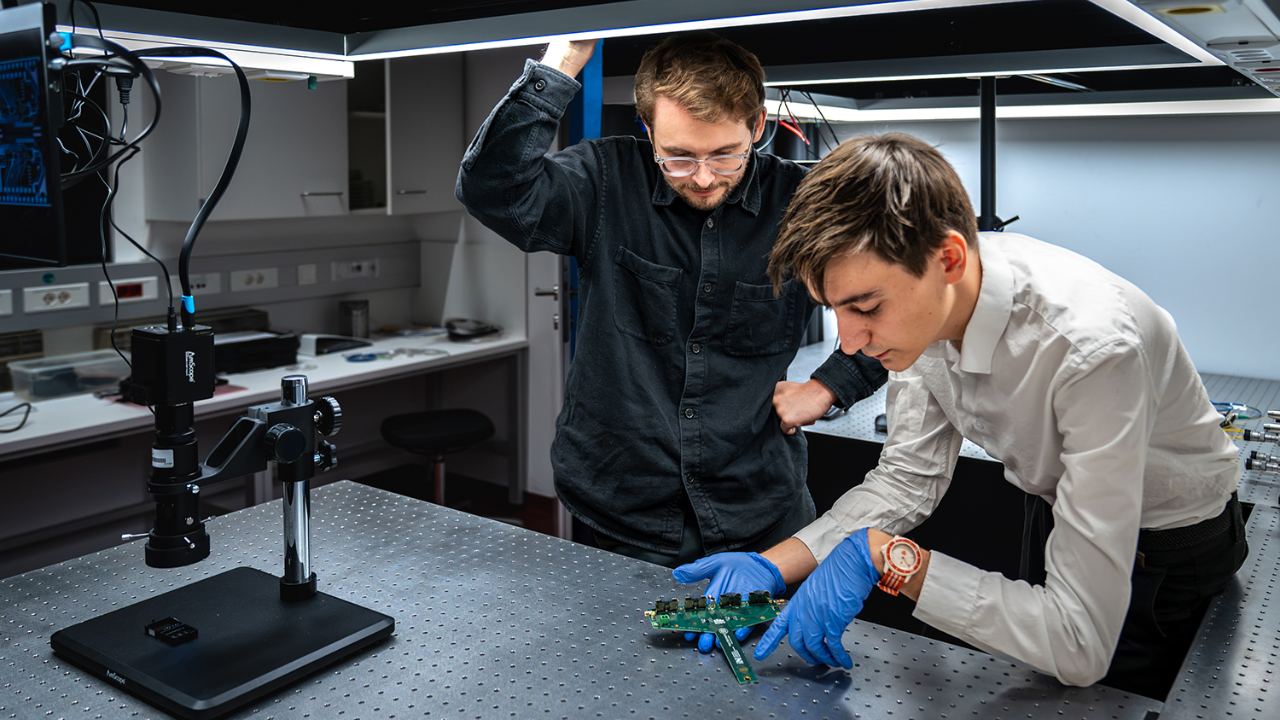
Image Courtesy: Institute of Science and Technology of Austria
The device developed by the researchers is a photonic chip. Unlike conventional electronic chips, which use electrical signals and electrons to carry information, photonic chips work with light itself. They guide photons through extremely small channels on a silicon surface.For their experiment, the researchers directed two infrared lasers into the chip. As the light from the two sources overlapped, it produced a partially coherent mixture.Inside the chip, a network of tiny optical components called interferometers, supported by algorithms, examined the statistical properties of the incoming light. It then separated the mixture into its individual components and directed them towards different outputs. These components are known as coherence modes. In simple terms, they are distinct parts of a light field that do not remain correlated with one another.Interestingly, the chip does not simply take a reading of the mixed light and use a computer to reconstruct what the original beams might have looked like. It physically separates the different coherence modes into individual channels, allowing researchers to study and use them independently.To check whether the separation had worked, the team recombined the two output beams. They found that the light waves did not synchronise with each other, confirming that the chip had successfully separated them into independent beams.The researchers then introduced a third laser into the experiment. The device was still able to sort the resulting mixture, suggesting that the technology could work with more than just two sources of light.
What could this mean for cameras and telescopes?
One of the most promising applications of this technology is imaging.When we take a photograph, a camera primarily records the intensity of light, or how bright different parts of the image appear. But light carries other information too, including its phase, which describes the relative timing and alignment of its waves. Much of this information is lost when an image is formed.The new chip could help preserve and separate some of these otherwise overlooked details. Consider a microscope, where two fluorescent particles are positioned so close to each other that they appear to be a single object. Although they may look identical in the resulting image, the light they emit could carry different signatures.A chip capable of separating their coherence modes could potentially help researchers distinguish between the two sources, even when they overlap.Astronomy is another field that could benefit. Light travelling across enormous distances can become difficult to interpret once it reaches a telescope. What appears to be a single blurry source may contain contributions from several different objects. The researchers are exploring a collaboration with NASA to investigate whether their technology could help scientists study such light.There are also possibilities in optical communications, sensing and computing. Since the chip can adjust itself to changing light conditions, it could potentially help systems work more effectively in environments where atmospheric disturbances interfere with incoming signals.
A different way of looking at light
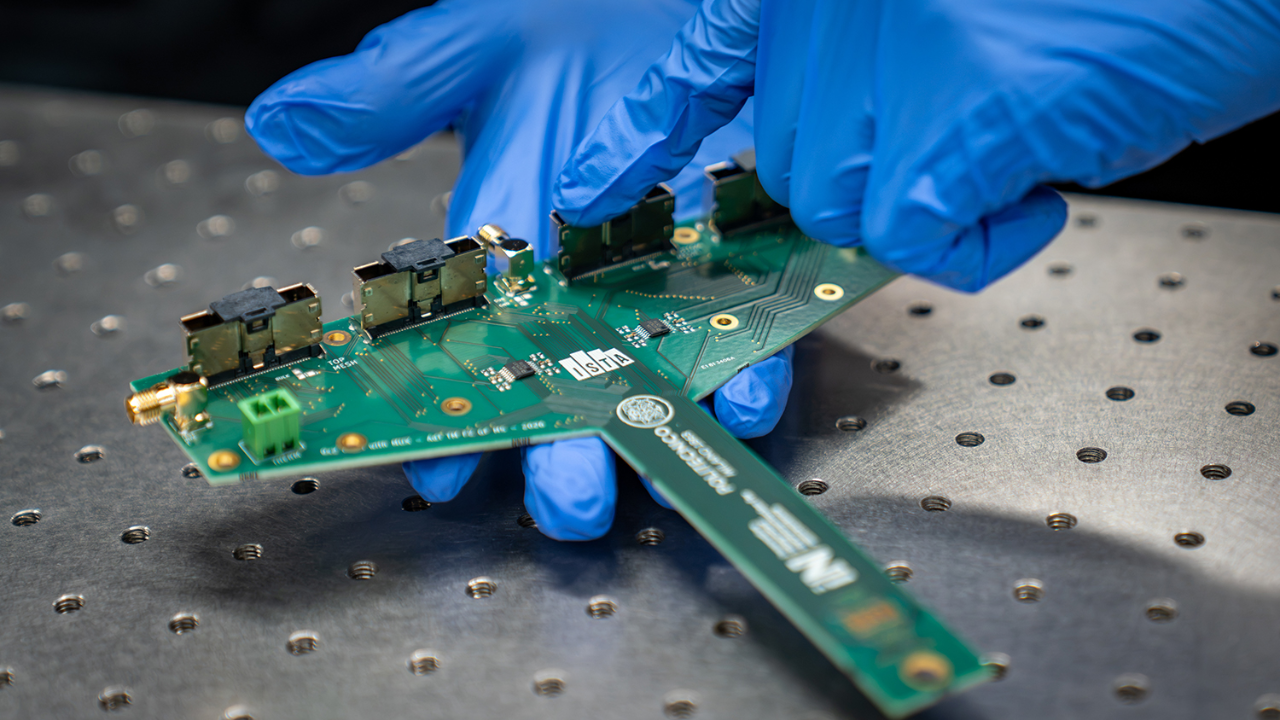
Image Courtesy: Institute of Science and Technology of Austria
It is important to understand what the device can and cannot do. It does not automatically identify and recover every original light source. Instead, it separates the incoming light into its underlying coherence modes. These modes correspond to the original sources only under certain conditions, such as when the incoming beams are spatially orthogonal. Even with this distinction, the achievement is significant.Earlier approaches relied on taking repeated measurements of mixed light and using extensive computational work to understand its properties. The Stanford chip performs the separation physically on a compact silicon platform, without requiring researchers to know the incoming light field beforehand.In their experiments, the researchers successfully separated the two strongest coherence modes from light produced by two independent lasers. The results showed a fidelity of more than 98% when compared with a benchmark method. A separate experiment involving three lasers demonstrated that the approach could extend beyond two light sources.For a long time, scientists have largely approached partially coherent light as something that needs to be corrected or controlled. This research offers a different perspective. Perhaps the information hidden in messy light is just as valuable as the information we can already see.A fingernail-sized chip might not look like much, but its ability to untangle light could eventually change how we observe the world. From identifying tiny particles under a microscope to studying distant galaxies, the technology could help scientists see details that conventional imaging systems might otherwise miss.