
The first time you see a home loan offer, the tenure can feel heavy. Twenty years, sometimes thirty, of monthly payments. It is natural to wonder whether you are signing up for half a working life of debt.
Here is the reassuring part. The tenure is the longest your loan can run, not how long it has to. Most borrowers close their home loans well ahead of schedule, and they rarely do it with one heroic payment. The average duration of loan re-payment is recorded to be 12.5 years. Over 85% home loans are repaid earlier than the tenure. They do it with two ordinary habits: raising the EMI a little every year, and making bulk payments whenever money comes in.
Why a long tenure works in your favour
- A comfortable start. The loan EMI ties up a big, fixed part of every month’s income. A longer tenure keeps the EMI lighter compared to shorter tenures and gives monthly budget room to breathe. Lenders often allow an EMI of up to 50% of take-home pay.
- Your income grows; the EMI does not. With every pay raise, the same EMI takes a smaller share of what you earn, so there is room to pay a little more.
- Freedom to pay early. Most home loans can be partially prepaid or closed at any time without a penalty. In other words, you choose the pace. People only set the slowest pace one to start with.
Habit 1: Raise your EMI every year
Each year, raise the EMI. Because your income has grown too, the increase is barely felt in the monthly budget. On the loan, it is felt a lot.
A 5% increase in EMI every year shortens a 20-year loan by more than a third and cuts the total interest by about a third. At 10% a year, the loan is done in about half the time. Given the annual income growth in the range of 7-12% every year, this is very much feasible.
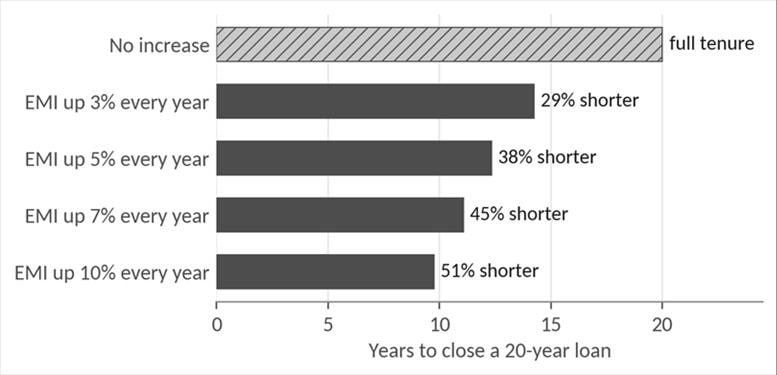
(Raising the EMI every year shortens the loan sharply)
Small, steady increases do more than you expect, because every extra rupee goes straight to the principal.
Habit 2: Make bulk payments, and make them often
Bonuses, incentives, tax refunds and FD maturity savings are natural moments to send a lump sum to the loan. You do not need large amounts. A bulk payment equal to just one extra EMI a year already trims years off.
Frequency matters. Spreading bulk payments through the year, half-yearly or quarterly, keeps chipping at the principal before interest builds on it. Four extra EMIs a year, one each quarter, shorten a 20-year loan by more than 40%.
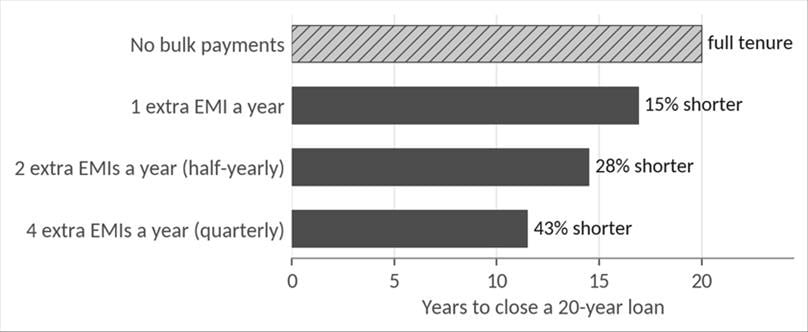
(More frequent bulk payments, faster closure)
When you make a bulk payment, ask the lender to reduce the tenure rather than the EMI. That is where the savings come from.
Start early, it counts the most
In the early years, most of each EMI goes to interest. A bulk payment made then removes interest for every year that follows. The same payment made in the second year saves about six times as much interest as one made in the fifteenth.
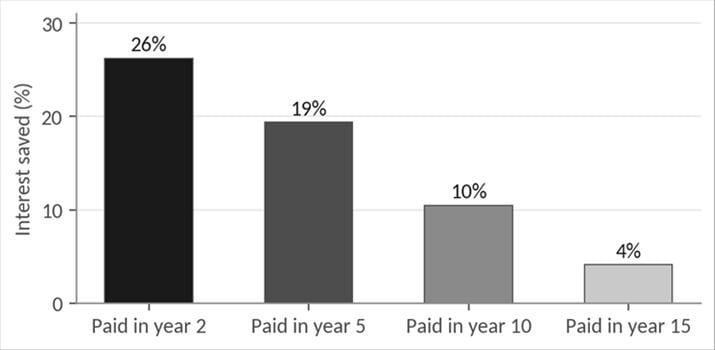
(The same bulk payment, made at different times)
Together, the two habits halve the journey
Combine a 5% yearly EMI increase with a bulk payment twice a year, and a 20-year loan is closed in about half the time, with close to half the interest saved. Neither habit asks for sacrifice. Both simply move money you were going to earn anyway towards the loan.
A simple plan
- Choose the tenure that keeps today’s EMI comfortable.
- Raise the EMI every year, close to your pay rise.
- Send part of every bonus or windfall to the loan, more than once a year if you can.
- Prepay hardest in the early years.
- Always ask for a shorter tenure, not a smaller EMI.
A home loan is a long road only if you walk it at the slowest pace. Take the tenure that lets you buy with confidence, then let your growing income bring the finish line closer every year.
(Amit Kumar Agarwal is cofounder and CEO of NoBroker.)