
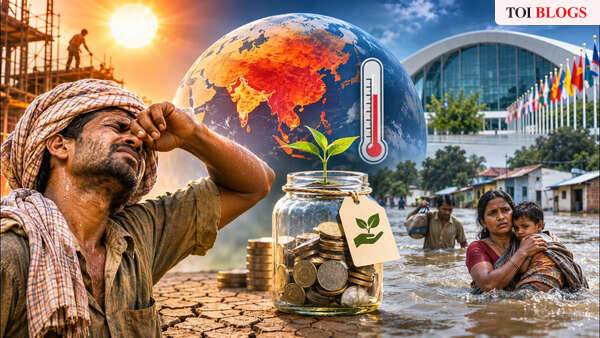
In the run up to COP 31, three reports, namely UNEP Emissions Gap Report 2026, Lancet Countdown on Health and Climate Change 2026 and UNFCCC Standing Committee on Finance’s Seventh Biennial Assessment (https://bit.ly/4iCG9Es) were launched. The UNEP Emissions Gap Report 2026 warns that the world has passed the point at which 1.5°C can be held without or with limited overshoot; the report examines how to minimise overshoot and return to 1.5°C by 2100. The Lancet Countdown on Health and Climate Change 2026 brings home the human cost, with heat-related risks affecting health, livelihoods and productivity. Meanwhile, the UNFCCC Finance’s Seventh Biennial Assessment provides the financial backdrop against which these growing impacts must be addressed. In a nutshell, we are facing an uncomfortable reality: while the human costs of climate change are mounting, the world is falling short of its climate ambitions, and the financial resources promised to developing countries to address these consequences remain not only inadequate but also opaque in their accounting and delivery. Rather than looking at these individually, it gives us an opportunity to read their messages in tandem, particularly from India’s perspective: Climate change is increasingly becoming a development challenge, with adaptation costs competing for resources that India already needs for its other pressing priorities.India: the human and economic costThe Lancet Countdown’s India data sheet makes for sobering reading. Heat-related potential income losses in 2025 were estimated at US$174 billion, equivalent to 4.2% of GDP. Potential work hours lost to heat averaged 193 billion annually during 2016–2025, 75% higher than in the 1990s. Though these are estimates of potential economic exposure, the magnitude is difficult to ignore. The consequences extend beyond those working outdoors in agriculture and construction. Workers in poorly ventilated factories, processing units and MSMEs may also face dangerous heat, often without adequate workplace mitigation. Heat affects health, productivity, working hours and household incomes.Floods, meanwhile, disrupt agriculture, housing, infrastructure, livelihoods and essential services. The human cost of climate change is therefore not confined to disaster relief or the budgetary outlay for health and social protection. It increasingly affects the very foundations of our economic development.Adaptation, therefore, is not a luxury (yes, even the air-conditioning) for the country but a basic survival strategy. Heat-resilient workplaces, flood-resistant infrastructure, climate-resilient agriculture, health systems and early-warning mechanisms all require investment.Who pays for resilience?India must, of course, invest in protecting its people and economy. But these investments come from resources already required for education, healthcare, infrastructure, employment and poverty reduction. The already scarce resource availability is compounded by geopolitical instability, particularly in West Asia. Energy insecurity, price volatility and competing demands on public expenditure add to an already challenging economic environment.When international climate finance falls short, the additional burden of adaptation has to be met from domestic budgets or through further borrowing. This is particularly inequitable when the historical contribution of developing countries to the accumulation of greenhouse gases has been far smaller than that of developed countries. The question is not whether India should finance its own resilience, it is anyway doing it to the extent possible. It is whether the international climate-finance architecture is fulfilling its responsibility to support developing countries in doing so.Climate finance: the promise and the realityThe inadequacy of climate finance is not merely a question of quantum. Its quality and composition matter equally.In my 2024 ET EnergyWorld article, “The 100 Billion Dollar Climate Finance Conundrum” (https://bit.ly/4BT6TcE), I had questioned the ambiguity surrounding “new and additional” finance, the predominance of loans, and the treatment of commitments as finance. The concerns remain relevant.Climate finance reported by developed countries has relied heavily on loans, while grants have formed a much smaller share. Adaptation has also received a considerably smaller proportion of reported finance than mitigation. Commercially viable energy and transport projects naturally attract investment; adaptation, with benefits often intangible and spread over long periods, is less readily financed by private capital. But should climate finance intended to support developing countries’ adaptation needs create further debt burdens? And can finance diverted from existing development assistance reasonably be described as additional?The distinction between pledges, commitments, approvals and actual disbursements is equally important. A multi-year commitment may look impressive in a report, but it does not mean that the entire amount has reached the recipient country.The UNEP Adaptation Gap Report 2026 estimates developing countries’ annual adaptation needs at US$305 billion by 2035, against international public adaptation finance flows of only US$28.2–31.7 billion in 2024. Even tripling these flows would cover only a fraction of estimated requirements. The inadequacy is therefore not marginal. And even the proposed tripling of international public adaptation finance by 2035 would cover only about 20–29% of the estimated needs.Measuring adaptation, but financing it?The Belém Adaptation Indicators, adopted under the Global Goal on Adaptation, are intended to help assess progress towards resilience. Measurement is undoubtedly necessary. Yet the Belém–Addis Vision on Adaptation envisages a further two-year process of policy alignment, alongside technical work on indicator methodologies and metadata. The human cost in the interim continues unabated. The indicators may tell us whether heat action plans exist or whether early-warning systems cover vulnerable populations. They cannot, by themselves, ensure that workers are protected, infrastructure is resilient or adequate finance reaches those who need it.Neither the climate crisis nor these geopolitical disruptions are of India’s making. Disruptions to energy supplies and international markets can increase import costs, fuel inflation and put pressure on the balance of payments, further constraining the fiscal space available for development and adaptation. Yet India must absorb their consequences while continuing to finance its development and resilience.India has never shied away from its climate responsibilities while pursuing its development priorities. Indeed, its initiatives on several fronts speak for themselves. Rather, it is an argument about equity, historical responsibility and the distribution of costs.Will COP31 in Antalya move beyond declarations and indicators to address the inadequacy of adaptation finance—in its quantum, additionality, terms and actual delivery?For India and other developing countries, another reaffirmation of commitments would hardly suffice. The real test is whether international climate cooperation can finally translate into resources that protect people and livelihoods, without making resilience yet another burden on development. It is hoped that COP31 will live up to its stated theme: “COP of the Future – COP of Implementation”.
Disclaimer: Views expressed above are the author’s own.