
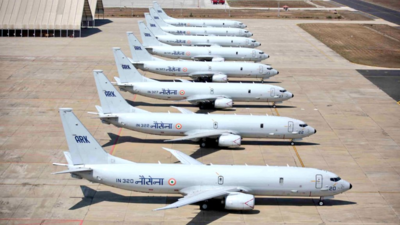
The Indian Navy marks the Golden Jubilee of its Long-Range Maritime Reconnaissance (LRMR) operations on November 18, 2026, 50 years after Indian Naval Air Squadron (INAS) 312, the Albatross, was commissioned. The anniversary commemorates five decades of airborne vigil over India’s waters at a time when submarines are increasingly deciding the strategic balance in the Indian Ocean Region.The capability goes back to the aftermath of the 1971 war, when the Navy saw a need for shore-based maritime patrol aircraft that could work with ships and helicopters, and took over responsibility for long-range reconnaissance. INAS 312 was commissioned on November 18, 1976, at INS Hansa in Goa, with five Lockheed Super Constellation aircraft transferred from the Indian Air Force. The Ilyushin Il-38, inducted in 1977, strengthened reconnaissance and anti-submarine warfare, and the Tupolev Tu-142M, which joined INAS 312 in 1988, extended patrol reach across the Indian Ocean. The Boeing P-8I, inducted at INS Rajali in Arakkonam in 2013, brought wide-area surveillance, anti-submarine warfare and maritime strike. Today, P-8I aircraft of INAS 312 at Arakkonam and INAS 316 at INS Hansa keep watch over the Indian Ocean and beyond.Over the five decades, these aircraft have supported Operations Cactus, Vijay, Parakram and Sindoor, besides anti-piracy and search and rescue missions. The Navy says the milestone honours the aviators, mission crews, maintainers and support staff who built and sustained the capability.
Why the watch matters
Locating, identifying and tracking hostile submarines is critical to protecting the coastline, naval installations, aircraft carriers, merchant shipping and sea lines of communication. Submarines can stay submerged for long periods and operate covertly, so finding them takes persistent surveillance and a mix of sensors and platforms.Long-range reconnaissance aircraft can monitor vast stretches of ocean in a short time. With maritime surveillance radars, electro-optical sensors, electronic intelligence systems and sonobuoys, they can detect surface vessels, investigate suspicious contacts and find submarines. In an anti-submarine role they can drop sonobuoys to make underwater contact, classify a target and, if required, attack with torpedoes. Their speed and endurance, and their ability to coordinate with warships, submarines and shore command centres, help the Navy keep a complete maritime picture.
A busier underwater neighbourhood
The need is growing as submarine fleets in the neighbourhood expand. China operates around 60 submarines, including nuclear-powered attack boats, ballistic missile submarines and conventional types, and its growing presence in the Indian Ocean adds to India’s surveillance burden. Pakistan is building up through an eight-boat Hangor-class programme with China, alongside its Agosta-class boats, and the newer submarines have air-independent propulsion, which gives them longer underwater endurance.For India, the P-8I fleet is an important part of its maritime security architecture. After 50 years, the Navy’s reconnaissance squadrons have grown from a handful of transferred aircraft to a modern network, and sustained investment in long-range reconnaissance, underwater surveillance, networked sensors and anti-submarine warfare will be essential to keeping an eye on submarine activity across the region.