
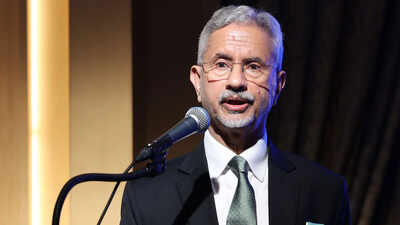
The global economy is increasingly being weaponised, with countries using access to energy, technology, finance and trade as tools of geopolitical pressure, External affairs minister S Jaishankar warned on Wednesday, flagging five defining features reshaping the international order.Addressing the inaugural session of Raisina Tokyo 2026 in Japan, Jaishankar said repeated global shocks, strategic competition and growing economic uncertainty were forcing countries to rethink their dependencies, diversify supply chains and prioritise trusted partnerships over cost and efficiency, ANI reported.Jaishankar identified repeated shocks to the international system as the first defining feature, saying decades of steady globalisation had been disrupted by a series of crises, including the Covid-19 pandemic, major conflicts, trade disruptions and economic volatility.“Let’s start with the current state of the world. To my mind, it has five defining features,” he said, identifying the first as “the shocks to the international system”.He said the global order, which had evolved steadily through globalisation over several decades, was now facing successive disruptions that had exposed vulnerabilities in the interconnected international system.The second feature, according to Jaishankar, was the growing weaponisation of resources, energy, technology, market access and finance, with countries increasingly using their control over critical economic assets to advance strategic interests.“Whether it is resources or energy, market access or technology, or indeed even finance, every aspect of global economic activity has been more and more openly weaponised by relevant players,” he said.He added that physical and virtual chokepoints were also becoming instruments of strategic competition, warning that established international rules and assumptions were weakening.The remarks point to a changing international environment in which economic interdependence is increasingly being used as a source of geopolitical leverage. Control over critical resources, technology networks, financial systems and strategic trade routes can give countries the ability to influence or restrict the choices available to others.The third defining feature, he said, was the growing mindset of extreme competition and greater risk-taking. Jaishankar said countries were increasingly willing to take bigger risks in an attempt to convert their strategic advantages into concrete outcomes across different domains.The fourth feature was de-risking and diversification, which he described as natural responses to growing global uncertainty. He said major economies were reassessing their dependence on concentrated supply chains and seeking alternative sources of essential goods and resources.“Our choices are shaped now less by cost and efficiency, and perhaps more dependent on reliability and multiplicity. New supply chains and new economic arrangements are starting to come into being,” Jaishankar said.He added that the risks of over-concentration were increasingly being recognised, with countries either looking for alternatives or seeking ways to mitigate their exposure to disruptions.The fifth feature was the growing importance of trusted partnerships. Jaishankar said governments and businesses were placing greater value on reliable partners and shorter supply chains as they navigated an increasingly uncertain international environment.“In such uncertain times, nations, as indeed enterprises, put a much greater value on trusted partners and shorter supply chains,” he said.He also cautioned against the manipulation of international rules to disadvantage countries that abide by them, saying governments were becoming increasingly aware of how such rules could be used to advance strategic interests.
Share your thoughts in the comments
Be respectful · TOI community guidelines
Turning to India-Japan relations, Jaishankar called for deeper cooperation amid the changing global landscape, urging Japan to recognise India’s transformation since 2014.He highlighted India’s infrastructure growth, expanding domestic market and improvements in human resource development, calling for greater collaboration in semiconductors, critical minerals, advanced manufacturing, clean energy, pharmaceuticals and defence.Saying India and Japan had maintained friendly relations without any clash of interests, he expressed confidence in stronger ties under Prime Minister Narendra Modi and Japanese Prime Minister Sanae Takaichi.“By expanding India-Japan ties, we will not only serve to stabilise and secure the Indo-Pacific but also add an important pillar to an increasingly multi-polar Asia and the world,” he said.