

A beautiful stranger, a chance encounter, a seemingly genuine romance and eventually, a request that could compromise national security.It sounds like a plot straight out of a James Bond film, where seduction is as potent a weapon as a gun or a spy gadget. But in the real world, the art of turning intimacy into intelligence is far from fiction.From the Soviet KGB’s female operatives and East Germany’s Romeo spies during the Cold War to alleged Chinese intelligence links surrounding Nvidia CEO Jensen Huang, honey trapping has remained a potent tool in the world of espionage.The methods may have evolved, but the underlying strategy remains remarkably unchanged: exploit human relationships to gain access to information, influence or leverage that conventional intelligence-gathering methods may struggle to obtain.The latest controversy involving Nvidia co-founder and CEO Jensen Huang and Chinese businesswoman Alice Huang, also known as Huang Le, has brought renewed attention to the use of personal relationships in espionage.According to reports by The New York Times, Jensen Huang had an intimate relationship with Alice Huang, a former executive of Singapore-based data-centre company Megaspeed International.

US intelligence reportedly suspect Alice Huang of passing information to the Chinese government.
Huang later acknowledged having an extramarital affair in an apology to his family and Nvidia employees, but did not name the woman.US intelligence officials reportedly suspect Alice Huang of passing information to the Chinese government and have examined her alleged links to China’s ministry of state security (MSS), its civilian intelligence agency.However, it remains unclear whether she was recruited by Chinese intelligence, what information she may have obtained, or whether any sensitive information was shared.Beijing has dismissed the allegations as “groundless speculation”.The case has raised concerns about how personal relationships could potentially be exploited to gain access to influential corporate leaders and sensitive information, particularly amid growing US-China rivalry over artificial intelligence and semiconductor technology.It has also brought the spotlight back on honey trapping, an age-old espionage that continues to find relevance in the digital age.
The honey trap never went out of fashion: How spies exploit love, lust and loneliness
From KGB ‘swallows’ to Romeo spies
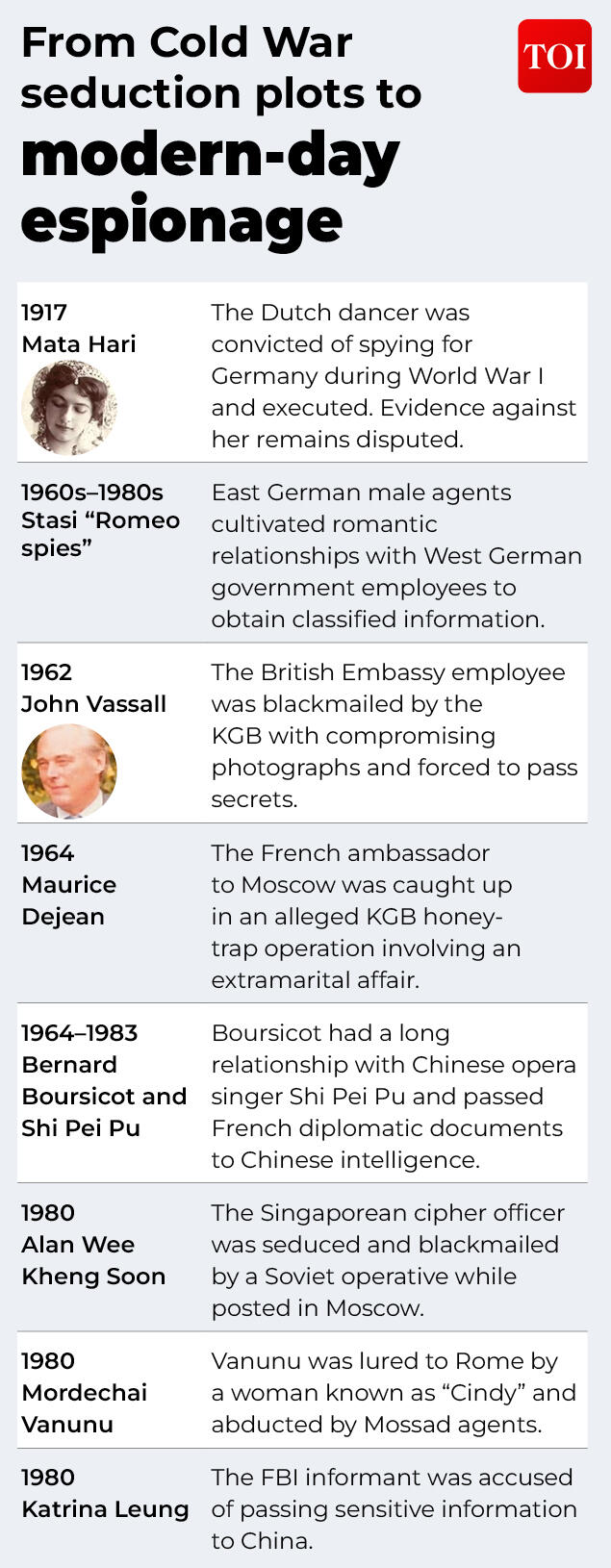
Honey trapping is hardly a new invention. During the Cold War, the Soviet KGB deployed female agents, commonly associated with the terms ‘sparrows’ or ‘swallows’, to cultivate relationships with Western diplomats and officials.Male operatives were also used, while East Germany’s Stasi became particularly notorious for its so-called Romeo spies.The objective was to establish intimacy and trust, obtain sensitive information or create compromising situations that could later be exploited through blackmail.One of the best-known examples involved East German spymaster Markus Wolf’s Romeo operations. Male agents were sent to West Germany to cultivate relationships with women working as secretaries in sensitive government offices.One of the best-known examples involved an East German operative codenamed Felix, who recruited Norma, a West German government employee.She went on to pass him confidential information from the West German chancellery. According to the CIA, 40 women were prosecuted in West Germany for espionage during the Cold War.The Soviet KGB also used sexual blackmail to recruit John Vassall, an employee at the British embassy in Moscow. He was photographed in compromising circumstances and threatened with exposure. Fearing that his private life would be revealed, Vassall eventually passed documents to Soviet intelligence.The tactic was not limited to heterosexual relationships or female operatives. In a famous case that later inspired the play and film M. Butterfly, French diplomat Bernard Boursicot had a nearly two-decade relationship with Chinese opera singer Shi Pei Pu, who concealed his gender.Boursicot, then a 20-year-old embassy clerk, met Shi at a Christmas party in Beijing in 1964. Shi, a performer with the Beijing Opera who also taught Chinese to diplomats’ families, told him he was a woman forced to live as a man.Boursicot believed the claim, and the friendship developed into a romantic relationship. Shi later claimed to have given birth to their child, further reinforcing Boursicot’s belief.The relationship took an espionage turn when Chinese security officials reportedly discovered the affair. Chinese intelligence eventually used the relationship to pressure Boursicot into handing over information from the French embassy.Boursicot said he had believed Shi was a woman throughout their relationship; the revelation became one of the most striking elements of a case that blurred the lines between romance, deception and espionage.Another case involved Chinese-American Katrina Leung, who was paid by the FBI to provide information on China. However, she was later accused of acting as a double agent and passing classified information to Beijing.She was also romantically involved with two FBI agents, including her longtime handler. Leung and the handler were arrested in 2003.The cases underline how intimacy, emotional attachment and the fear of exposure can become instruments of intelligence gathering.
How intelligence agencies identify their targets
The targets of honey-trap operations are not necessarily politicians or military officers. Anyone with access to sensitive information or the ability to influence important decisions can attract the attention of foreign intelligence agencies.Corporate executives, technology leaders, diplomats, defence personnel and government officials may all be of interest, particularly when their work involves strategic technologies, classified information or policy decisions.“There are structural mechanisms within each organisation across the world to identify a person of interest, and mapping their life in general and professional settings. While dossiers support the research, identifying a low hanging fruit or sub set of the POI is where the ground work is laid,” sources in the security establishment told TOI.“Intelligence agencies constantly seek and look for individuals who have access to information or can influence important decisions, irrespective of corporate executives, diplomats or military personnel. Now more than ever, with social media sites permeating every part of our lives, identifying and mapping individuals makes it easier than ever before,” the sources said.“Agencies have ample access to play out vulnerabilities of the individual and map an entire operation before it is even launched. Anyone within the map of the Person Of Interest can be used as a bait,” they added.The process, therefore, may begin long before a target realises they are being approached. Intelligence agencies can study an individual’s professional responsibilities, social circles, interests and personal vulnerabilities before deciding how to cultivate access.

Katrina Leung (center) and her husband, Kam Leung (rear), speaking to media after a hearing at the Los Angeles Federal Courthouse on July 8, 2003. (AP)
From dating apps to AI: How the game has changed
The digital world has significantly expanded the possibilities for intelligence gathering. Social media platforms, dating applications and professional networking sites offer information about people’s interests, relationships, movements and professional associations.What once required physical surveillance and prolonged groundwork can now begin with information available online.Artificial intelligence has added another dimension, making it easier to analyse publicly available information and build detailed profiles of potential targets.“Social media and dating applications have made it easier than ever before for intelligence agencies to map, draw, profile and act on an individual across the geographical boundaries with or without physical or direct contact or via intermediaries. Any person of interest in any government, military or official capacity is fair game, more often than not without them realising the pitfalls of it,” the sources told TOI.“Proliferation of artificial intelligence has made it easy to map the life of an entire individual and their lives even with snippets of publicly available information. Protecting data takes precedence in the age of AI on steroids,” they added.Modern honey traps do not always begin with a trained agent approaching a target with the intention of seducing them.In some cases, an individual may develop a relationship organically with someone of interest to an intelligence agency. The agency may subsequently identify the opportunity and recruit that person, through incentives or coercion, to obtain information.Former CIA intelligence officer John Sipher has pointed out that authoritarian governments may have greater latitude to use pressure and manipulation when recruiting individuals.“What the Chinese and Russians and others can do is, they can use much more manipulation and pressure (to recruit a spy),” Sipher told CNN, adding that “They can say, ‘Listen, we won’t let you return home, or you won’t be able to see your family, unless you work with us.'”Another method involves placing an individual in a compromising situation and subsequently using the threat of exposure or arrest to extract cooperation.However, the more familiar cinematic version, in which a trained foreign agent deliberately seduces a target from the outset and is reportedly less common than often portrayed.

Modern honey traps do not always begin with a trained agent approaching a target with intention of seducing.
When romance meets cyber espionage
The intersection of personal relationships, digital platforms and intelligence gathering has also come under scrutiny in India recently following an alleged honey-trap operation involving an Indian Air Force Wing Commander.According to a Delhi Police chargesheet, the serving officer allegedly shared sensitive information, including details of India’s war plans, with a Pakistan-based intelligence operative.The woman allegedly established contact with the officer through WhatsApp, posing as someone seeking help from a qualified therapist.Investigators suspect she exploited his personal circumstances, including his reported marital separation, to establish an emotional connection.Their conversations allegedly became increasingly personal, eventually leading to an exchange of “nude” photographs.The operative allegedly used the relationship to obtain confidential military information and subsequently attempted to expand access by sending malware.The chargesheet further alleges that the officer was instructed to install the software on the mobile phones and laptops of five subordinate officers, potentially exposing their data and communications.He was arrested on May 30, 2026, and the Delhi Police Special Cell subsequently filed a chargesheet. The case is awaiting cognisance by the court, and the allegations are yet to be established through trial.The case also highlights how personal manipulation can be combined with cyber espionage to gain access to information beyond the original target.Addressing the broader threat, IAF chief Air Chief Marshal Ashutosh Dixit said honey trapping was only one aspect of a wider espionage challenge. “It is not a honeytrap thing. It is basically a cyber espionage issue,” he said.“Nowadays espionage happens through cyber means, various other means and enticing. Honeytrap is only one aspect of the overall picture. Multi-level marketing is there and loan sharks are there. They’re also active. So we are fully aware of this. We are keeping a close eye and there is a systemic effort to control this,” he added.He also pointed out that since sensitive military communication networks are air-gapped, foreign intelligence handlers may increasingly seek to exploit human operators to gain access to information.

A photo shows NVIDIA CEO Jensen Huang with a woman confirmed by a Reuters source to be Alice Huang in Taipei, Taiwan released on June 7, 2024.
Why even powerful people fall prey
Professional success, intelligence and experience do not necessarily make individuals immune to manipulation.Experts say honey-trap operations exploit vulnerabilities that are fundamentally human, including loneliness, ambition, greed, ego and the desire for emotional validation.According to the security agencies, the effectiveness of such operations lies in understanding human behaviour and exploiting motivations that can make individuals susceptible to recruitment.“It all comes down to the psychology of the human mind and how effective low cost structures of intelligence operations can yield the most for the buck. Honey trapping remains effective because technology has evolved whereas human nature remains the same. Identifying target, mapping the overarching societal behaviour and preying on the principal is the key to a successful intelligence operation,” the security agencies sources said.
MICE – Money, Ideology, Coercion and Ego – explains four traditional motivations exploited in intelligence recruitment and selection of prey for Honey trap is the linchpin of such an operation. No amount of safeguards or technological advancement can beat the old fashioned way of HUMINT.
Sources told TOI
The MICE framework is commonly used in intelligence circles to explain why individuals may be recruited or compromised. Money, ideological beliefs, coercion and ego can all be exploited to establish influence over a target.The vulnerability is not necessarily limited to romantic relationships. Professional friendships, financial arrangements and other personal associations can also become channels through which information is obtained.

Professional success do not necessarily make individuals immune to manipulation.
How to recognise the warning signs
While no individual can entirely eliminate the possibility of being targeted, experts say awareness and early reporting are important safeguards. Sources said that professional experience does not necessarily translate into personal security awareness.“Humans greed of all and any kind is the key answer to why individuals fall prey, despite warnings, awareness, and understanding or the lack thereof. Professional experience does not guarantee personal security awareness. Anyone and everyone can be manipulated, irrespective of their moral compass,” the security agencies sources told TOI.“There are ample information and dossiers available to identify warning signs including unusually rapid emotional intimacy, excessive interest in professional responsibilities, demands for secrecy, reluctance to verify identity and requests for sensitive information or intimate photographs,” they said.“Sensitive organisations conduct regular counterintelligence awareness programmes covering social engineering, digital impersonation and blackmail. The most important safeguard is early reporting of an iota of suspicious activity and behaviour, irrespective of the situation,” the sources added.For organisations, this means strengthening counterintelligence awareness, educating employees about social engineering and digital impersonation, and ensuring that suspicious approaches can be reported without fear of embarrassment or repercussions.Ultimately, the methods of espionage may change, but the human element remains difficult to secure.As the Nvidia controversy and the alleged targeting of Indian defence personnel illustrate, the objective is not always to recruit a conventional spy. Sometimes, all an intelligence agency needs is a relationship that offers access to the right person.As the saying goes in the world of espionage, the most valuable intelligence may not always be behind a firewall. Sometimes, it is just one relationship away.