
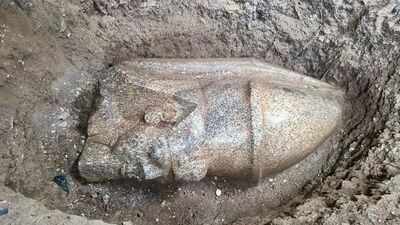
An Egyptian farmer working on his land in the Nile Delta made an unexpected discovery when he came across an ancient stone bearing royal inscriptions. His decision to report it to the authorities led archaeologists to uncover the remains of two enormous statues believed to represent Pharaoh Ramses II. The discoveries have attracted attention because of their size, historical significance and possible connection to an ancient temple. Researchers are now examining the objects and their surroundings to understand what once stood on the site.
Two statues of Ramses II discovered on a farmer’s property
The discovery took place in Behbeit el-Hagar, a village in Egypt’s Gharbia Governorate in the Nile Delta. According to Euronews, the farmer, Khaled Khalil, was growing cucumbers on his land when he came across a stone carrying ancient carvings. Rather than keeping the object or attempting to move it himself, he contacted the antiquities authorities.The Egyptian Ministry of Tourism and Antiquities examined the stone before sending a team from the Supreme Council of Antiquities to conduct an excavation. What began as an investigation of a single object soon uncovered several important remains.Archaeologists found 3 significant objects close to one another. These included a large pink granite block, the head of a colossal statue of Ramses II and the upper portion of another royal statue that may also represent the same pharaoh. The discoveries were particularly striking because they were found on privately owned land rather than at an established archaeological excavation site.
What makes the first statue particularly significant
The most striking find was the head of Ramses II, which measures approximately 1.6 metres (5.25 feet) in height. According to CBS News, the statue depicts the pharaoh wearing the double crown, which represented his rule over Upper and Lower Egypt.The head was found in relatively good condition, although the rest of the statue, including its body and base, remains missing. Archaeologists also recovered the upper section of its back pillar, which carries another important clue about the identity of the ruler.Popular Mechanics reported that the pillar bears the pharaoh’s Horus name, Hor Ka Nakht Mery Maat. The title is understood to mean The Strong Bull, Beloved of Truth. Such royal inscriptions help researchers connect the remains to a particular ruler rather than relying only on facial features or artistic style.Based on the proportions of the surviving head and pillar, experts believe the complete statue could have stood approximately 8.5 metres (28 feet) tall, including its base. Euronews reported that this estimate was provided by Hisham el-Leithy, secretary-general of the Supreme Council of Antiquities.
Could the second statue also represent the same pharaoh
The excavation revealed another substantial statue fragment close to the first discovery. This surviving section measures approximately 2.4 metres (7.87 feet) and includes a well-preserved face, although its legs, base and part of its royal headdress are missing.According to Euronews, the second figure wears a nemes headdress, the striped royal head covering commonly associated with ancient Egyptian rulers. Its facial features bear similarities to those of the first statue, leading archaeologists to consider the possibility that it also represents Ramses II.However, researchers have not yet confirmed its identity. Missing portions make it more difficult to establish exactly whom the second statue depicts.
What do the inscriptions reveal about the possible temple
The pink granite block that initially attracted attention provides another important connection to the ancient Egyptian ruler. Measuring approximately 1.3 metres (4.26 feet), the stone carries hieroglyphic inscriptions featuring two of Ramses II’s royal titles.CBS News reported that the inscriptions include Nesw-Bity, meaning King of Upper and Lower Egypt, and Sa-Ra, meaning Son of Ra, referring to the ancient Egyptian sun god.These titles, combined with the two statue discoveries, have raised the possibility that the property could be part of an ancient religious or royal complex.Officials from Egypt’s Ministry of Tourism and Antiquities are considering whether the remains point to a temple dedicated to Ramses II. There is also another possibility. Researchers are examining whether the statues and inscribed block originally belonged to a different site and were transported to the area at some point in the past.The distinction is important because finding several objects connected to the same pharaoh does not automatically establish that they were originally part of a temple.
Why is the location important to Egypt’s archaeological history
The discovery has attracted additional interest because Behbeit el-Hagar is already known for its ancient religious remains. According to Euronews, the village contains the ruins of a large temple dedicated to Isis, one of the most important goddesses in ancient Egyptian religion.The newly discovered objects could help researchers understand more about the area’s development and its role during different periods of ancient Egyptian history.Ramses II, also known as Ramesses the Great, ruled Egypt from approximately 1279 BC to 1213 BC during the 19th Dynasty. His reign lasted more than 6 decades, making him one of the longest-reigning rulers in ancient Egyptian history.Euronews noted that some of the most recognisable monuments associated with him include the colossal statues at Abu Simbel. Archaeological work is continuing on the farmer’s property, with researchers examining the recovered objects and their relationship to the surrounding area.The farmer’s decision to report the unusual stone also received official recognition. According to CBS News, Egypt’s Tourism and Antiquities Minister Sherif Fathy visited his hometown and presented him and his wife with certificates of appreciation. They were also awarded a trip to Saudi Arabia to perform the Umrah pilgrimage.