
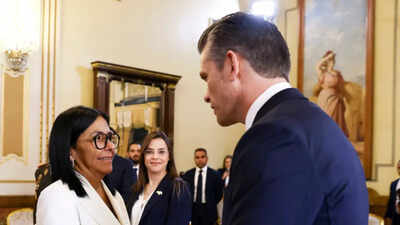
The US went from storming Venezuela to capture its president to shaking hands with his successor over a military deal.Less than a year after American forces toppled Nicolás Maduro’s government and seized him in a daring raid, Washington is now rebuilding defence ties with Caracas in one of the most striking turnarounds in recent US foreign policy.The agreement was signed on Wednesday during US defence secretary Pete Hegseth’s meeting with Venezuela’s interim President Delcy Rodríguez at the presidential palace in Caracas.The deal marks the restoration of military cooperation between the two countries, which was severed in 2005 under former Venezuelan president Hugo Chávez.Although the full details of the agreement have not been made public, Rodríguez said it would focus on training Venezuela’s armed forces, upgrading their operational equipment and providing access to new technology to tackle shared security threats.Hegseth described the agreement as a major shift in bilateral relations, saying Venezuela had gone from being Washington’s “most aggressive regional threat” to a “compliant security partner” in less than 12 months.Addressing security threats in the region, he said the partnership would operate through the US-led Americas Counter Cartel Coalition and warned drug-trafficking networks and armed groups using Venezuela as a safe haven that Washington would hunt them down.Rodríguez, meanwhile, called the agreement “extraordinarily relevant” to bilateral relations, saying both countries had turned a period of difficult relations into one of cooperation and mutual benefit. She said the arrangement would help Venezuela strengthen its armed forces and improve their ability to confront common threats.The agreement comes less than a year after Washington launched a military operation to capture Maduro, marking one of the most dramatic interventions in Latin America in recent years.On January 3, US forces carried out strikes in Venezuela, including in the capital Caracas, as American troops moved to seize Maduro and his wife, Cilia Flores. The operation ended with both being taken into US custody and flown to New York to face drug-trafficking and conspiracy charges, which they have denied.The operation followed months of escalating pressure from the Trump administration, which had accused Maduro of running a narco-terrorism network and facilitating drug trafficking into the United States.Washington had increased its reward for information leading to his capture to $50 million late last year. Maduro, meanwhile, had publicly challenged the US to come and get him, a remark Hegseth recalled during his visit to Caracas. “Well, we answered that call,” the US defence secretary said on Wednesday.Maduro’s capture brought an abrupt end to his presidency, with his former vice-president Delcy Rodríguez taking over as interim president.The same administration that Washington had confronted militarily is now engaging with the US on defence cooperation, military training and regional security.The latest agreement, therefore, marks a striking reversal in bilateral relations, with the US moving from forcibly removing Venezuela’s leader to building a military partnership with his successor in less than a year.