
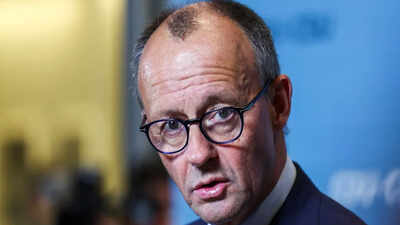
The world once watched three powerful leaders sit around a table at Yalta and shape the future of post-war Europe. Nearly 81 years later, Germany fears a similar chapter could unfold again.As Donald Trump, Vladimir Putin and Xi Jinping meet in China amid the war in Ukraine, German Chancellor Friedrich Merz has drawn a clear red line, warning that a “Yalta format will not bring peace to Europe” and insisting that Ukraine’s future cannot be decided by major powers behind its back.According to Reuters, speaking at a press conference following the Coalition of the Willing meeting in Berlin on Thursday, German Chancellor Friedrich Merz said Germany wanted Ukraine to secure “freedom that is rightful and lasting” and pledged to support Kyiv “for as long as needed”.He also pointed to a broad European consensus on providing financial backing to Ukraine, underlining that continued support for Kyiv remained central to Europe’s approach to the war.Taking a swipe at the Trump-Putin-Xi meeting in Shenzhen, Merz described the gathering as “above all a photo opportunity”, questioning its significance in bringing an end to the war.He said Russia knew its maximalist demands were unrealistic and warned against any settlement that undermined Ukraine’s sovereignty or Europe’s security interests.On the possibility of easing pressure on Moscow, Merz said a conditional lifting of sanctions against Russia could be considered if meaningful progress was made towards peace. He also stressed that Washington could count on Germany’s cooperation as long as both countries continued to share the same objectives.A meeting of the Coalition of the Willing was held in Berlin, bringing together Ukraine’s main European allies as they sought a greater role in US-led efforts to end the war.According to Reuters, the gathering included the leaders of Germany, France, Britain, Poland and Italy, along with Nato secretary general Mark Rutte. Ukrainian President Volodymyr Zelenskyy and US President Donald Trump’s special envoys Steve Witkoff and Jared Kushner also attended.The summit was jointly convened by German Chancellor Friedrich Merz, French President Emmanuel Macron and British Prime Minister Andy Burnham.The meeting focused on coordinating diplomatic efforts, reaffirming support for Kyiv and discussing security guarantees that could come into force following a ceasefire. German officials said its timing was intended to allow European allies to respond jointly to developments from the Shenzhen summit.In Shenzhen, Trump, Putin and Xi held their first-ever trilateral meeting on Thursday, bringing together the leaders of the world’s three largest nuclear powers for discussions on global security, nuclear arms control and the war in Ukraine.The meeting, held on the sidelines of the Asia-Pacific Economic Cooperation (APEC) summit, lasted around 70 minutes, according to the Associated Press.Trump said the three countries were “making history”, while Putin highlighted their shared interests in resolving regional conflicts, including the war in Ukraine. Xi called for cooperation among the three major powers to maintain international peace and stability.Following the meeting, the three countries issued a joint declaration reaffirming that a nuclear war “cannot be won and must never be fought”.The document also called for reforms to the United Nations, increased supplies of refined petroleum products and respect for the immunity of state officials in international courts.However, it offered no concrete breakthrough or roadmap for ending the Ukraine war, despite the conflict being discussed. Ukraine was also not represented at the trilateral meeting.