
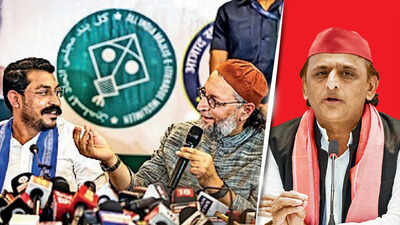
When Asaduddin Owaisi and Chandrashekhar Azad joined hands on November 12, the immediate question was whether the alliance of AIMIM and Azad Samaj Party (Kanshi Ram) would become Akhilesh Yadav‘s biggest worry ahead of the 2027 Uttar Pradesh assembly elections.After all, the two communities they are seeking to mobilise, Muslims and Dalits, are key to Akhilesh’s PDA (Pichhda, Dalit, Alpsankhyak backward classes, Dalits and minorities) formula, which helped the Samajwadi Party (SP) emerge as the single-largest party in UP in the 2024 Lok Sabha elections.Owaisi had been reaching out to Akhilesh for an alliance since July, even warning him not to regret rejecting the offer if the BJP returned to power. Interestingly, Owaisi was targeting the SP more than the BJP in his election meetings.
I am ready to join hands. I am ready to form an alliance. Today is the time to talk. Don’t cry later after the elections are over. We don’t want the BJP to come to power again.
Asaduddin Owaisi, AIMIM
Four months later, with his attempts to forge an alliance with the SP and BSP chief Mayawati yielding no results, Owaisi joined hands with Azad to form the Samajik Parivartan Morcha.Akhilesh, however, appears unfazed. He claimed the new front would cost the BJP, rather than his party, 2-3% of its votes. He also ruled out expanding the SP’s existing alliance.
An additional option will now be available to such innocent people who cast their votes after being misled. This will cause the BJP a loss of 2-3 per cent votes. The BJP will be left with nothing.
Samajwadi Party chief, Akhilesh Yadav
So, is Akhilesh right in playing down the threat? Here are five reasons why the Owaisi-Azad alliance may not be as big a worry as it appears.
Akhilesh has worked hard to change the SP’s pro-Muslim image
Akhilesh Yadav has made a conscious effort to move away from the image of Muslim appeasement that the Samajwadi Party acquired under his father Mulayam Singh Yadav.While Mulayam openly flaunted Muslim voters and built his party’s electoral strength around the Muslim-Yadav combination, Akhilesh has been trying to expand the SP’s appeal among Hindu voters without alienating its traditional support base.From visiting temples and attending Durga Puja celebrations to hosting iftar gatherings, Akhilesh has been trying to strike a balance between the two communities.The change became particularly evident after the BJP’s sweeping victory in the 2017 assembly elections, when the SP began making Akhilesh’s religious engagements more public.Since then, Akhilesh has visited the Vindhyachal temple in Mirzapur and the Ravidas temple in Varanasi, installed a 51-foot statue of Lord Krishna in Saifai and initiated the construction of the Kedareshwar temple in Etawah.On December 12, Akhilesh and his wife Dimple Yadav are scheduled to make their first visit to the Ram Temple in Ayodhya since its consecration in January 2024.At the same time, his outreach to Muslims has continued. However, Akhilesh has been careful to avoid giving the BJP an opportunity to accuse the SP of Muslim appeasement.
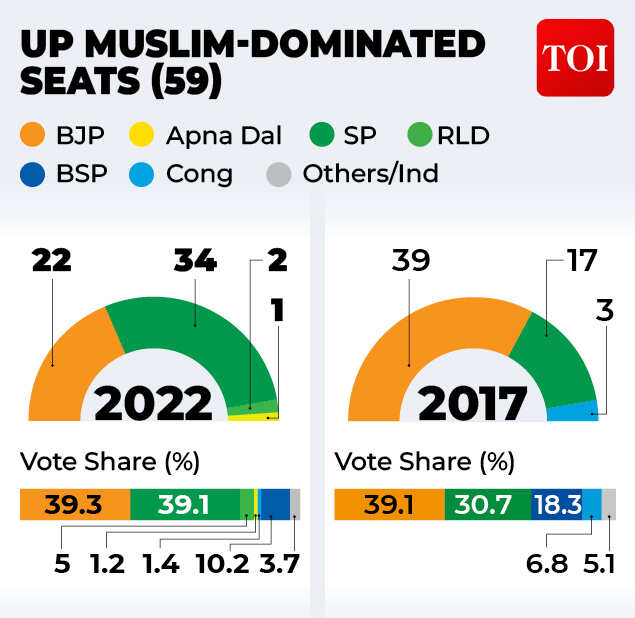
The SP increased its tally from 17 seats in 2017 to 34 in 2022, while the BJP’s count fell from 39 to 22 across 59 constituencies.
Joining hands with Owaisi could undo some of that work and give the BJP fresh ammunition against the SP. By rejecting an alliance with AIMIM, Akhilesh may actually be helping himself retain the broader support base he has built over the years.
Azad’s primary battle is with Mayawati
Chandrashekhar Azad is a leader known for taking aggressive political positions that keeps him in the news. But in Uttar Pradesh, he faces a tough challenge from Mayawati, who continues to command the support of a significant section of Dalit voters.Azad’s victory from Nagina in the 2024 Lok Sabha elections established him as a Dalit leader to watch. He defeated the BJP candidate by over 1.5 lakh votes, while the SP finished a distant third and the BSP fourth.However, one Lok Sabha victory does not establish Azad as a leader of Dalits across UP. In the 2022 assembly elections, he contested against Yogi Adityanath from Gorakhpur Urban, secured fewer than 8,000 votes and lost his deposit.“Jatavs, who account for around 11% of Uttar Pradesh’s population, are still largely loyal to Mayawati. In the 2024 Lok Sabha elections, non-Jatav Dalits, particularly the Pasis, shifted towards the INDIA bloc. This played an important role in the alliance’s performance,” said Praveen Kumar, senior political observer and Resident Editor of TOI, Lucknow.According to the CSDS-Lokniti post-poll survey, 44% of Jatav voters in UP backed the BSP in 2024, even though the party failed to win a single Lok Sabha seat.Moreover, Mayawati has brought her nephew Akash Anand back into the party and reinstated him as national convener, tasking him with expanding the BSP’s appeal among young voters.Interestingly, when Mayawati removed Anand from the party in September, Azad had invited him to join the Azad Samaj Party.While Azad enjoys popularity among sections of Dalit youth, his ability to turn that popularity into votes across the state is yet to be established.
Owaisi’s success in Bihar is no guarantee of success in UP
AIMIM won five assembly seats each in Bihar in 2020 and 2025. However, Owaisi has struggled to make a similar impact in Uttar Pradesh.“Owaisi has not been able to replicate his success in Bihar in Uttar Pradesh. The only time AIMIM made its presence felt was during the 2023 urban local body elections, when it won five chairperson seats and around 75 councillor seats. But these were just flashes of success, not signs of a larger political shift,” Praveen Kumar said.
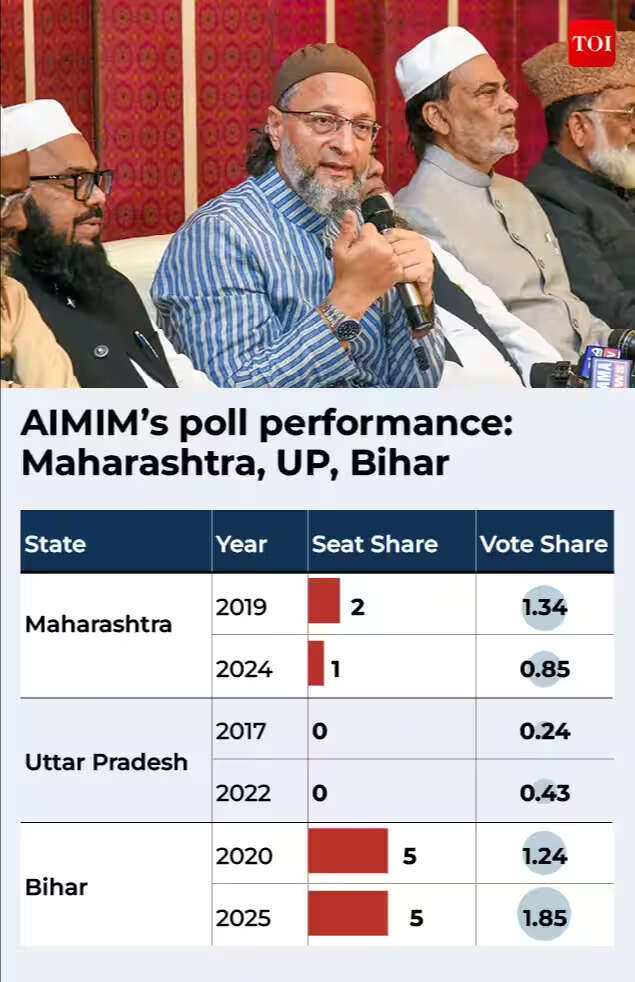
Owaisi’s party won five seats in Bihar in both 2020 and 2025, but failed to win a single seat in Uttar Pradesh in 2017 and 2022.
In Bihar, Owaisi found a strong base in Seemanchal, a region with a large concentration of Muslim voters. All five seats won by AIMIM in both elections came from this region.In UP, however, AIMIM failed to win a single seat despite contesting 38 constituencies in 2017 and 95 in 2022. Its vote share in the last assembly elections was less than 1%.While Muslims account for around 19% of UP’s population, their presence is spread across several regions. Owaisi is yet to establish a stronghold comparable to Seemanchal, while the SP enjoys considerable support among Muslim voters.Despite nearly a decade of contesting elections in UP, AIMIM is still looking for its first assembly seat.
An alliance born out of limited choices
Chandrashekhar Azad was not Owaisi’s first choice for an alliance in Uttar Pradesh. The AIMIM chief had repeatedly approached Akhilesh Yadav to join hands against the BJP.When the SP showed no interest, AIMIM reached out to Mayawati’s Bahujan Samaj Party (BSP), hoping to bring Muslims and Dalits together. However, that attempt also failed, and Owaisi eventually joined hands with Azad.But forming an alliance is one thing and getting voters to support each other’s candidates is another.While Azad enjoys support among sections of Dalit youth, his ability to mobilise Dalits across the state and transfer their votes to AIMIM candidates is yet to be tested.Similarly, Owaisi will have to convince Muslim voters to back candidates fielded by Azad’s party instead of the SP. For now, both Owaisi and Azad have far more to prove in the upcoming assembly elections than Akhilesh.
Samajwadi Party remains the strongest challenger to the BJP
In Uttar Pradesh, Muslim voters have largely backed parties they believe are best placed to defeat the BJP. For now, that party is the Samajwadi Party, not AIMIM.According to the CSDS-Lokniti post-poll survey, around 79% of Muslim voters backed the SP-led alliance in the 2022 assembly elections. In the 2024 Lok Sabha elections, 92% backed the SP-Congress alliance.The alliance won 43 of UP’s 80 Lok Sabha seats, with the SP alone winning 37, compared to the BJP’s 33.
Share your thoughts in the comments
Be respectful · TOI community guidelines
Akhilesh’s position is also reflected in his ongoing seat-sharing negotiations with the Congress. Though the arrangement is yet to be finalised, he has made it clear that seats will be allocated based on each party’s chances of winning them.While Owaisi is asking Muslims to move away from traditional political parties and build their own leadership, Akhilesh is offering them an alliance that has already demonstrated its ability to defeat the BJP.And as long as defeating the BJP remains a priority for a large section of Muslim voters in UP, convincing them to shift their support away from the SP may not be easy for Owaisi.On paper, the Owaisi-Azad alliance looks promising, with Muslims and Dalits together accounting for around 40% of UP’s population. But the reality on the ground is different. Owaisi has struggled to replicate his Bihar success, while Azad is yet to establish statewide appeal. The alliance could influence closely contested seats, particularly in western UP, where Owaisi has some support.So, while the alliance may appear to be a threat to Akhilesh’s PDA formula on paper, both leaders have several electoral challenges of their own to overcome.And that is perhaps why Akhilesh has little reason to be worried, at least for now.