
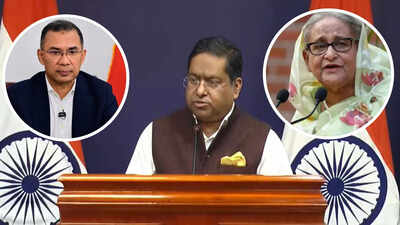
Government declined to comment on remarks made by Bangladesh PM Tarique Rahman blaming India and the Awami League led by former PM Sheikh Hasina for a fresh wave of unrest in the country, choosing not to get drawn into the political rhetoric emerging from Dhaka.“Our position remains consistent that India desires a positive, constructive and forward-looking relationship with Bangladesh, one which is rooted in the shared histories of the two countries and in their shared cultural ties of their peoples. I have no comments to offer to make on the internal developments in Bangladesh,” said MEA spokesperson Randhir Jaiswal.However, while maintaining so far that the Hasina passport issue is between Dhaka and the former PM, the government suspects that Dhaka’s insistence on her return only under the extradition treaty might be a stalling tactic to avoid confronting political risks and security challenges of keeping her in custody.Hasina renewed her passport and national identity card request this week through a ‘signed’ letter which was promptly turned down. Bangladesh has also questioned the authenticity of the letter. For India, the issue of her extradition is distinct from the passport request and the 2 should not be conflated, as extradition is a mechanism to compel the return only of a person who is resisting going back.India sees the issue of passport as a question of Bangladesh’s own laws and its obligations towards a citizen. It also believes though that with Hasina seemingly ready to return to Dhaka of her own volition, there may not be any case for her extradition, which in any case is going to be a complicated legal process. For India, the lack of a travel document is the only thing blocking voluntary Hasina’s return as New Delhi is unlikely to do anything to block it.Government considers significant many international conventions that Bangladesh is also a party to refer explicitly to a person’s right to return to his/her own country. Universal Declaration of Human Rights (UDHR) Article 15 recognises the right to a nationality and bars its arbitrary deprivation. Article 13(2) also recognises the right to leave and return to one’s country. While UDHR is not a legally binding instrument, it’s seen as setting important standards.
Share your thoughts in the comments
Be respectful · TOI community guidelines
Similarly, International Covenant on Civil and Political Rights (ICCPR) Article 12(4) shields against arbitrary deprivation of the right to enter one’s own country.Government also sees as misconceived the argument about “convicted criminal” passport restriction as it is an exit-control provision and not an entry-control tool. According to authorities here, a citizen reserves the right to return to his/her own country and this cannot be framed as a procedural step to be processed through a treaty.