
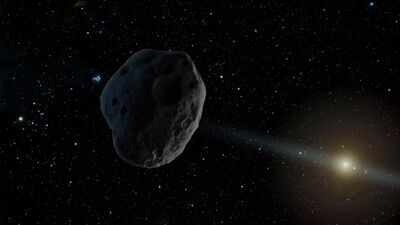
Jupiter has a whole family of moons, Saturn boasts even more, and even our neighbouring Mars has two. Earth, on the other hand, has always had just one natural satellite to call its own.But not anymore, at least for a little while. Our planet has found itself a second celestial companion after a tiny asteroid was pulled into its gravitational embrace. The catch? This unexpected guest is only here temporarily and is expected to make its exit in early December.What appears to be an unusual addition to Earth’s neighbourhood is a tiny asteroid designated 2026 QQ8, measuring approximately 2 metres (6 feet) across.The asteroid has been temporarily captured by Earth’s gravity and is now orbiting the planet as a mini-moon. However, unlike our permanent natural satellite, this rocky visitor is only passing through and is expected to escape Earth’s gravitational influence in early December.Matthew Payne, director of the International Astronomical Union’s Minor Planet Center, told CNN that the asteroid entered Earth’s gravitational influence in April 2026.So, how did Earth manage to capture this tiny space rock? The asteroid was already travelling around the Sun when it approached our planet in April. As it moved closer, Earth’s gravitational pull began influencing its trajectory, gradually drawing it into a temporary orbit around the planet. The gravitational interaction also involved the Moon, further influencing the asteroid’s movement.Matthew Payne explained to CNN that the object was moving alongside Earth before drifting closer, allowing it to increasingly feel the gravitational forces of both Earth and the Moon. This temporary capture has turned the asteroid into what astronomers call a mini-moon.The asteroid, designated 2026 QQ8, is approximately 2 metres (6 feet) in diameter, making it barely larger than an average adult human. Despite being Earth’s temporary companion, it is too small and faint to be spotted with the naked eye. It is also not particularly close to our planet, with its distance reaching approximately 568,000 kilometres at its closest approach during the capture.Unlike Earth’s permanent Moon, which has remained in orbit for billions of years, 2026 QQ8 is only a temporary visitor. Once it escapes Earth’s gravitational influence, it will continue travelling around the Sun along its own orbital path.The mini-moon was first spotted on August 19/20 by Hungarian astronomer Krisztián Sárneczky, who initially suspected it could be a piece of space debris rather than a natural asteroid.Further observations using telescopes in Arizona and Hawaii helped scientists establish its natural origin.By early December, it is expected to leave our planet’s gravitational grasp and continue its journey around the Sun, leaving Earth with its familiar single permanent moon once again.