
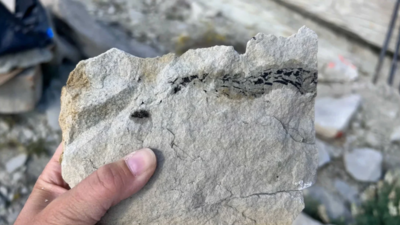
A tiny skeleton has caused quite a stir in the paleontology world. Discovered in 2022, the fossil was found trapped inside a slab of sandstone in Wyoming, with only a few vertebrae visible to the people who unearthed it. The rest of the skeleton was hidden beneath the rock, leaving researchers with a rather unusual puzzle. Was it a baby dinosaur, a prehistoric snake or an early relative of crocodiles?Nearly four years later, scientists have managed to piece together much of the mystery using a combination of neutron and X-ray imaging. The study, titled Neutron and X-ray computed tomography reveals new early-branching choristoderes from the lower Morrison Formation of Wyoming, USA, was published in Royal Society Open Science on 18 November 2026.The scans revealed the previously unknown reptile lived around 156 million years ago, during the Jurassic period. Measuring approximately 45 centimetres from head to tail, the little creature had two unusual, horn-like projections at the back of its skull. Its discovery has also offered researchers new clues about the evolutionary relationships of an ancient group of reptiles whose origins have remained difficult to trace.
A discovery in Wyoming
The fossil was unearthed in August 2022 by an excavation team from Switzerland’s Aathal Dinosaur Museum at Meilyn Quarry in Wyoming. The region is part of the Morrison Formation, a geological formation particularly famous for its Jurassic fossils. It has produced remains of some of the most recognisable prehistoric animals, including Diplodocus, Stegosaurus and Allosaurus.This discovery, however, was considerably smaller. The team initially spotted the vertebrae of a tiny skeleton embedded in sandstone, but the rest of its bones were concealed within the rock. The fossil was brought back to Switzerland, where researchers hoped to identify the animal without damaging its delicate remains.There were several possibilities. Its vertebrae could have belonged to a prehistoric snake, an early relative of crocodiles or a young dinosaur. However, the visible remains were insufficient to establish its identity, and physically extracting the bones risked destroying valuable evidence.An unexpected encounter helped the investigation move forward. In January 2023, Pavel Trtik, a materials scientist at the Paul Scherrer Institute (PSI) in Switzerland, visited the Aathal Dinosaur Museum with his three sons. Interested in the museum’s fossil collection, he left his business card with the staff, offering to help investigate any specimens that might benefit from his expertise.Trtik specialises in neutron imaging, a technique that allows researchers to examine the internal structure of objects without having to cut them open. Just ten days after his visit, the museum contacted him about the mysterious Wyoming fossil.
What was hiding inside the sandstone?
The international research team, jointly led by Trtik and palaeontologist Torsten Scheyer from the University of Zurich, began examining the fossil using neutron and X-ray computed tomography.Neutron imaging works particularly well for identifying certain materials because neutrons are sensitive to hydrogen. This is useful when studying fossils because hydrogen is also present in hydroxyapatite, a mineral component of bone. The difference helps scientists distinguish the fossilised remains from the surrounding sandstone.The team combined these scans with X-ray images taken at the Paul Scherrer Institute, the Swiss Federal Laboratories for Materials Science and Technology (Empa) in Dübendorf, and the Department of Palaeontology at the University of Zurich. Each technique provided different information about the fossil, allowing researchers to build a more complete picture of what lay inside the rock.The process involved examining, combining and interpreting tens of thousands of cross-sectional images. Eventually, the scans revealed an articulated vertebral column, pelvic bones, parts of a hind leg and scattered remains of a skull. Most remarkably, the skull contained an almost completely preserved braincase measuring less than two centimetres across.Researchers also identified two unusual, dragon-like projections at the back of the head. These features were particularly striking given the animal’s small size. Its head and torso, however, were found separated from each other within the sandstone.
What happened to the little reptile?
The researchers believe the animal lived in a freshwater environment, possibly spending at least some of its time in water. Its vertebrae, pelvic structure and hindlimb bones bear similarities to those of other small, lizard-like reptiles associated with semi-aquatic lifestyles.There is also a mystery surrounding how its remains ended up in separate pieces. Based on the fossil’s condition, researchers suggest that the animal may have died in a river around 156 million years ago, after which its head and torso became detached before being covered by fine river sand. Over millions of years, the sediment hardened into sandstone, preserving the remains.A larger predator could have been responsible for the separation. However, Scheyer has cautioned that it is difficult to establish exactly what happened, and the possibility of a predator attack cannot be confirmed. The fact that the skull remained relatively intact, rather than being carried away by the current or destroyed, ultimately gave researchers an exceptionally valuable specimen to study.The braincase has proved particularly important because it contains clues about the animal’s evolutionary relationships. The group to which it belongs has long puzzled palaeontologists, partly because its unusual skull anatomy has made it difficult to establish how it relates to other reptiles.The tiny bones in the inner ear region offer a new piece of evidence. Researchers found that they bear a striking resemblance to those in the crown group of reptiles, which includes all living reptiles. This could indicate that the extinct group was more closely related to modern reptiles than earlier fossil evidence had suggested.The discovery is also significant because it represents the most complete early-branching specimen of its group identified so far, as well as the oldest known record of the group in North America. The findings could therefore help researchers better understand an important, but poorly documented, part of reptile evolution.The fossil is also expected to feature in the travelling exhibition Rock Fossils on Tour at the Aathal Dinosaur Museum in early 2027. After spending 156 million years hidden in sandstone, it is finally getting a chance to be seen.