
Bengaluru: A few years ago, Javokhir Sindarov overslept and missed a round of the Uzbekistan national championship. He had won his first two games when it happened.
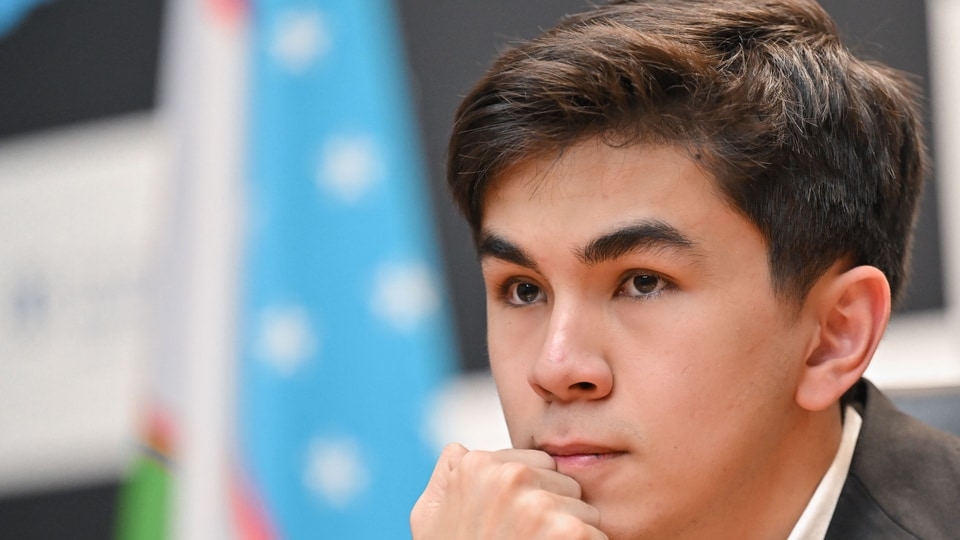
“(On the morning of round three) I woke up and realised that I had ruined my best tournament. I started crying…My father was about to kill me because of it,” the 20-year-old Uzbek GM recalls in a newly released Chess.com documentary.
“I won five or four games in a row and even though I slept one round, I won the tournament. It made me really confident.”
The confidence has carried him a long way.
Starting November 24, he will face defending champion D Gukesh in a 14-game World Chess Championship match in Geneva.
The ever-joyful Sindarov has arguably been the most impressive player over the past year, gaining 61 Elo points. Last year, he became the youngest to win the Fide World Cup, qualifying for the Candidates tournament in Cyprus. He went on to win the Candidates unbeaten, with a round to spare, scoring 10/14 and recording a performance rating of over 2900. It was the best performance by a player since the Candidates adopted its current format.
Sindarov’s journey in chess began aged four-and-a-half, for an unusual reason: he hated having to nap at kindergarten. Instead, he joined his then best friend for chess classes. When his grandfather, Komil Sindarov, now vice-president of the Uzbek chess federation, heard about it, he bought him a chess set and taught him the moves. His grandfather was also pleased that chess might keep the boy away from video games.
Two weeks later, Sindarov played his first tournament and lost eight games. His only point came from a bye.
Chess would eventually become a family pursuit, though not without sacrifices. His brother Islom gave up playing competitively because the family could afford to support only one professional chess career.
In 2018, at 12 years, 10 months and eight days, Sindarov became a grandmaster, the second-youngest in history at the time, beating R Praggnanandhaa’s record by five days. Yet, while a generation of Indian teenagers, including Praggnanandhaa and Gukesh, was rapidly climbing the rankings and making headlines, Sindarov wasn’t progressing at quite the same pace.
The pandemic proved to be a turning point.
“I started thinking about my whole life, what I did wrong, why I spend my time playing Counter-Strike and other video games, why I didn’t work like other chess players. Then the pandemic happened. That period gave me motivation that I can also become strong if I work on myself.”
In early 2025, he began working with Ukrainian international master Roman Vidonyak, who has played a defining role in his subsequent rise.
There had been glimpses of Sindarov’s exceptional talent long before his recent results.
Russian GM Daniil Dubov, who was part of world No.1 Magnus Carlsen’s team for the 2018 and 2021 World Championship matches, recalls being “incredibly impressed” by Sindarov when they met at a training camp several years ago.
“He was rated below 2700 then. In my whole life I’d say only three players have impressed me – Magnus Carlsen, a young Alireza Firouzja, and Javokhir. On day two of the camp I was like, ‘wow, this guy is something’,” Dubov told HT.
What struck Dubov was Sindarov’s intuitive understanding of positions.
“He can navigate sharp positions much better than most others and his precision and calculation stood out. For instance, some things that looked completely random to me, he started move after move, and I checked with the engine and those were the best moves. And I go like, ‘what’s the logic’? He’s like, ‘yeah, I don’t know what’s the logic, but this is what I feel’.”
In Geneva, a hungry and ambitious Sindarov will face the biggest test of his career yet. He arrives as the challenger, but also as the one riding a wave of form. Should he win the title, the Counter-Strike junkie has a ready list of dream skins to splurge on. “One AVP Dragon Lore and one Wild Lotus AK-47,” he grins.